
 - FREE webinar with Name & Place creator Paul Carter!
 Sat 19 July | 4PM (GMT+1)
 Online
Learn how to get the most out of Name & Place – the powerful tool built by Paul himself.
Perfect for beginners & pros alike!
- FREE webinar with Name & Place creator Paul Carter! Sat 19 July | 4PM (GMT+1)
Online

Proceedings of the 5th International Symposium on Place Names 2019 -
"Recognition, Regulation, Revitalisation: Place Names and Indigenous Languages".
7–9 November 2025 | University of Calcutta, Kolkata, West Bengal
The Place Names Society of India (PNSI) has officially announced the dates and venue of its much-anticipated XLIV Annual Congress, which will take place from 7th to 9th November 2025 at the Department of Ancient Indian History and Culture, University of Calcutta, Kolkata. The congress is set to bring together renowned scholars, researchers, and enthusiasts of Indian toponymy for three days of rich academic exchange and exploration.

Hosted by one of India’s oldest and most prestigious universities, the event will be presided over by Sri Jai Prakash, former Director of Epigraphy at the Archaeological Survey of India. Prof. Susmita Basu Majumdar will serve as the Local Secretary for the congress.

Researchers and delegates are invited to submit full papers with abstracts and photographs to the Society by 7th October 2025 via email at placenamesociety@gmail.com. Submitted papers must comply with the Society’s official guidelines for contributors.
The accepted papers will be published in Volume 44 of the Society’s journal Studies in Indian Place Names, which will be released during the congress.
To present a paper or attend the congress, membership in the Society is mandatory. Membership options are:
Life Membership: Rs. 3,000 (Individual), Rs. 6,000 (Institutional)
Student Membership: Rs. 1,000 (valid for 5 years or until first earning, whichever is earlier)
Annual Membership: Rs. 300 (Individual), Rs. 600 (Institutional)
Members will also be charged Rs. 100 per copy of the published volume (postage extra if sent by registered mail).
Key figures in the organizing committee include:
Chairman: Dr. T. S. Ravishankar
Vice Chairmen: Dr. E. S. M. Prasad and Dr. P. N. Narasimha Murthy
Secretary: Dr. S. Krishnamurthy
Asst. Editor: Dr. Meka V. Raghavendra Varma
Treasurer: Dr. Aditya Kr. Singireddy
For inquiries, submissions, or membership application:
📧 Email: placenamesociety@gmail.com
🌐 Website: www.epigraphicalsociety.com/pnsi
Brill’s African Social Studies Series proudly announces its 50th volume, Subversion, Resistance and Contestations: Politics of Names and Naming in Zimbabwe, edited by Tanaka Chidora, Zvinashe Mamvura, and Sheunesu Mandizvidza. This pioneering volume marks the first comprehensive academic collection devoted solely to the onomastics of Zimbabwe - a country where names are more than just identifiers; they are sites of struggle, memory, resistance, and reinvention.

Structured chronologically, the volume explores naming practices from colonial impositions to the post-Mugabe "New Dispensation," challenging any linear or monolithic reading of Zimbabwean history. Instead, the chapters expose how place names, personal names, and other linguistic signifiers have been used as tools of colonial control, cultural erasure, nationalist assertion, and political maneuvering.
The volume brings together scholars from a wide range of disciplines—linguistics, literature, history, media studies, sociology, and ethnomusicology—illustrating how deeply embedded names are in every aspect of Zimbabwe’s historical and contemporary identity.
Tanaka Chidora – poet, novelist, Humboldt Fellow, and lecturer at the University of Malawi.
Zvinashe Mamvura – Humboldt Fellow and lecturer at the University of Zimbabwe.
Sheunesu Mandizvidza – lecturer at Midlands State University’s Centre for Communication Studies.
Title: Subversion, Resistance and Contestations: Politics of Names and Naming in Zimbabwe
Series: African Social Studies Series (Vol. 50)
Language: English
Publisher: Brill
Publication Date: 27 November 2025
ISBN: 978-90-04-74449-3 (E-Book), 978-90-04-74448-6 (Print)
Price: €79.00 excl. VAT / €84.53 net
Availability: Brill website
This book is a must-read for scholars and students in:
Onomastics
African Studies
Cultural and Literary Studies
Sociology and Political Science
Geography and Urban Studies
Ethnomusicology
Whether you're tracing colonial legacies, examining linguistic resistance, or studying identity politics, Subversion, Resistance and Contestations is an indispensable resource for understanding how naming becomes a powerful act of agency and contestation in Zimbabwe.

What’s in a Name? A Toponymic Journey with the Tennessee Geographic Alliance
Place names are more than geographic labels - they are powerful vessels of history, identity, and cultural memory. The Tennessee Geographic Alliance (TGA) is bringing this idea to the forefront with its upcoming workshop titled "What’s in a Name? Exploring Place Names as Forms of Social and Geographic Storytelling", scheduled to take place on October 6–7, 2025 at the East Tennessee Historical Society in Knoxville.
Supported by the Library of Congress through the “Teaching with Primary Sources Southern Regional Partner” initiative, this workshop aims to enrich both teacher pedagogy and student learning by highlighting the geographical, social, and political dimensions embedded in place names.
Participants—15 carefully selected secondary school teachers from across Tennessee - will:
Enhance their geographic literacy, delving into the core concepts of location, place, movement, human-environment interaction, and region.
Work hands-on with primary sources, learning how to incorporate historical maps, documents, and multimedia into their classrooms.
Explore innovative pedagogy, collaborating on interactive projects that marry geography with storytelling.
The TGA plans to select:
One teacher from each of Tennessee’s 9 Congressional Districts
One additional teacher from each Grand Division (West, Middle, East)
Three teachers from the Knoxville Metropolitan Statistical Area
To ensure statewide representation and reduce duplication, participant selection will prioritize geographic diversity, but open slots may be filled based on merit.
Teachers will be valued and supported:
A $600 stipend will be provided upon completion of the workshop (IRS-reporting threshold)
Hotel, meals, and mileage reimbursements will be covered for those traveling over 50 miles
Lunch provided daily during the sessions
Pre-workshop:
Watch a recorded Library of Congress orientation
Complete and certify two online modules: one on primary source analysis, another on using multiple sources
Post-workshop:
Create an Esri Story Map centered on a toponym - either preserving or contesting a place name
Integrate primary sources, reflect multiple perspectives, and engage with civic sensitivity
This workshop is more than professional development - it's an opportunity for educators to reflect on how names shape our understanding of place and power. Through digital storytelling, historical inquiry, and place-based pedagogy, the TGA is empowering teachers to help students see the world in more meaningful ways.
Applications are now open. If you’re a Tennessee teacher passionate about geography, identity, and storytelling, this is your chance to be part of something transformative.
Learn more and apply at
🌐 tngeographicalliance.org
📧 tngeogalliance@gmail.com
📘 Facebook
🐦 Twitter: @tngeogalliance
English Version
The 10th Mainzer Namentagung will be held on 29–30 September 2025 at the Academy of Sciences and Literature Mainz, marking a major gathering in onomastics focused on how personal names intersect with migration and multilingual language biographies.

🔍 Themes and Format
Building on insights from Münster’s 2023 workshop “Personennamen in Migration,” this conference deepens exploration into how given and family names are maintained, adapted, or abandoned during migration. Key research questions include transcription shifts, pragmatic name use, grammatical adaptation, transliteration, token variation, and full name changes due to assimilation or discrimination.
📝 Programme Outline
Sunday, 28 Sept (Warm-Up)
18:30 – Informal meet-up (venue tbd)
Day 1 – Monday 29 Sept
08:45–09:15 – Registration
09:15–09:45 – Opening by Anne Rosar & Theresa Schweden
09:45–10:30 – Elena Bandt & Josephine Klingebeil (Berlin): Analysis of personal names in historical foreign‑language textbooks
11:00–11:45 – Linda Steiner & Simone Berchtold Schiestl (Bern): Family names, multilingualism and interference in Switzerland
11:45–12:30 – Daniel Kroiß (Mainz): French-to-German surname transformations in West Central Germany
14:00–14:45 – Jones Y. Anam & Christian Zimmer (Dortmund): Graphemic variation in Turkish names in German contexts
14:45–15:30 – Luca Winklmüller (Mainz): The –ski suffix from surname marker to pejorative
16:00–16:45 – Anja Hasse & Anne Rosar (Zürich & Mainz): Amish Swiss names in cultural contact zones
17:30 onward – Ceremony awarding Henning‑Kaufmann Prize to Dr Rita Heuser, followed by an invited keynote and reception
Day 2 – Tuesday 30 Sept
09:00–09:45 – Simona Leonardi (Bologna): Onomastic identity in immigrant narratives in Palestine/Israel
09:45–10:30 – Marietta Calderón (Salzburg): Franco-Israeli names and multi‑citizenship in onomastic context
11:00–11:45 – Gerrit Bloothooft (Utrecht): Three‑generation naming practices among Turkish migrants in the Netherlands
11:45–12:30 – Fatemeh Akbari & Eugen Schochenmaier (Vienna & Denzlingen): Iranian‑American surnames among U.S. diaspora
14:00–14:45 – Emine Şahingöz (Frankfurt/Main): History of Ossetian surnames in Turkey
14:45–15:30 – Larysa Kovbasyuk (Kherson/Münster): Migration history and Russification/Transliteration of Ukrainian names
16:00–16:45 – Andrea Scheller & Christiane Schiller (Mainz & Darmstadt/Berlin): Working and forced migration from Central/Eastern Europe reflected in surnames in Galicia/Wolhynia/Transcarpathia
16:45–17:30 – Antje Dammel (Münster): Name changes among Swedes, with or without migration history
19:00 – Conference dinner (location tbd)
✅ Registration Is Open!
Reserve your spot now via the Mainz Academy registration portal:
https://events.adwmainz.de/migration/
💡 Why You Should Attend
This conference is perfect for scholars in onomastics, sociolinguistics, migration studies, and cultural history, offering a richly interdisciplinary programme. From multilingual name interference to diaspora naming strategies, the event promises fresh insights into how names shape - and are shaped by - migration.
Am 29.–30. September 2025 lädt die 10. Mainzer Namentagung in die Akademie der Wissenschaften und Literatur Mainz ein – eine herausragende Tagung, bei der Personennamen vor dem Hintergrund von Migration, Mehrsprachigkeit und Sprachbiografien im Fokus stehen.
🔍 Themenschwerpunkte & Format
Basierend auf dem Münsterer Workshop 2023 setzt die Tagung bei Fragen an, wie Namen im Migrationsprozess beibehalten, angepasst oder aufgegeben werden. Zentrale Themen sind dabei grammatische Anpassung, Transliteration, situativ-pragmatische Variation oder vollständiger Namenwechsel als Folge von Assimilation oder Diskriminierung.
📝 Programmüberblick
Sonntag, 28. Sept (Warm‑Up)
18:30 – Gemütliches Kennenlernen (Ort noch offen)
Tag 1 – Montag, 29. Sept
08:45–09:15 – Anmeldung
09:15–09:45 – Eröffnung: Anne Rosar & Theresa Schweden
09:45–10:30 – Elena Bandt & Josephine Klingebeil (Berlin): Namen in historischen Fremdsprachenlehrwerken
11:00–11:45 – Linda Steiner & Simone Berchtold Schiestl (Bern): Familiennamen, Mehrsprachigkeit und Interferenz in der Schweiz
11:45–12:30 – Daniel Kroiß (Mainz): Französische Familiennamen im Raum Westmitteldeutschland
14:00–14:45 – Jones Y. Anam & Christian Zimmer (Dortmund): Graphematische Variation bei türkischen Namen im Deutschen
14:45–15:30 – Luca Winklmüller (Mainz): „-ski“ – vom Namensteil zum pejorativen Suffix?
16:00–16:45 – Anja Hasse & Anne Rosar (Zürich & Mainz): Namen der Schweizer Amischen im kulturellen Kontaktfeld
Ab 17:30 – Verleihung des Henning‑Kaufmann‑Preises an Dr Rita Heuser, anschließend Festvortrag & Empfang
Tag 2 – Dienstag, 30. Sept
09:00–09:45 – Simona Leonardi (Bologna): Onomastische Selbstthematisierung bei Einwander*innen in Israel/Palästina
09:45–10:30 – Marietta Calderón (Salzburg): Französische Anthroponymie bei franko-israelischen Mehrstaatern
11:00–11:45 – Gerrit Bloothooft (Utrecht): Namensgebung bei drei Generationen türkischer Migranten in den Niederlanden
11:45–12:30 – Fatemeh Akbari & Eugen Schochenmaier (Wien & Denzlingen): Iranian‑American surnames in the U.S. diaspora
14:00–14:45 – Emine Şahingöz (Frankfurt/Main): Ossetische Familiennamen in der Türkei – Migration, Assimilation, Rekonstruktion
14:45–15:30 – Larysa Kovbasyuk (Kherson/Münster): Migrationsgeschichte ukrainischer Namen: Russifizierung und Transliteration
16:00–16:45 – Andrea Scheller & Christiane Schiller (Mainz & Darmstadt/Berlin): Arbeits‑ und Zwangsmigration in Mittel‑ und Osteuropa – Familiennamen in Galizien/Wolhynien/Transkarpatien
16:45–17:30 – Antje Dammel (Münster): Namenwechsel bei Schweden mit und ohne Migrationserfahrung
19:00 – Gemeinsames Abendessen (Ort folgt)
✅ Jetzt anmelden!
Melden Sie sich direkt über das Online-Portal der Akademie Mainz an:
https://events.adwmainz.de/migration/
💡 Für wen ist die Tagung interessant?
Die Namentagung bietet Onomastikern, Soziolinguisten, Migrationsexperten und Kulturhistorikern eine Plattform für interdisziplinären Austausch. Von Mehrsprachigkeit und Graphemvariation bis hin zu Diaspora-Namensstrategien – die Tagung verspricht viele neue Einsichten in das Wechselspiel von Namen und Migration.
📌 Stand-alone citation for conference existence
The Mainzer Namentagung is a well-established conference series in onomastics, held biennially since 2021 by the University of Mainz or the Academy of Sciences and Literature.
Looking forward to seeing you in Mainz!
ENGLISH REPORT
International Conference Highlights the Role of Place Names in Preserving Linguistic Diversity


The conference provided a platform to explore the interplay between place names (toponyms), identity, memory, and recognition in regions where linguistic minorities are legally recognized and protected. These communities include Ladins, Cimbrians, Mòcheni, as well as speakers of Albanian, Catalan, German, Greek, Slovene, Croatian, French, Franco-Provençal, Friulian, Occitan, Sardinian, among others.
According to Regional President Arno Kompatscher, toponymy is not a mere administrative tool, but a deeply human and cultural issue, rooted in the lived experiences of communities. "It must be approached with a spirit of dialogue and mutual respect, avoiding any dominance or exclusion," he remarked during the opening.
The conference featured a series of thematic sessions organized by geographical and linguistic criteria and was conducted in Italian and English. Two high-level roundtables were held: one with native-speaking international experts and another focusing on the Alpine region, involving directors of minority cultural institutes and public administration officials.
Among the central topics were the legal implications of place naming, the need for updated regulations in light of regional autonomy statutes (particularly regarding the naming of trails and public signage), and the significance of place names in expressing and preserving cultural heritage.

Daniel Alfreider, Vice President and Councillor for Ladin Education and Culture of the Autonomous Province of Bolzano, stressed that "place names are not just geographical markers – they are carriers of history, community memory, and identity." He underlined the importance of protecting and promoting minority place names as part of a broader strategy to foster awareness of Italy's linguistic and cultural richness.
The event closed with an appeal to develop shared legislative instruments to ensure minority languages and place names are safeguarded not only in Italy but also across Europe. The conference thus served not only as a scholarly gathering but also as a call to action for cultural sustainability, diversity, and inclusive governance.
ITALIANO
Toponomastica e minoranze linguistiche: il primo congresso internazionale a Trento celebra la diversità culturale

L'obiettivo del convegno era duplice: promuovere il patrimonio linguistico delle minoranze riconosciute dallo Stato italiano e stimolare un dibattito interdisciplinare che coinvolgesse accademici, istituzioni, associazioni culturali e rappresentanti delle comunità locali. Le minoranze interessate includono, tra le altre, i ladini, cimbri, mocheni, oltre ai parlanti di albanese, catalano, tedesco, greco, sloveno, croato, francese, franco-provenzale, friulano, occitano e sardo.
Il presidente della Regione, Arno Kompatscher, ha evidenziato l'importanza del tema: "La toponomastica è una questione identitaria e culturale, non solo linguistica. Coinvolge la memoria e l'appartenenza. Deve essere trattata con rispetto reciproco e senza imposizioni."

I lavori, tenuti in lingua italiana e inglese, si sono articolati in sessioni tematiche con focus territoriali e due tavole rotonde: una con esperti internazionali madrelingua, l'altra centrata sull'ámbito alpino, che ha visto la partecipazione dei direttori degli istituti culturali delle minoranze e dei funzionari delle amministrazioni pubbliche.
Un punto centrale è stato la discussione sul futuro della segnaletica toponomastica, in particolare riguardo ai sentieri e ai luoghi pubblici nel contesto delle autonomie speciali. L'assessore Daniel Alfreider ha dichiarato: "I nomi dei luoghi sono memoria viva, identità condivisa, cultura tramandata. Questa conferenza è un'opportunità preziosa per valorizzare le lingue minoritarie e promuovere la diversità culturale come risorsa del Paese".

Il convegno si è concluso con un forte invito a costruire strumenti normativi comuni che tutelino i toponimi delle minoranze linguistiche e rafforzino il ruolo delle comunità nel dibattito istituzionale e culturale nazionale ed europeo.
DEUTSCH
Trient wird zum Zentrum der Toponomastik: Internationale Konferenz beleuchtet Ortsnamen der Sprachminderheiten
Vom 2. bis 4. Juli 2025 wurde die Vertretungshalle der Autonomen Region Trentino-Südtirol in Trient zum Tagungsort einer bahnbrechenden Veranstaltung: der ersten internationalen Konferenz über Ortsnamen der historischen Sprachminderheiten in Italien. Veranstaltet wurde sie auf Vorschlag von Luca Guglielmi, Regionalassessor für Sprachminderheiten, in Zusammenarbeit mit der Universität Trient, der Romano-Hellenischen Division der UN-Expertengruppe für geographische Namen (UNGEGN) und der gemeinsamen Kommission für Toponomastik von ICA und IGU.
Im Mittelpunkt der Tagung stand die Bedeutung von Ortsnamen als kulturelle Ausdrucksformen: Sie repräsentieren kollektive Identität, historische Erinnerung und rechtliche Anerkennung. Diskutiert wurde insbesondere die Situation in Gebieten mit anerkannten Sprachminderheiten wie den Ladiner:innen, Zimbern, Fersentaler:innen, sowie Sprecher:innen des Albanischen, Katalanischen, Deutschen, Griechischen, Slowenischen, Kroatischen, Französischen, Frankoprovenzalischen, Friaulischen, Okzitanischen und Sardischen.
Landeshauptmann Arno Kompatscher betonte, wie sensibel das Thema der Toponomastik sei. Sie betreffe die Lebenswirklichkeit der Menschen und müsse mit "Dialog und gegenseitigem Respekt" angegangen werden. Die Konferenz beinhaltete thematische Panels sowie zwei Diskussionsrunden: eine mit internationalen Fachleuten, die andere mit Fokus auf die Alpenregion.
Ein besonderer Aspekt war die Diskussion über die Beschriftung von Wanderwegen und öffentlichen Einrichtungen in Minderheitensprachen. Trotz früherer Vereinbarungen mit der italienischen Regierung wurden bisher keine gesetzlich bindenden Regelungen umgesetzt.
Daniel Alfreider, Vizepräsident der Autonomen Provinz Bozen, hob hervor: "Ortsnamen sind keine Zufälligkeiten – sie sind Ausdruck von Erinnerung, Identität und kulturellem Erbe." Er rief dazu auf, Minderheitensprachen als Ressource für ein vielfältiges Europa zu begreifen und konkrete gesetzliche Grundlagen zu schaffen.
Die Konferenz wurde nicht nur als wissenschaftliches Ereignis wahrgenommen, sondern als Appell für kulturelle Nachhaltigkeit, Vielfalt und gemeinsame Verantwortung in der Namensgebung von Orten in Europa.
The countdown to one of the most anticipated onomastic events of the year has officially begun! The Eighth International Symposium on Place Names (ISPN 2025) is now open for registration, offering a vibrant platform for scholars, practitioners, and students in the fields of toponymy, cartography, linguistics, geography, and cultural heritage.

🗓 Date: 26–29 November 2025
📍 Venue: Protea Hotel, Clarens, South Africa
🌍 Theme: Harmonising toponymic heritage: balancing standardisation and local diversity
Jointly organised by the University of the Free State (South Africa), the Joint ICA/IGU Commission on Toponymy, and the ICOS Working Group on Toponymy, ISPN 2025 will gather international experts to explore the dynamics between global naming standards and local naming practices.
10:30–12:30: Systematising participatory toponymic diagnostics during street addressing and settlement mapping operations
14:00–15:30: Ethical principles of doing toponymic research with Deaf communities
Standard: R4 000 (includes both workshops)
Students: R3 500 (includes both workshops)
Single workshop: R1 000
Both workshops: R1 200
Registration closes: 20 October 2025
Proof of payment due: 20 October 2025
🔗 Register & Info: ISPN 2025 website
📧 Contact: kongresETFB@ufs.ac.za
💬 Join the conversation: ISPN LinkedIn Group
Whether you’re working on participatory mapping, indigenous naming, linguistic heritage, or ethical data collection in marginalised communities, this symposium will be a hub of shared knowledge and forward-looking discussion. Don’t miss your chance to join this global conversation on place names!
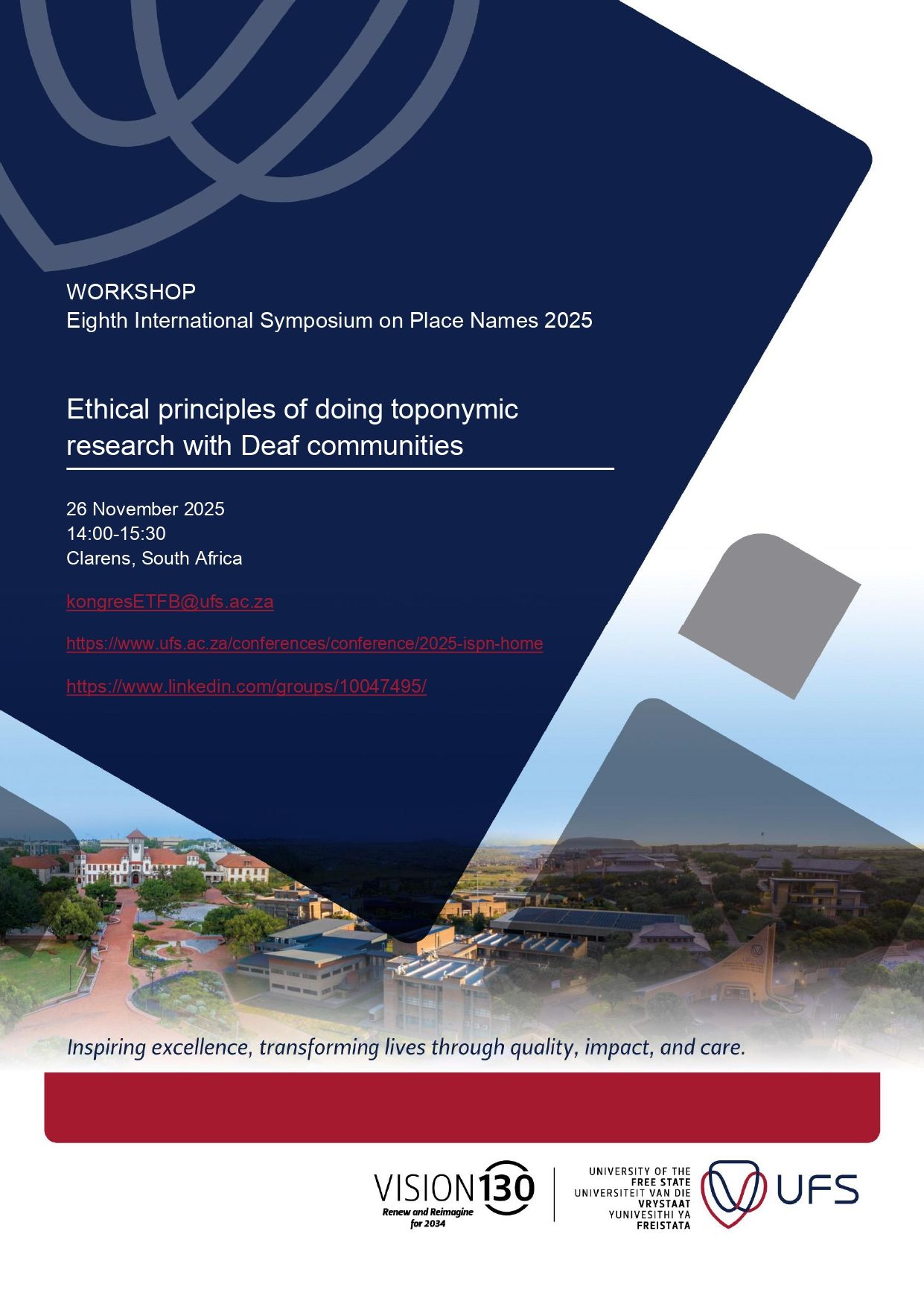
The Eighth International Symposium on Place Names (ISPN 2025), to be held from 26–29 November in Clarens, South Africa, will host a groundbreaking workshop that intersects toponymy, ethics, and Deaf studies. Scheduled for 26 November 2025, 14:00–15:30 at the Protea Hotel, this session titled “Ethical Principles of Doing Toponymic Research with Deaf Communities” promises to be a pivotal moment in inclusive place-name scholarship.
Led by Dr Patrick Sibanda and Dr Chrismi Loth from the University of the Free State, the workshop is part of a broader initiative by the Department of South African Sign Language and Deaf Studies. It is organized in collaboration with the Joint ICA/IGU Commission on Toponymy and the ICOS Working Group on Toponymy, reaffirming the international momentum behind ethical and inclusive naming practices.
Toponymy often privileges dominant voices and visible communities. However, Deaf communities, who operate in rich linguistic and cultural spheres of their own, are frequently overlooked in naming processes, street addressing, and spatial documentation. This workshop turns that tide by focusing on signed toponymy and the specific ethical considerations when conducting research involving Deaf individuals.

What to expect
The session is designed as an interactive dialogue and will include:
Introductions to sign language, Deaf culture, and Deaf identity
Examination of the Deaf community as a marginalised research population
The linguistic and cultural significance of place-name signs
Established ethical frameworks and best practices for working with Deaf participants
Opportunities for participant feedback and shared experience
This initiative not only fills a critical gap in the field of toponymy but also represents a landmark step toward inclusive geographic naming and respectful representation of all language communities.
The registration fee is R1 000, or R1 200 for both ISPN workshops (free for ISPN delegates). Interested participants can register at the official conference site or reach out directly to the organizers at kongresETFB@ufs.ac.za.
As the landscape of global naming becomes increasingly diverse and digital, sessions like this challenge researchers to think beyond sound - and listen to the hands that shape place.


