Showing posts with label onomastic stipend. Show all posts

Thursday, May 20, 2021

Utlysning av stipendiemedel för år 2021

 link

Ortnamnssällskapet i Uppsala utlyser stipendiemedel för år 2021 om 40 000 kronor att användas för namnforskning i vid bemärkelse

Tänkbara ändamål för den sökande kan vara bland annat dessa (utan prioritetsordning):

  • publicering (inkl. tryckbidrag, språkgranskning, översättning),
  • anordnande av konferenser, exkursioner, studiebesök och liknande,
  • resekostnader, t.ex. deltagande i konferenser och symposier,
  • möjliggörande av kortare period av ledighet från annat arbete för att bedriva namnforskning.

Den sökande ska vara medlem i Ortnamnssällskapet och bör vara verksam över grundutbildningsnivå (t.ex. inom ämnet verksamma masterstudenter, doktorander, forskare och handläggare). Ansökan, med obligatoriska uppgifter, ska göras på särskild blankett, som finns tillgänglig på sällskapets hemsida (http://ortnamnssallskapet.se). Ansökan skickas till sällskapets sekreterare Mats Wahlberg (mats.wahlberg@isof.se) och ska vara honom tillhanda senast den 1 juni 2021.

Redovisning för hur de beviljade medlen har använts skall tillställas sällskapet inom ett år efter utbetalning.

Sällskapets styrelse bereder, prioriterar och beslutar om eventuell tilldelning av medel under september månad.

Blankett för ansökan

Friday, January 15, 2016

PhD studentship on Berwickshire place-names

http://www.gla.ac.uk/colleges/arts/graduateschool/fundingopportunities/leverhulmeenglishlanguagehough/

HomeLeverhulme Doctoral Studentship commencing April 2016

‘Recovering the earliest English language in Scotland: evidence from place-names’


The Leverhulme-funded project ‘Recovering the earliest English language in Scotland: evidence from place-names’ seeks a suitably qualified graduate to pursue doctoral research on Scottish place-names. The doctoral work will be on some aspect of the place-names of Berwickshire, and will be carried out under the supervision of Prof Carole Hough and Dr Simon Taylor. The successful candidate will have a strong background in historical linguistics, with a good first degree relevant to the history of English or Scots, and some undergraduate or postgraduate training in place-name study.
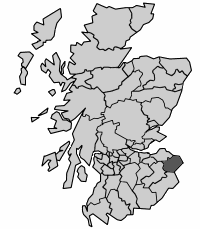
This 3-year project will use place-name evidence to investigate the Old Northumbrian dialect of Old English and its development into Scots. It focuses on the historical county of Berwickshire, the heartland of Anglo-Saxon settlement in Scotland, and aims to collect and analyse all place-names in six parishes along the Anglo-Scottish border, and all major settlement names throughout the historical county of Berwickshire.


The project is headed by Professor Carole Hough and Dr Simon Taylor, and draws on the University of Glasgow’s considerable and growing strengths in research within Name Studies and on Scotland’s history and languages. The objectives of the research are:

  • to investigate the Old Northumbrian dialect of Old English. As most Old English texts are preserved through the medium of the West Saxon literary dialect, place-names comprise key data for other varieties. The project will use place-name evidence to produce a ground-breaking study of Old Northumbrian, including its lexis, morphology and phonology.
  • to investigate the development of Older Scots in the Scottish borders. Like Middle English, Older Scots is a descendant of Old English, but it is uncertain how far the differences reflect the respective varieties of Old English from which they derive, and how far they result from interaction with other languages, particularly Norse. With no evidence of major Norse settlement in the borders, there is greater continuity of language from Old English to Scots here than elsewhere, so this is the best opportunity to establish which features of Scots derive from Old Northumbrian rather than from Old Norse.
  • to advance understanding of the relationship between place-names on either side of the present Scottish/English border. Cross-border comparison will both assist analysis of the project data, and lead to significant re-interpretations of place-names related to those in the study area.
  • to advance the recently-inaugurated Survey of Scottish Place-Names, making available data for the study of the history of language, settlement, environment, social organisation, and the use and perception of landscape.


Candidates interested in applying for funded PhD study on this project are encouraged to make informal contact with Professor Hough (Carole.Hough@glasgow.ac.uk) in the first instance.
Candidates wishing to submit an application should prepare and submit the following documentation:
  • A research proposal of no more than 1,000 words
  • A current CV
  • A transcript of qualifications to date (and anticipated results if you are still studying for your Masters)
  • An example of scholarly work up to 5000 words in length (e.g. a full essay or dissertation chapter)
  • 2 academic references
The closing date for receipt of complete applications is 12 noon on Monday, 1 February 2016. Applications should be emailed to critstudies-pgscholarships@glasgow.ac.uk.

Saturday, June 6, 2015

Doctoral Studentship at the University of Glasgow: Protocols for the use of name evidence in lexicography

http://www.jobs.ac.uk/job/ALF983/ahrc-collaborative-doctoral-studentship-protocols-for-the-use-of-name-evidence-in-lexicography/




AHRC Collaborative Doctoral Studentship with Scottish Language Dictionaries

Protocols for the use of name evidence in lexicography: comparative analysis of onomastic and non-onomastic data for historical and contemporary Scots


Applications are invited for a PhD at the University of Glasgow offered under the AHRC CDA programme with Scottish Language Dictionaries, Edinburgh.
The studentship will be based at the University of Glasgow and will be co-supervised by Professor Carole Hough and Dr Wendy Anderson (Glasgow) and Dr Alison Grant (Scottish Language Dictionaries). Training will be provided by both the University of Glasgow and Scottish Language Dictionaries in their respective areas of expertise. The studentship is funded for three years to commence in October 2015 and covers tuition fees at the Home/EU rate. Home students and EU students who have lived in the UK for 3 years prior to the start date of the award will also receive a maintenance bursary (stipend) of £14,057 (2015/16 RCUK rate).
About the research
Dictionaries have traditionally used written texts as sources of evidence. The first edition of the Oxford English Dictionary (OED), like A Dictionary of the Older Scottish Tongue and The Scottish National Dictionary, relied heavily on volunteer readers; present-day lexicographers have access to large text corpora, online archives and the internet. Corpora such as the Scottish Corpus of Texts & Speech, with a spoken component, also provide evidence of colloquial lexis for dictionaries of contemporary language. For historical dictionaries, this type of material is unavailable, but sources of non-literary data include personal names and place-names.
The increasing use of name evidence is a major trend in current lexicography. Most names originate as descriptions, and preserve lexical evidence that may predate or otherwise extend information from other sources. Birchin Lane in London derives from an unrecorded Middle English *berdcherver ‘beard-cutter, barber’; the surname Kibbler predates the earliest citation in the OED for kibbler ‘grinder’. This type of material was largely overlooked by early lexicographers, and is providing new words, as well as new meanings and antedatings of known words, for ongoing projects such as the 3rd edition of the OED and the 2nd edition of the Concise Scots Dictionary. Since many names originate in speech, these discoveries are generally taken to represent colloquial lexis, but that assumption has not yet been tested.
Ironically these developments have coincided with a trajectory of research in name studies which has identified significant differences between uses of terms in names and in ordinary language. Work on so-called ‘onomastic dialects’ initially focused on pre-historic and historic languages, establishing that the lexicon and onomasticon split off at an early stage of Indo-European before developing along similar but not identical lines. Further work has revealed a continuing divide between onomastic and lexical registers up to the present day, e.g. Norse-derived gata ‘street’ is still used in creating street-names, but is not part of ordinary language. Implications for the use of name evidence in dictionaries are far-reaching, but have not yet been explored.
This project will provide a more nuanced understanding of names as witnesses to vocabulary through a comparative analysis of uses of the Scots language in speech, written texts, and names of various kinds. The research focuses specifically on Scottish Language Dictionaries’ in-house Word Collection, which is used for producing and updating the dictionaries. There is flexibility for the student to select the types of names on which to focus, but it is expected that one case study will deal with street-names, the most productive area of the present-day onomasticon. Other case studies might deal with field-names, place-names, medieval personal names, or other types of names.
Candidates ideally should have:
  • A high quality Honours degree (2:1 or above) in English Language or a related discipline.
  • A strong Masters degree (Merit or Distinction) in English Language or a related discipline.
  • Demonstrable knowledge of at least two of the following: Lexicography, Onomastics, Scots.
  • Applicants should be able to demonstrate strong research capabilities and be fluent in spoken and written English.
Applications should include:
  • A statement of no more than 1,000 words indicating what skills and experience you will bring to the project
  • A current CV
  • A transcript of qualifications to date (and anticipated results if you are still studying for your Masters)
  • A writing sample (a full essay or Masters dissertation, up to 15,000 words)
  • Two letters of recommendation
The deadline for applications is Monday 29 June 2015
Interviews will be held on Thursday 23 July 2015
For general enquiries: Carole.Hough@glasgow.ac.uk
Applications should be made via critstudies-pgscholarships@glasgow.ac.uk. Please make clear in your online application that you are applying for the Protocols for the use of name evidence in lexicography studentship.