Showing posts with label NameExoWorlds. Show all posts

Thursday, January 9, 2020

100 000s of People from 112 Countries Select Names for Exoplanet Systems

link

On 17 December 2019 the names of 112 sets of exoplanets and host stars named in the IAU100 NameExoWorlds campaigns were announced at a press conference in Paris (France). Within the framework of the International Astronomical Union’s 100th anniversary commemorations (IAU100) in 2019, 112 countries organised national campaigns that stimulated the direct participation of over 780 000 people worldwide, who proposed and selected names for each exoplanet and its host star.

The IAU100 NameExoWorlds project saw massive and widespread participation around the world, as the public eagerly engaged in this exciting opportunity to suggest meaningful, creative and unique names for exoplanet systems for their respective countries. This is only the second time in history that a campaign has led to the naming of stars and exoplanets. Overall, 360 000 proposals for names were received from 112 countries. The National Committee in each country reduced their proposals to a shortlist of national candidates, which were presented to the public for their votes. A total of 420 000 people voted for their preferred candidates. The complete list of names approved by the IAU100 NameExoWorlds Steering Committee can be explored here. This project will have a lasting impact, as the winning names will be used in parallel with the existing scientific nomenclature, credited to the person, group or institution that suggested them.
"Astronomical observations over the past generation have now discovered over 4000 planets orbiting other stars — called exoplanets. The number of discoveries continues to double about every 2½ years, revealing remarkable new planet populations and putting our own Earth and Solar System in perspective. Statistically, most of the stars in the sky are likely to be orbited by their own planets — they are everywhere,” said Eric Mamajek, co-chair of the NameExoWorlds Steering Committee. “While astronomers catalogue their new discoveries using telephone-number-like designations, there has been growing interest amongst astronomers and the public alike in also assigning proper names, as is done for Solar System bodies,” Mamajek continued. 
The IAU100 NameExoWorlds global project was conceived to create awareness of our place in the Universe and to reflect on how the Earth would potentially be perceived by a civilisation on another planet. As the IAU is the authority responsible for assigning official designations and names to celestial bodies, the IAU100 celebrations in 2019 were used as a special occasion to offer every country the chance to name one planetary system, comprising an exoplanet and its host star. IAU100 NameExoWorlds Project Manager, Eduardo Monfardini Penteado said “The IAU100 NameExoWorlds campaign provided the public with the exciting opportunity to help with the naming of over 100 new worlds and their stars, and to help the IAU establish a thoughtful naming theme for naming future discoveries in those systems.” 
Each nation's designated star for naming is visible from that country, and is sufficiently bright to be observed through small telescopes. The respective National Committees, following the methodology and guidelines set up by the IAU100 NameExoWorlds Steering Committee, were the bodies responsible for establishing the conditions for public participation, disseminating the project in the country and developing a voting system. 
The newly named exoplanets are likely to be large gas giants, and all were discovered via one of two discovery methods: the transit method — where planets are observed to pass in front of their star and block a portion of the star’s light; and the radial velocity method — where careful measurement of a star’s spectrum reveals it to be wobbling back and forth under the influence of the gravity of its planets [1]
Some examples of the new IAU names for exoplanets and their stars include: 
  • Ireland: The names of mythological dogs (Bran, Tuiren) from the Irish legend The Birth of Bran, for the planet HAT-P-36b (Bran) orbiting the star HAT-P-36 (Tuiren) in the constellation of Canes Venatici (the Hunting Dogs),
  • Jordan: The names of ancient cities and protected areas in southern Jordan, for the exoplanet WASP-80b (Wadirum) orbiting the star WASP-80 (Petra) in the constellation of Aquila (the Eagle),
  • Malaysia: The names of gemstones in Malay language, for the exoplanet HD 20868 b (Baiduri) orbiting the star HD 20868 (Intan) in the constellation of Fornax (the Furnace),
  • Burkina Faso: The new names for the planet HD 30856 b (Nakambé) and its star HD 30856 (Mouhoun) refer to the local names for prominent rivers in Burkina Faso. Fittingly, the system lies in the river constellation of Eridanus (the River). 
In recognition of the UN 2019 International Year of Indigenous Languages, speakers of indigenous languages were encouraged to propose names from those languages, and a few dozen of the selected names are of indigenous etymology. In Argentina, the winning proposal was submitted by a teacher and community leader in the indigenous Moqoit community. The new names for the planet HD 48265 b (Naqaya) and star HD 48265 (Nosaxa) mean brother-family-relative (referring to all human beings as brothers) and spring (literally, new year), respectively, in Moqoit language. 
“The IAU is delighted to see the broad international interest that this NameExoWorlds campaign has generated,” noted IAU President-elect Debra Elmegreen. “It is gratifying that so many people across the globe have helped create a name for a planetary system that is meaningful to their culture and heritage. This effort helps unite us all in our exploration of the Universe.” 
The NameExoWorlds project was organised within the framework of the IAU’s 100th anniversary in 2019. With over 5000 activities in 140 countries, millions of people around the world are celebrating the astronomical breakthroughs that have shaped science, technology and culture throughout the last century, as well as highlighting the importance of astronomy as a tool for education, development and diplomacy. Find more information on the IAU100 website.
“Throughout the year we have engaged with the public through various astronomy activities for the IAU’s 100th anniversary. The NameExoWorlds Global Project has been the perfect initiative to close a year full of projects engaging with society. It will surely have a lasting impact for years to come,” concludes IAU President Ewine van Dishoeck.

Tuesday, October 29, 2019

Votez pour le nom d'une exoplanète et de son étoile !


À l'occasion de son 100ème anniversaire, l'Union Astronomique Internationale (UAI) lance une campagne mondiale offrant l'opportunité à chaque pays de donner un nom à une exoplanète et à son étoile. Plus de 120 pays participent à cette campagne. La France donnera un nom à l'étoile HD8574 et à sa planète HD8574b. Le vote pour les noms qui seront attribués à ces deux objets célestes est ouvert à tous dès maintenant et jusqu’au 14 novembre.
IAU100-NameExoWorlds
Le prix Nobel de physique 2019 vient d'être attribué à Michel Mayor et Didier Queloz pour la première découverte en 1995 d'une exoplanète en orbite autour d'une étoile de type solaire. Depuis, les astronomes ont découvert des milliers d'autres planètes en orbite autour d'étoiles proches. Certaines sont de petites planètes rocheuses comme la Terre, d'autres sont des géantes gazeuses comme Jupiter.
L’Union Astronomique Internationale (UAI) fondée en 1919 et regroupant plus de 13700 astronomes de 107 pays différents est l’autorité internationale responsable des désignations scientifiques et des noms qui sont donnés aux objets célestes. Tous les peuples partageant le même ciel, l'UAI souhaite contribuer à la fraternité à l'occasion de son centième anniversaire en donnant à tous l'occasion de donner un nom à une exoplanète et à son étoile. Après la campagne NameExoWorlds de 2015 qui avait vu l'attribution d'un nom à 31 exoplanètes réparties dans 19 systèmes planétaires, c'est aujourd'hui la deuxième fois dans l'histoire qu'une campagne mondiale conduira à nommer des étoiles et des exoplanètes : IAU100-NameExoWorlds.
La planète HD8574b
L'UAI a attribué à chaque pays un système constitué d'une étoile et de sa planète pour qu'il leur donne un nom. La France s'est vue attribuer le système composé de l'étoile HD8574 et de sa planète HD8574b. Cette étoile est visible depuis la France métropolitaine avec une paire de jumelles ou une petite lunette, notamment pendant les soirs d'automne. Elle est située dans la constellation des Poissons, non loin des constellations du Triangle et d’Andromède.
L'étoile HD8574, située à près de 150 années-lumière de nous, est à peine plus massive et plus grande que le Soleil. HD8574, comme le Soleil, est une étoile classée par les astronomes dans la "Séquence principale", c'est à dire que dans son cœur de l'hydrogène se transforme en hélium, produisant ainsi l'énergie qui la fait briller.
La planète HD8574b est la seule planète connue aujourd'hui en orbite autour de l'étoile HD8574. Elle a été découverte en 2002 à l'Observatoire de Haute-Provence grâce à l’observation du mouvement de l'étoile provoqué par la planète. Cette planète est une géante gazeuse et a une masse égale à au moins 1,8 fois la masse de Jupiter. Elle tourne autour de son étoile en 227 jours terrestres, soit environ 7 mois. Son orbite n'est pas circulaire, c'est une ellipse dont l'excentricité est égale à 0,29 ; et, par conséquent, la distance entre l'étoile et la planète varie de 0,55 à 1,0 unité astronomique, produisant des variations saisonnières de la température d'équilibre de la planète entre 10°C et 110°C (une unité astronomique = la distance Terre-Soleil = 149,6 millions de kilomètres).
Votez pour le nom de HD8574 et de HD8574b
Dans le cadre de la campagne IAU100-NameExoWorlds, plus de 2000 propositions de noms ont été reçues pour HD8574 et HD8574b, dont 800 propositions complètes. Après une sélection fondée sur le respect des critères de l’UAI, huit couples de noms ont été retenus pour le vote final. 
Quiconque peut voter pour un des 8 couples de noms. Le formulaire de vote mis en place par le Comité National est ouvert dès maintenant et jusqu'au 14 novembre 2019. Il suffit de se rendre sur le site de vote : https://questionnaires.obspm.fr/index.php/712813?
Parmi les huit couples de noms proposés au vote, on trouve des personnages de roman (Pantagruel et Gargantua) ou historiques (Abélard et Héloïse), des noms de dieux gaulois (BélisamaBélénosCerciusGrannosAlisanosGrannosAlisanosAvetaAdsullata), sumériens (Enki et Ninhursag) ou issus de la mythologie nordique (Freyja et Njörd).
Les classes des écoles, collèges et lycées, et les clubs d’astronomie sont vivement invités à participer au vote.
À l'issue du vote, le Comité National publiera une liste ordonnée de 3 couples de noms qui seront proposés à l'Union Astronomique Internationale.
In fine, le Comité International de l'UAI publiera le 15 décembre les noms choisis pour HD8574 et HD8574b.
Les 8  couples de noms proposés au vote
Pantagruel et Gargantua  Personnages de deux romans créés par l'auteur français François Rabelais au seizième siècle : le géant Gargantua et son fils, tout aussi gigantesque, Pantagruel. Ces ouvrages pleins de verve  sont des plaidoyers pour une culture humaniste, d’une grande richesse lexicale, et d’une écriture souvent crue.
Abélard et Héloïse  Abélard et Héloïse  Abélard était professeur de philosophie, de théologie et de mathématiques au douzième siècle. Il fut le professeur d'Héloïse qui devint une femme de lettres célèbre. Ils vécurent un amour violemment contrarié, leur vie fut romanesque, se retirant finalement chacun dans un couvent. A eux deux, ils forment une figure mythique de la passion amoureuse et transgressive.
Bélisama et  Bélénos  Dans la mythologie gauloise, Bélénos était le dieu gaulois de lumière, Dieu du Soleil et de la santé . Bélisama, était la déesse gauloise du foyer, de la métallurgie, des arts du verre, et du tissage. Bélénos et Bélisama étaient époux.
Cercius et Grannos Cercius était une locution gauloise désignant un vent tourbillonnant, impétueux, et probablement une divinité associée, priée pour la fécondité. Grannos était une divinité solaire gauloise.
(note : Grannos et Bélénos sont peut-être deux noms de la même divinité celtique, tant ils sont proches.)
Alisanos et Grannos  Dans la mythologie gauloise, Alisanos était un dieu adoré dans ce qui est aujourd'hui la Côte-d'Or en Bourgogne-Franche-Comté et à Aix-en-Provence. Grannos était une divinité solaire gauloise.
Aveta et Adsullata Aveta était un déesse gauloise (Gaule celtique) des naissances et des accouchements. Elle est devenue une déesse-mère dans la religion gallo-romaine. Adsulatta était une déesse celtique des rivières et des sources.
Enki et Ninhursag Dans l’antiquité sumérienne, Enki était le dieu des eaux douces souterraines, associé aux rites de purification, à la magie et à la sagesse. Il a été conçu comme un dieu civilisateur, patron des arts et des techniques. Ninhursag  était une déesse mère qui donna le souffle de vie aux premiers humains. Avec Enki elle mit au monde huit divinités favorables à l’homme. De nombreux rois aimaient aussi la considérer comme leur mère. Son nom a été donné à une constellation par les Mésopotamiens.
Freyja et Njörd   Freyja était une déesse majeure dans le paganisme germanique et nordique, où de nombreux contes l’impliquaient ou la représentaient. Dans la mythologie nordique, Njörd était le dieu de la Mer et des Vents. Il apportait la bonne fortune en mer ainsi qu’une bonne pêche. Père de Freyja.
Il est entendu que les désignations scientifiques HD8574 et HD8574b ne seront pas remplacés par les noms qui seront proposés. En revanche, ces noms seront reconnus par l’UAI comme les noms d’usage public pour ces objets et il en sera fait publicité comme tel, ainsi que rendu crédit à l’organisation ou à l’individu qui l’auront proposé. Ces noms publics pourront ensuite être utilisés à un niveau international ainsi que, ou à la place des désignations scientifiques, de façon permanente et sans restriction.
Liens
·        Illustrations  
·        Site Web NameExoWorlds (en Anglais)
·        Site Web 100ème anniversaire de l’UAI (en Anglais)
Comité National
Le Comité National se compose comme suit :
·        Guillaume Hébrard, IAP-Observatoire de Haute Provence
·        Alain Lecavelier des Etangs, Institut d'astrophysique de Paris
·        Fabrice Mottez, Observatoire de Paris-Meudon (Président)
·        Thierry Montmerle, ancien Secrétaire Général de l'UAI. 
·        Claire Moutou, IRAP Toulouse
·        Annie Robin, Observatoire de Besançon
·        Véronique Verdier, Philosophe

Tuesday, October 15, 2019

NameExoWorlds: A global project in celebration of 100 years of IAU

link


In recent years, astronomers have discovered thousands of planets and planetary systems orbiting nearby stars. Some are small and rocky, like the Earth, whilst others are gas giants, like Jupiter. It is now believed that most stars in the Universe have planets orbiting them and that some of them have physical characteristics that resemble those of the Earth. The sheer number of stars in the Universe, each potentially with orbiting planets, along with the ubiquity of chemical species which are the building blocks of life, suggests that extraterrestrial life may be likely.

As part of the IAU's mission to promote and safeguard the science of astronomy through international cooperation, the IAU is the authority responsible for assigning official names to celestial bodies. Now, while celebrating its first 100 years of fostering international collaboration (IAU100), the IAU wishes to contribute to the fraternity of all people with a significant token of global identity. Following the first NameExoWorlds competition, which named 19 "ExoWorlds" in 2015, the IAU will now, within the framework of the IAU100 NameExoWorlds project, offer every country the chance to name one planetary system, comprising an exoplanet and its host star. Each country’s designated star is visible from that country, and sufficiently bright to be observed through small telescopes.

We encourage all people of Earth to consider themselves “Citizens of the Cosmos”, and set aside borders, wars, and cultural differences for a universal, peaceful view of humanity as just one race, possibly among many cosmic neighbours in the Universe.


Wednesday, June 3, 2015

LPSC 2015: First results from Dawn at Ceres: provisional place names and possible plumes

http://www.planetary.org/blogs/emily-lakdawalla/2015/03191629-lpsc-2015-dawn-at-ceres.html

Posted By Emily Lakdawalla
2015/03/19 23:29 UTC
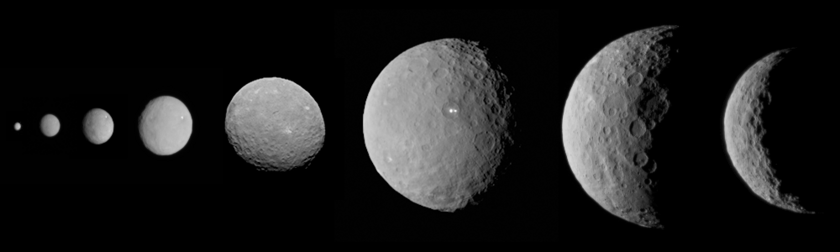
Three talks on Tuesday at the Lunar and Planetary Science Conference concerned the first results from Dawn at Ceres. Dawn has only just entered orbit around the largest asteroid, and the spacecraft is currently on its night side. You've already seen in my blog many of the best images that we have so far. So it's early days yet for Ceres science, but what Dawn has seen so far is pretty exciting. As a reminder, here is a series of images that shows how Dawn's point of view on Ceres has changed throughout its approach to orbit insertion:
Approaching Ceres


NASA / JPL / UCLA / MPS / DLR / IDA / collage by Emily Lakdawalla
Approaching Ceres
Dawn took this series of images of Ceres before it was captured into its first orbit. Dawn approached Ceres from the direction of the Sun and passed to its night side before orbital capture. In order from left to right, the images were taken December 1, 2014 (camera calibration); January 13 and 25 and February 4 (optical navigation images 1, 2, and 3); February 12 and 19 (Rotation Characterizations 1 and 2); and February 25 and March 1 (optical navigation images 4 and 5). The next images will be taken in April.
And here's a look at the world rotating:
Rotating Ceres from Dawn, February 19, 2015
NASA / JPL / UCLA / MPS / DLR / IDA / Emily Lakdawalla
Rotating Ceres from Dawn, February 19, 2015
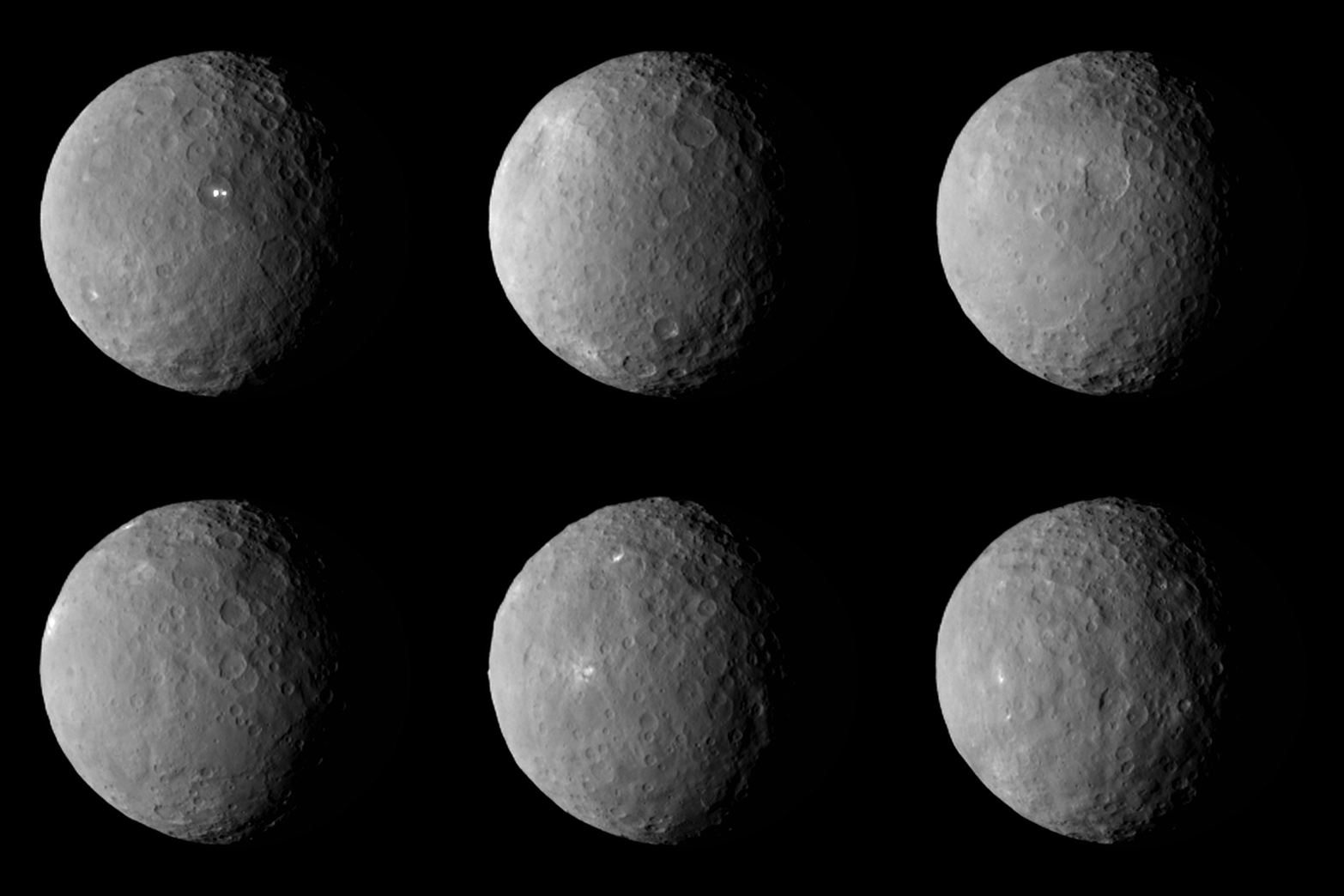
Dawn took 27 photos of Ceres during its Rotation Characterization 2 in order to make this animated view of the dwarf planet rotating. The publicly released version of this animation had been stretched to make Ceres' disk appear circular. Ceres is, in fact, quite oblate, so this version has had Ceres' shape corrected. At full size the animation has been enlarged to about 200% of its original resolution.
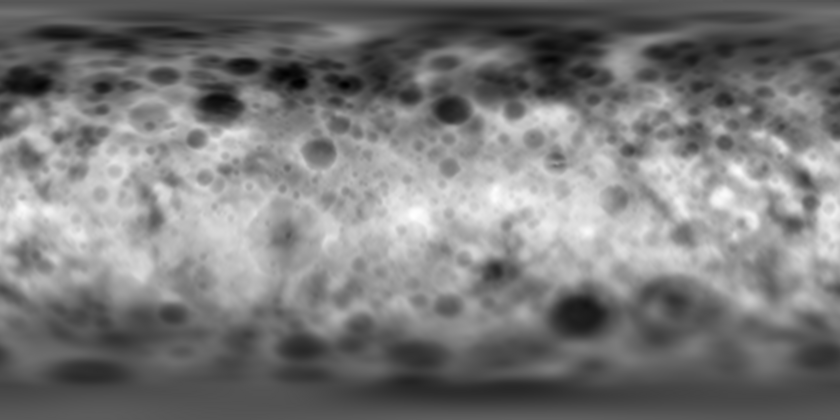
And here is  a newly released digital elevation model for Ceres, available from the Planetary Data System:
Topographic map of Ceres as of February 2015


NASA / JPL / UCLA / MPS / DLR / IDA / unmannedspaceflight.com user "JohnVV"
Topographic map of Ceres as of February 2015
This map is a digital elevation model of Ceres made from Rotation Characterization 2 data gathered on February 19, 2015. Darker areas represent lower elevations, and brighter areas represent higher elevations. The map was originally posted here.
As you can see, Dawn has already observed the entire globe of Ceres, albeit at low resolution. Chris Russell opened the session with an overview of the mission and some early first impressions of Ceres. "This is very much unlike Vesta," he said. The impact craters are quite different. In general, Russell said in response to an audience question, early Dawn measurements of Ceres' shape and physical properties are results are "almost perfectly consistent" with the work done by Peter Thomas and coworkers on Ceres' shape as seen in Hubble images. The major news from Russell's presentation was the announcement of some names for features on Ceres. Back in October, the IAU adopted two naming themes for Ceres: craters will be named after agriculture deities, while other features were be named for world agricultural festivals. Russell showed this map that organizes Ceres' surface into quads, with each quad named after one harvest deity. As they did at Vesta, they will split the quads among the team as they begin to map Ceres, and these names will be applied to prominent craters within each quad. Thanks very much to Paul Schenk for sharing the map with me! Russell pointed out his own favorite quad name: Yumyum, located within Ceres' southern hemisphere.

Provisional quad names for Ceres
I went ahead and applied these quad names to the digital elevation model. The crater with the bright feature in it is unfortunately right on the boundary between the Palo and Ebisu quads. The flat-floored huge crater I wrote about earlier lies mostly inside the quad called Kumba. The bright splash crater is in the quad named Hobnil.

NASA / JPL / UCLA / MPS / DLR / IDA / JohnVV / Emily Lakdawalla
Topographic map of Ceres, with quad names
The second talk of the session was most sensational: Andreas Nathues, presenting on early imaging results. At the beginning of his talk, he requested for bloggers not to blog it, but for reasoning I explained here, I'm writing about it anyway, as Alex WitzeEric HandIrene Klotz, and others have already done. Nathues said that there was a variety of terrain on Ceres, ranging from smooth, to lineated, to rough. Many craters have flat floors; perhaps they are relaxed (meaning that the icy mantle has flowed over time to make the preexisting crater shallower, evening out the gravitational potential). He pointed to linear features throughout the surface, and says they already see some scarps. (Linear features and scarps are hallmarks of tectonics: geology driven by internal forces.) He called the large smooth crater the "pillowy-floored basin" and says it measures 270 kilometers in diameter. In general, the transition in crater shape from simple craters to complex ones with central peaks happens near a diameter of 25 kilometers.
Then he focused on the bright feature. It is located in the floor of a crater 80 kilometers in diameter. From its behavior as the globe rotates, he said, the bright feature appears to lie in a depression. The images that have been released to the public from the rotation animation do not show all of the photos of the bright feature, so the next point concerns images that I can't show you. "What is amazing," he said, "is that you can see the feature while the rim is still in front of the line of sight. Therefore we believe at the moment that this could be some kind of outgassing. But we need higher resolution data to confirm this." What he is saying is that as Ceres' globe rotates and the 80-kilometer crater's rim rotates into view, that rim should block our ability to see the bright feature on the floor of the crater. However, the bright feature is already visibly bright as the crater begins to rotate into view. Therefore, it must be vertically above the rim of the crater: it must be some kind of plume. "During the day," Nathues went on, "the feature evolves: it brightens. At dusk it gets fainter; at late dusk it disappears completely. We see this for cometary activity."
He moved to color data, showing a global map of Ceres as seen through different-colored filters. There was a striking asymmetry to the color: one hemisphere was much more red and the other much more blue. The images were taken from too great a distance to resolve the bright spot; it is smaller than 4 kilometers across. So they can say that its albedo is at least 0.4 (meaning that it reflects at least 40% of the light that strikes it), but it could be much higher. The color information over the spot is consistent with an icy surface, but this is not a unique interpretation. The feature has variable brightness with time: its brightness increases strongly as seen through the 550-nanometer filter around local noon.
Obviously, active outgassing on Ceres would be a big deal, if it really exists. Fortunately, Dawn will get much closer and will take much better images, which will hopefully confirm this discovery!
Approaching Ceres: one bright spot turns into two
NASA / JPL / UCLA / MPS / DLR / IDA
Approaching Ceres: one bright spot turns into two
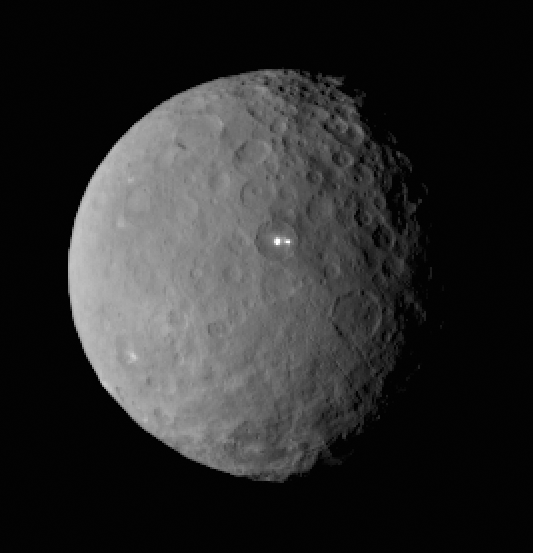
Dawn captured this image of Ceres during its Rotation Characterization 2, on February 19, 2015. This photo includes the enigmatic bright spot, which has now separated into two bright spots, both of them still smaller than the resolution of the camera (which is roughly 4 kilometers per pixel at a distance of 46,000 kilometers). This image has been enlarged by a factor of two from the original data.
The last talk on actual Dawn data was given by Francesca Zambon, on the imaging spectrometer data, showing global maps. The spatial resolution of her map is only 11 kilometers per pixel at the moment, which is relatively coarse, but still better than Hubble. As was evident in Nathues' maps, Zambon's VIR maps showed a red hemisphere and a blue hemisphere; the bright spot is located at 20 degrees north, 240 degrees east, near the middle of the blue hemisphere. She showed some early temperature maps of Ceres' surface, and a surprising result: the bright spot showed no obvious temperature contrast with the area around it. But a different bright spot, the splash crater located at 4 degrees north, 8 degrees east, is markedly colder than the area around it. (You would expect cooler temperatures for brighter surfaces, all else being equal.)
The rest of the talks in the Ceres session concerned Earth-based observations, geophysical modeling, and future Dawn work. One of the interesting talks from that part of the session was by Tim Titus, who tried to use modeling to figure out where the "snowline" on Ceres is -- that is, the latitude at which ice is stable at the surface. Ceres has nights and days, of course, so the surface temperature varies with time, but those variations die out as you go beneath the surface. Titus defined locations where the subsurface never gets above 145 kelvins to be the location of the snowline on Ceres. For a variety of possible surface properties, a smooth surface would have a snowline somewhere between 40 and 60 degrees. If that surface is roughened (by, say, impact craters), then the snowline shifts poleward. So near-surface ice is stable near the poles, and comet-like ice sublimation could happen there, especially with help from seasonal heating or a meteor impact. On the other hand, plume activity at lower latitudes -- like the 20-degree-north position of the bright spot -- is happening in a place where near-surface water ice is not stable. Activity there would need to originate in a source of water ice that gets recharged somehow, such as by cryovolcanism. Of course, as Andy Rivkin pointed out during the question period, a sufficiently big impact could expose much more deeply-buried ice; he asked if Titus had modeled how often impacts would be expected to expose such deep ice. Titus replied that this was beyond the scope of his work.
A related talk, by Norbert Schorghofer, concerned a prediction for the GRaND neutron spectrometer results, which will not be able to begin acquiring quality science data until Dawn is in its lowest orbit, much later this year. Schorghofer's models suggest that Dawn GRaND should detect  water ice within half a meter of the surface of Ceres, and he predicted that GRaND would observe this ice poleward of 60 degrees latitude. This assumes Ceres' current obliquity, which is very slight at only 3 degrees. As he spoke, I wondered if Ceres' spin axis has tilted more than this in the past, as Earth's and Mars' do. And later in the talk, he answered this question: even if Ceres' obliquity has varied, the prediction is still that there will be near-surface ice poleward of 60 degrees latitude. "This prediction can go wrong, but then it would mean something," he said. It could mean Ceres has lost a lot of near-surface volatiles due to impacts; or there has been true polar wander; or lots of dessication during an early period of radiogenic heating.
I enjoyed a later talk given by Thomas Davison on the shapes of Ceres' largest impact craters and how they may serve as a sensitive probe of the subsurface structure of Ceres. He modeled Ceres in three ways: with a dry olivine core; with a much wetter, serpentine core; and with a "mudball" core of mixed rock and water. Then he struck his model Ceres with asteroids of different sizes, arriving with speeds of 4 kilometers per second. In general, the mudball Ceres produced incredibly flat-floored craters, and the impact had little effect on the core-mantle boundary. The dry-core Ceres tended to produce the most surface topography, with prominent central peaks. The hydrated-core Ceres had more topography and prominent uplift of the core-mantle boundary underneath the crater. This kind of uplift would be obvious as a concentration of mass beneath the crater in Dawn's gravity data. Now, over geologic time, the original shapes of the craters may have been modified by relaxation, as ice flows from high places to low places to even out the surface; but the different appearance of the core-mantle boundary between the three cases should be visible in gravity maps.

All in all, there is a lot to look forward to on Dawn, and I can't wait for more pictures from closer orbits!

NameExoWorlds

http://www.nameexoworlds.org/


I would call it "ASTRONOMASTICS"


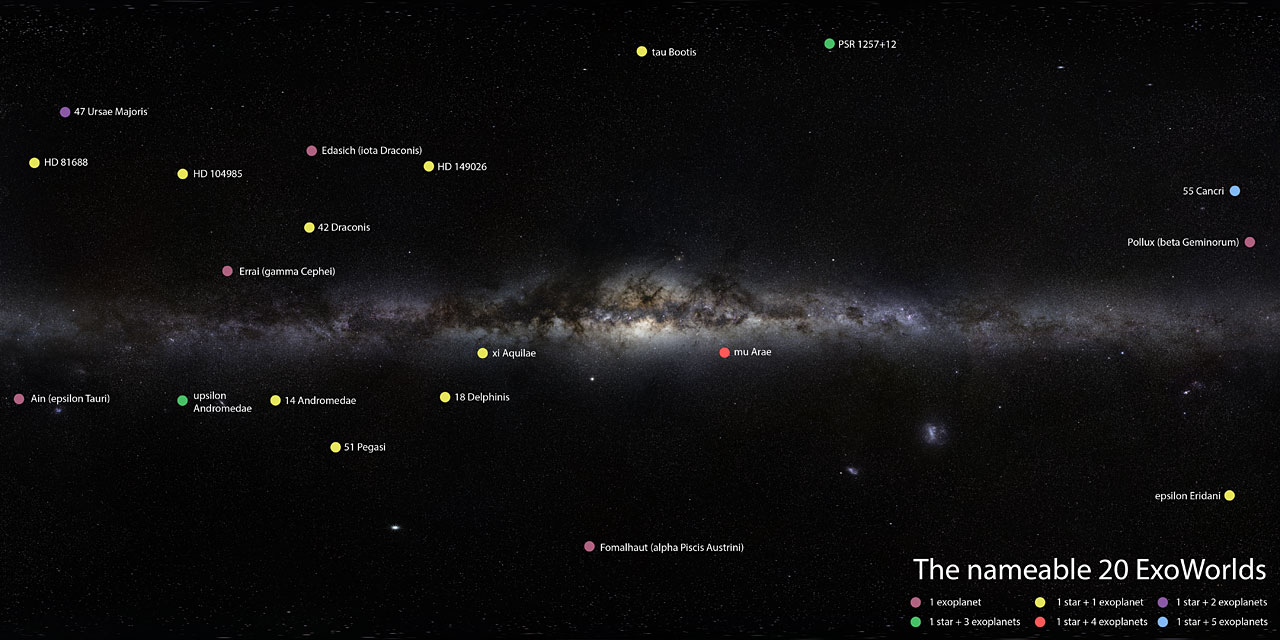
The NameExoWorlds contest, organised by the IAU and Zooniverse, is now entering its next stage. The 20 most popular ExoWorlds have been made available for naming proposals from registered clubs and non-profit organisations.
Although people have been naming celestial objects for millennia, the IAU has the task of assigning scientifically recognised names to newly discovered celestial bodies by its member countries. The NameExoWorlds contest provides not only the first opportunity for the public to name exoplanets, but also, for the first time in centuries, to give popular names to some stars — those that have known exoplanets in orbit around them.
The list of the 20 ExoWorlds can be found here. Some of them are single-planet systems, while others are multiple-planet systems. Each organisation can submit one naming proposal, for one ExoWorld only. The number of names that need to be submitted depends on which system is selected. For single- and multiple-planet systems, a name for each planet must be submitted, as well as one for the host star. In the 20 ExoWorlds list, five stars already have common names. Consequently, these five stars cannot be considered for public naming. There are 15 stars and 32 planets (47 objects in total) available for naming. The name of the 20 host stars are explained and personal messages from some discoverers are also available here.
To participate in the contest, clubs and non-profit organisations must first register with the IAU Directory of World Astronomy. The deadline for registrations has been extended to 23:59 UTC on 1 June 2015.
The naming proposals can be submitted here. All naming submissions having to abide by the IAU Exoplanet naming conventions and must be supported by a detailed argument for their choice. The deadline for submitting naming proposals is 23:59 UTC on 15 June 2015.
Once this stage has concluded, the public worldwide will be invited to vote on their favourite proposed names.
The final results are expected to be announced at a special public ceremony held during the IAU XXIX General Assembly in Honolulu, USA, 3–14 August 2015.

More information

The IAU is the international astronomical organisation that brings together more than 10 000 professional astronomers from almost 100 countries. Its mission is to promote and safeguard the science of astronomy in all its aspects through international cooperation. The IAU also serves as the internationally recognised authority for assigning designations to celestial bodies and the surface features on them. Founded in 1919, the IAU is the world's largest professional body for astronomers.

Contacts

Sze-leung Cheung
IAU International Outreach Coordinator
Tokyo, Japan
Tel: +81-(0)422-34-3896
Cell: +852- 54253118
Email: cheungszeleung@iau.org
Thierry Montmerle
IAU General Secretary / Institut d'Astrophysique de Paris
Paris, France
Tel: +33 1 43 25 83 58
Email: montmerle@iap.fr
Chris J. Lintott
Zooniverse, Citizen Science Alliance, University of Oxford
Oxford, United Kingdom
Tel: +44 7808 167288
Email: cjl@astro.ox.ac.uk