Астрономы и популяризаторы астрономии издавна обращаются к толкованию небесных названий, чаще всего ограничиваясь ссылками на античную мифологию.
Возникновение старых астронимов теряется в глубине веков, так как звездное небо давало древнему человеку возможность прекрасно ориентироваться ночью и во времени, и в пространстве.
Небесные названия могут раскрыть много ценной информации о жизни наших предков.
Основным источником космических названий является мифология. Все названия присваиваются в соответствии с определёнными правилами, утверждёнными МАС (международным астрономическим союзом) и расписанными в планетной номенклатуре.
Showing posts with label astronomastics. Show all posts
Showing posts with label astronomastics. Show all posts
Thursday, April 15, 2021

Tuesday, March 30, 2021
NASA is using the Navajo Language for Martian toponyms

Since its landing on the surface of Mars in mid-February, NASA’s Perseverance rover has been diligently documenting every detail and sending more than 7,000 images back to Earth. A common activity undertaken by surface missions is to assign nicknames to the various landmarks discovered by the rover; this provides the mission team with a common vocabulary with which to discuss their findings. The team for the Mars 2020 mission is working in conjunction with the Navajo Nation to name the various features and geological landmarks discovered on the Red Planet’s surface with words from the Navajo language...
Wednesday, March 16, 2016
Winners in Naming the Exoplanets
http://www.americannamesociety.org/winners-in-naming-the-exoplanets/
http://nameexoworlds.iau.org/names
There are planets that orbit our sun (e.g. Mercury, Saturn, and or beloved Earth) and there are planets that orbit around a star that is not our sun. These celestial bodies are called “exoplanets.”
This past spring, registered clubs and non-profit organizations were invited to suggest names for several exoplanets and stars. Among the winning bids came from the Kamagari Astronomical Observatory in Japan. This organization received the honor of bestowing the planet Ain b (epsilon Tauri b) the name Amateru, a common appellation for shrines devoted to the Shinto Sun goddess, Amaterasu. Learn about these onomastics winners.


http://nameexoworlds.iau.org/names
There are planets that orbit our sun (e.g. Mercury, Saturn, and or beloved Earth) and there are planets that orbit around a star that is not our sun. These celestial bodies are called “exoplanets.”
This past spring, registered clubs and non-profit organizations were invited to suggest names for several exoplanets and stars. Among the winning bids came from the Kamagari Astronomical Observatory in Japan. This organization received the honor of bestowing the planet Ain b (epsilon Tauri b) the name Amateru, a common appellation for shrines devoted to the Shinto Sun goddess, Amaterasu. Learn about these onomastics winners.
Monday, January 4, 2016
Transcription et signification des noms d’étoiles arabes et notes d’Onomastique stellaire
http://saptoulouse.net/sap/nom-arabe-des-etoiles/
Extrait des Annales de l’Observatoire Astronomique
Transcription et signification des noms d’étoiles arabes
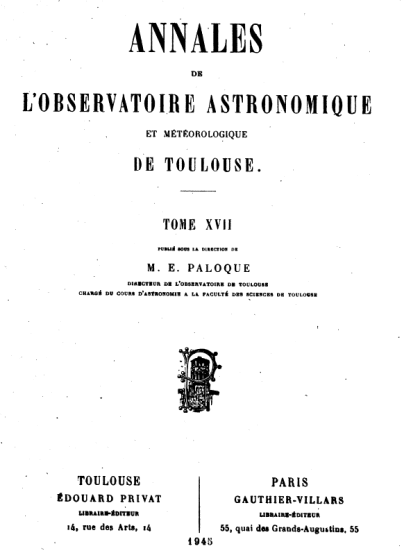
Extrait des Annales de l’Observatoire Astronomique
et Météorologique de Toulouse :
Transcription et signification des noms d’étoiles arabes
et notes d’Onomastique stellaire
par H. MESNARD
Pour voir l’exposé détaillé (format pdf), cliquer sur l’image ci-dessous
Wednesday, June 3, 2015
LPSC 2015: First results from Dawn at Ceres: provisional place names and possible plumes
http://www.planetary.org/blogs/emily-lakdawalla/2015/03191629-lpsc-2015-dawn-at-ceres.html
NASA / JPL / UCLA / MPS / DLR / IDA / collage by Emily Lakdawalla
Posted By Emily Lakdawalla
2015/03/19 23:29 UTC
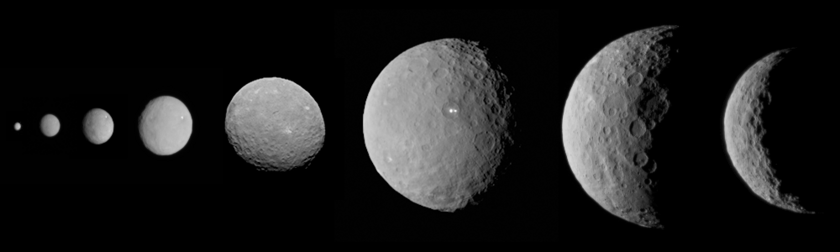
Three talks on Tuesday at the Lunar and Planetary Science Conference concerned the first results from Dawn at Ceres. Dawn has only just entered orbit around the largest asteroid, and the spacecraft is currently on its night side. You've already seen in my blog many of the best images that we have so far. So it's early days yet for Ceres science, but what Dawn has seen so far is pretty exciting. As a reminder, here is a series of images that shows how Dawn's point of view on Ceres has changed throughout its approach to orbit insertion:
NASA / JPL / UCLA / MPS / DLR / IDA / collage by Emily Lakdawalla
Approaching Ceres
Dawn took this series of images of Ceres before it was captured into its first orbit. Dawn approached Ceres from the direction of the Sun and passed to its night side before orbital capture. In order from left to right, the images were taken December 1, 2014 (camera calibration); January 13 and 25 and February 4 (optical navigation images 1, 2, and 3); February 12 and 19 (Rotation Characterizations 1 and 2); and February 25 and March 1 (optical navigation images 4 and 5). The next images will be taken in April.
And here's a look at the world rotating:
NASA / JPL / UCLA / MPS / DLR / IDA / Emily Lakdawalla
Rotating Ceres from Dawn, February 19, 2015
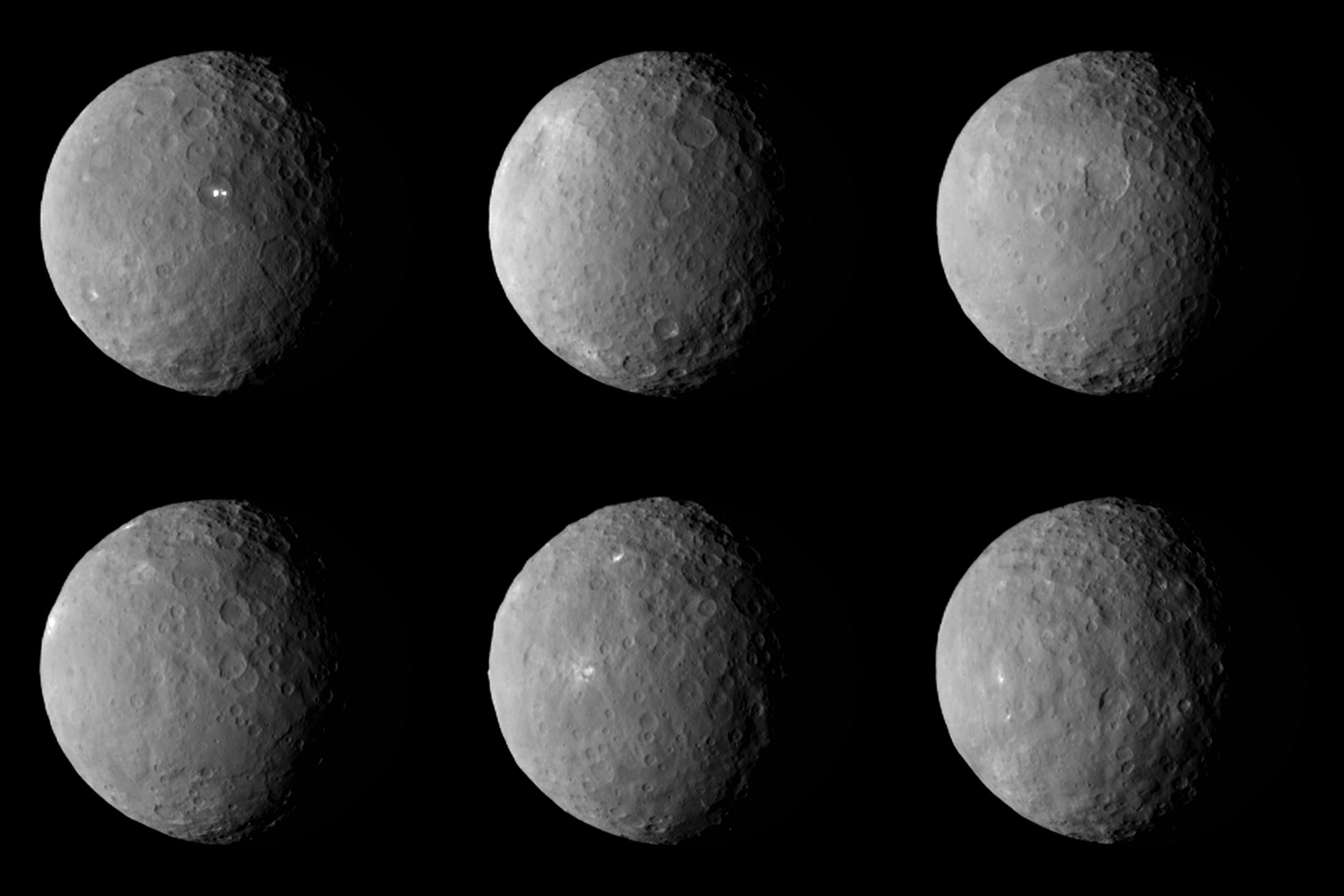
Dawn took 27 photos of Ceres during its Rotation Characterization 2 in order to make this animated view of the dwarf planet rotating. The publicly released version of this animation had been stretched to make Ceres' disk appear circular. Ceres is, in fact, quite oblate, so this version has had Ceres' shape corrected. At full size the animation has been enlarged to about 200% of its original resolution.
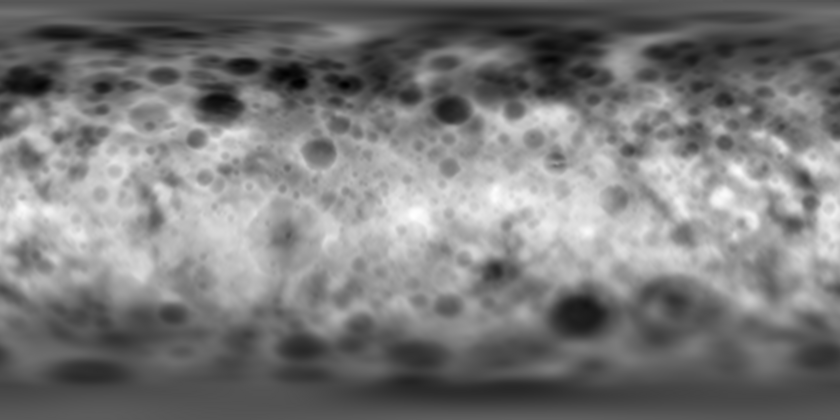
And here is a newly released digital elevation model for Ceres, available from the Planetary Data System:
NASA / JPL / UCLA / MPS / DLR / IDA / unmannedspaceflight.com user "JohnVV"
Topographic map of Ceres as of February 2015
This map is a digital elevation model of Ceres made from Rotation Characterization 2 data gathered on February 19, 2015. Darker areas represent lower elevations, and brighter areas represent higher elevations. The map was originally posted here.
As you can see, Dawn has already observed the entire globe of Ceres, albeit at low resolution. Chris Russell opened the session with an overview of the mission and some early first impressions of Ceres. "This is very much unlike Vesta," he said. The impact craters are quite different. In general, Russell said in response to an audience question, early Dawn measurements of Ceres' shape and physical properties are results are "almost perfectly consistent" with the work done by Peter Thomas and coworkers on Ceres' shape as seen in Hubble images. The major news from Russell's presentation was the announcement of some names for features on Ceres. Back in October, the IAU adopted two naming themes for Ceres: craters will be named after agriculture deities, while other features were be named for world agricultural festivals. Russell showed this map that organizes Ceres' surface into quads, with each quad named after one harvest deity. As they did at Vesta, they will split the quads among the team as they begin to map Ceres, and these names will be applied to prominent craters within each quad. Thanks very much to Paul Schenk for sharing the map with me! Russell pointed out his own favorite quad name: Yumyum, located within Ceres' southern hemisphere.
Provisional quad names for Ceres
I went ahead and applied these quad names to the digital elevation model. The crater with the bright feature in it is unfortunately right on the boundary between the Palo and Ebisu quads. The flat-floored huge crater I wrote about earlier lies mostly inside the quad called Kumba. The bright splash crater is in the quad named Hobnil.
NASA / JPL / UCLA / MPS / DLR / IDA / JohnVV / Emily Lakdawalla
Topographic map of Ceres, with quad names
The second talk of the session was most sensational: Andreas Nathues, presenting on early imaging results. At the beginning of his talk, he requested for bloggers not to blog it, but for reasoning I explained here, I'm writing about it anyway, as Alex Witze, Eric Hand, Irene Klotz, and others have already done. Nathues said that there was a variety of terrain on Ceres, ranging from smooth, to lineated, to rough. Many craters have flat floors; perhaps they are relaxed (meaning that the icy mantle has flowed over time to make the preexisting crater shallower, evening out the gravitational potential). He pointed to linear features throughout the surface, and says they already see some scarps. (Linear features and scarps are hallmarks of tectonics: geology driven by internal forces.) He called the large smooth crater the "pillowy-floored basin" and says it measures 270 kilometers in diameter. In general, the transition in crater shape from simple craters to complex ones with central peaks happens near a diameter of 25 kilometers.
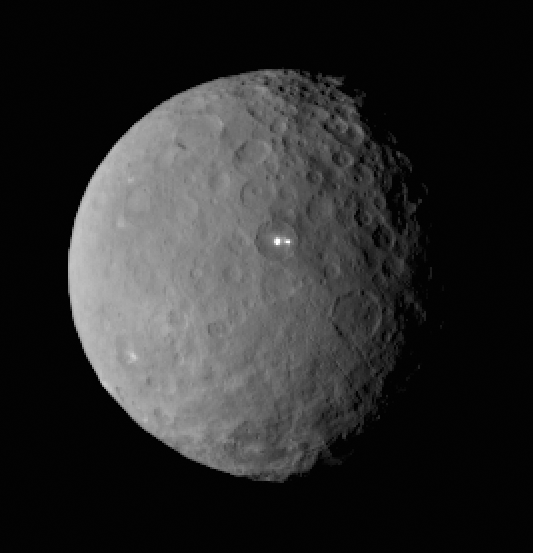
Then he focused on the bright feature. It is located in the floor of a crater 80 kilometers in diameter. From its behavior as the globe rotates, he said, the bright feature appears to lie in a depression. The images that have been released to the public from the rotation animation do not show all of the photos of the bright feature, so the next point concerns images that I can't show you. "What is amazing," he said, "is that you can see the feature while the rim is still in front of the line of sight. Therefore we believe at the moment that this could be some kind of outgassing. But we need higher resolution data to confirm this." What he is saying is that as Ceres' globe rotates and the 80-kilometer crater's rim rotates into view, that rim should block our ability to see the bright feature on the floor of the crater. However, the bright feature is already visibly bright as the crater begins to rotate into view. Therefore, it must be vertically above the rim of the crater: it must be some kind of plume. "During the day," Nathues went on, "the feature evolves: it brightens. At dusk it gets fainter; at late dusk it disappears completely. We see this for cometary activity."
He moved to color data, showing a global map of Ceres as seen through different-colored filters. There was a striking asymmetry to the color: one hemisphere was much more red and the other much more blue. The images were taken from too great a distance to resolve the bright spot; it is smaller than 4 kilometers across. So they can say that its albedo is at least 0.4 (meaning that it reflects at least 40% of the light that strikes it), but it could be much higher. The color information over the spot is consistent with an icy surface, but this is not a unique interpretation. The feature has variable brightness with time: its brightness increases strongly as seen through the 550-nanometer filter around local noon.
Obviously, active outgassing on Ceres would be a big deal, if it really exists. Fortunately, Dawn will get much closer and will take much better images, which will hopefully confirm this discovery!
NASA / JPL / UCLA / MPS / DLR / IDA
Approaching Ceres: one bright spot turns into two
Dawn captured this image of Ceres during its Rotation Characterization 2, on February 19, 2015. This photo includes the enigmatic bright spot, which has now separated into two bright spots, both of them still smaller than the resolution of the camera (which is roughly 4 kilometers per pixel at a distance of 46,000 kilometers). This image has been enlarged by a factor of two from the original data.
The last talk on actual Dawn data was given by Francesca Zambon, on the imaging spectrometer data, showing global maps. The spatial resolution of her map is only 11 kilometers per pixel at the moment, which is relatively coarse, but still better than Hubble. As was evident in Nathues' maps, Zambon's VIR maps showed a red hemisphere and a blue hemisphere; the bright spot is located at 20 degrees north, 240 degrees east, near the middle of the blue hemisphere. She showed some early temperature maps of Ceres' surface, and a surprising result: the bright spot showed no obvious temperature contrast with the area around it. But a different bright spot, the splash crater located at 4 degrees north, 8 degrees east, is markedly colder than the area around it. (You would expect cooler temperatures for brighter surfaces, all else being equal.)
The rest of the talks in the Ceres session concerned Earth-based observations, geophysical modeling, and future Dawn work. One of the interesting talks from that part of the session was by Tim Titus, who tried to use modeling to figure out where the "snowline" on Ceres is -- that is, the latitude at which ice is stable at the surface. Ceres has nights and days, of course, so the surface temperature varies with time, but those variations die out as you go beneath the surface. Titus defined locations where the subsurface never gets above 145 kelvins to be the location of the snowline on Ceres. For a variety of possible surface properties, a smooth surface would have a snowline somewhere between 40 and 60 degrees. If that surface is roughened (by, say, impact craters), then the snowline shifts poleward. So near-surface ice is stable near the poles, and comet-like ice sublimation could happen there, especially with help from seasonal heating or a meteor impact. On the other hand, plume activity at lower latitudes -- like the 20-degree-north position of the bright spot -- is happening in a place where near-surface water ice is not stable. Activity there would need to originate in a source of water ice that gets recharged somehow, such as by cryovolcanism. Of course, as Andy Rivkin pointed out during the question period, a sufficiently big impact could expose much more deeply-buried ice; he asked if Titus had modeled how often impacts would be expected to expose such deep ice. Titus replied that this was beyond the scope of his work.
A related talk, by Norbert Schorghofer, concerned a prediction for the GRaND neutron spectrometer results, which will not be able to begin acquiring quality science data until Dawn is in its lowest orbit, much later this year. Schorghofer's models suggest that Dawn GRaND should detect water ice within half a meter of the surface of Ceres, and he predicted that GRaND would observe this ice poleward of 60 degrees latitude. This assumes Ceres' current obliquity, which is very slight at only 3 degrees. As he spoke, I wondered if Ceres' spin axis has tilted more than this in the past, as Earth's and Mars' do. And later in the talk, he answered this question: even if Ceres' obliquity has varied, the prediction is still that there will be near-surface ice poleward of 60 degrees latitude. "This prediction can go wrong, but then it would mean something," he said. It could mean Ceres has lost a lot of near-surface volatiles due to impacts; or there has been true polar wander; or lots of dessication during an early period of radiogenic heating.
I enjoyed a later talk given by Thomas Davison on the shapes of Ceres' largest impact craters and how they may serve as a sensitive probe of the subsurface structure of Ceres. He modeled Ceres in three ways: with a dry olivine core; with a much wetter, serpentine core; and with a "mudball" core of mixed rock and water. Then he struck his model Ceres with asteroids of different sizes, arriving with speeds of 4 kilometers per second. In general, the mudball Ceres produced incredibly flat-floored craters, and the impact had little effect on the core-mantle boundary. The dry-core Ceres tended to produce the most surface topography, with prominent central peaks. The hydrated-core Ceres had more topography and prominent uplift of the core-mantle boundary underneath the crater. This kind of uplift would be obvious as a concentration of mass beneath the crater in Dawn's gravity data. Now, over geologic time, the original shapes of the craters may have been modified by relaxation, as ice flows from high places to low places to even out the surface; but the different appearance of the core-mantle boundary between the three cases should be visible in gravity maps.
All in all, there is a lot to look forward to on Dawn, and I can't wait for more pictures from closer orbits!
NameExoWorlds
http://www.nameexoworlds.org/

I would call it "ASTRONOMASTICS"
I would call it "ASTRONOMASTICS"
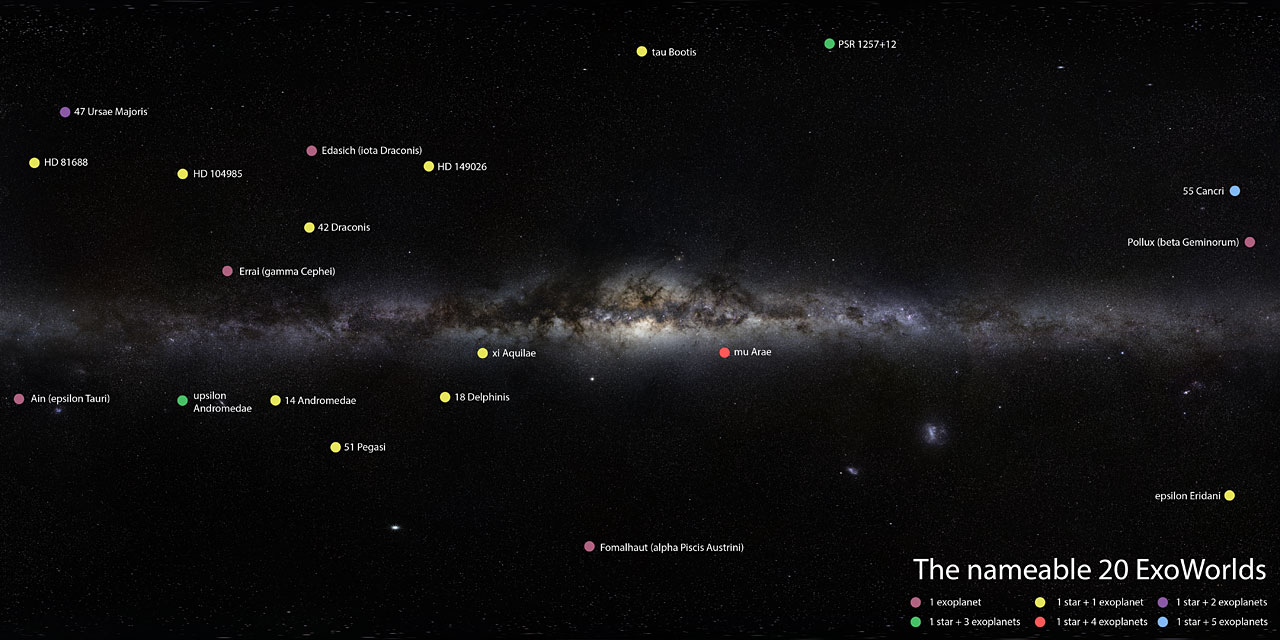
The NameExoWorlds contest, organised by the IAU and Zooniverse, is now entering its next stage. The 20 most popular ExoWorlds have been made available for naming proposals from registered clubs and non-profit organisations.
Although people have been naming celestial objects for millennia, the IAU has the task of assigning scientifically recognised names to newly discovered celestial bodies by its member countries. The NameExoWorlds contest provides not only the first opportunity for the public to name exoplanets, but also, for the first time in centuries, to give popular names to some stars — those that have known exoplanets in orbit around them.
The list of the 20 ExoWorlds can be found here. Some of them are single-planet systems, while others are multiple-planet systems. Each organisation can submit one naming proposal, for one ExoWorld only. The number of names that need to be submitted depends on which system is selected. For single- and multiple-planet systems, a name for each planet must be submitted, as well as one for the host star. In the 20 ExoWorlds list, five stars already have common names. Consequently, these five stars cannot be considered for public naming. There are 15 stars and 32 planets (47 objects in total) available for naming. The name of the 20 host stars are explained and personal messages from some discoverers are also available here.
To participate in the contest, clubs and non-profit organisations must first register with the IAU Directory of World Astronomy. The deadline for registrations has been extended to 23:59 UTC on 1 June 2015.
The naming proposals can be submitted here. All naming submissions having to abide by the IAU Exoplanet naming conventions and must be supported by a detailed argument for their choice. The deadline for submitting naming proposals is 23:59 UTC on 15 June 2015.
Once this stage has concluded, the public worldwide will be invited to vote on their favourite proposed names.
The final results are expected to be announced at a special public ceremony held during the IAU XXIX General Assembly in Honolulu, USA, 3–14 August 2015.
More information
The IAU is the international astronomical organisation that brings together more than 10 000 professional astronomers from almost 100 countries. Its mission is to promote and safeguard the science of astronomy in all its aspects through international cooperation. The IAU also serves as the internationally recognised authority for assigning designations to celestial bodies and the surface features on them. Founded in 1919, the IAU is the world's largest professional body for astronomers.
Contacts
Sze-leung Cheung
IAU International Outreach Coordinator
Tokyo, Japan
Tel: +81-(0)422-34-3896
Cell: +852- 54253118
Email: cheungszeleung@iau.org
IAU International Outreach Coordinator
Tokyo, Japan
Tel: +81-(0)422-34-3896
Cell: +852- 54253118
Email: cheungszeleung@iau.org
Thierry Montmerle
IAU General Secretary / Institut d'Astrophysique de Paris
Paris, France
Tel: +33 1 43 25 83 58
Email: montmerle@iap.fr
IAU General Secretary / Institut d'Astrophysique de Paris
Paris, France
Tel: +33 1 43 25 83 58
Email: montmerle@iap.fr
Chris J. Lintott
Zooniverse, Citizen Science Alliance, University of Oxford
Oxford, United Kingdom
Tel: +44 7808 167288
Email: cjl@astro.ox.ac.uk
Zooniverse, Citizen Science Alliance, University of Oxford
Oxford, United Kingdom
Tel: +44 7808 167288
Email: cjl@astro.ox.ac.uk
Subscribe to:
Posts (Atom)