Showing posts with label British placenames. Show all posts

Thursday, February 4, 2021

Borgue Field Names Talk on the 10th February 2021

 link 

Over the last 18 months a small team of local volunteers have collected and mapped nearly 1,000 field names analysing the meaning and possible origin of every name gathered.

Old field names act as a memorial, telling the story of the way the land was farmed and making connections between people and places, past and present.

Speakers Rachel Lucas, John Shields and Michael Ansell will describe how the names were collected and analysed, where you can find the results as well as presenting some of the research behind local field names.

February 10th 7.00pm

To register please contact secretary@kirkcudbrighthistorysociety.org.uk by February 5th.

Your initial email will be responded to, followed by an email confirming registration on 6th. If you don’t receive this email, please contact the same email address again. The invitation will be sent out on the 8th.

Monday, September 28, 2020

2020 SNSBI Autumn Zoom Conference

 SNSBI

17 October 2020: SNSBI autumn half-day conference (online).


A morning of short papers on personal and place-names of the UK from Keith Briggs, Kathryn Bullen, Thomas Clancy, Clare Green, and Paul Tempan. For those not familiar with Zoom, there will be advice on how to access and use it, and an opportunity for a practice session. Non-members are welcome to attend, though if necessary numbers may have to be limited. The conference is free but booking is essential. Further details on the booking process will follow in a few days.

1000 – 1110 Session 1 – Personal names

Keith Briggs The first girls in England

The words ‘boy’ and ‘girl’ are both of very obscure etymology. Both are attested as personal names before lexical use starts to be recorded about 1300, but whether the anthroponymic evidence is of any value for the history of the words is controversial. This paper points out that ‘girl’ occurs as a byname throughout the thirteenth century, but only in East Anglia. This allows speculation that the word originated in the east, possibly as a borrowing from a continental language heard in the coastal ports. The talk is based on a paper available here.

Clare Green (SOAS, University of London) Naming Welsh-speaking children: case studies from London and Gwynedd

Many factors go into choosing children's names, and for multilingual families there are extra issues to consider. Should the name represent all the family’s languages? How much should it take into account the linguistic environment the family lives in? Does the chosen name predict the language(s) a child will speak as they grow up? This paper looks at two families with a first-language Welsh-speaking parent, living in very different linguistic landscapes: one in London and one in Gwynedd, North Wales. Based on qualitative interviews with parents, it explores how they chose their children's names, the influence of their Welsh-speaking heritage, and how the decisions reflect their linguistic attitudes and practices. This research uses names as a medium to learn about personal experiences of multilingualism and family language policy. This paper is based on research for a Masters dissertation in Language Documentation and Description.

1110 – 1125 break

1125 – 1300 Session 2 – Place-names

Paul Tempan Names in the Irish built environment transferred due to a common function

Abstract to follow.

Kathryn Bullen (University of Nottingham) Axholme – place-names in the marsh

In this talk I will take you on a journey into the bogs and moors of the Isle of Axholme, situated in north Lincolnshire. The presentation will give an overview of my current PhD research, which aims to assess the impact of language, history, and landscape on place-names on the Isle of Axholme. I will explore the background to the project, demonstrate some of the evidence I have collected so far, and ask how what we know of the past can help manage future challenges.

Thomas Clancy (University of Glasgow) Iona's Namescape: place-names and their dynamics in Iona and its environs (report on a new project)

Abstract to follow.

Sunday, January 19, 2020

New Peace IV funded book captures ‘Placenames and Fieldnames of Culfeightrin’

source

The community-led project was supported by Causeway Coast and Glens Borough Council’s Museum Services. The initiative was funded by the European Union’s PEACE IV Programme, which is managed by the Special EU Programmes Body, under the theme ‘Understanding Our Area – People and Places’ which forms part of the Council’s £3.8m Local Authority Action Plan.

The book will help to preserve many of the unique names which exist in the area and will serve as an important record for generations to come. The launch was attended by members of the local community, including those who made valuable contributions to the project by sharing their knowledge and historical information.

After two years of hard work, a range of cross community projects like this new book are nearing completion in many areas of the Borough. The PEACE IV Funding has encouraged increased expression and understanding of our people and places, through museum collections, historic sites and cultural heritage using interpretation, arts and multimedia to create a peace building legacy.

You can read ‘Placenames and Fieldnames of Culfeightrin’ online now by going to www.niarchive.org and a reference copy available is available in Causeway Museum Services Resource Area in Ballymoney Town Hall.

Thursday, December 5, 2019

Lecture "Language, Landscape and Place-Names in Medieval Staffordshire"

link

Dr Jayne Carroll: Language, Landscape and Place-Names in Medieval Staffordshire

Associate Professor in the History of English and Director of the Institute for Name-Studies at the University of Nottingham
Start: 7th December 2019 2:00pm
Details:
Free public lecture, no need to book. But, for further details contact
Dr Andrew Sargent at a.sargent1@keele.ac.uk


Location:
Westminster Theatre, Keele University. 

Wednesday, January 24, 2018

Saturday, January 7, 2017

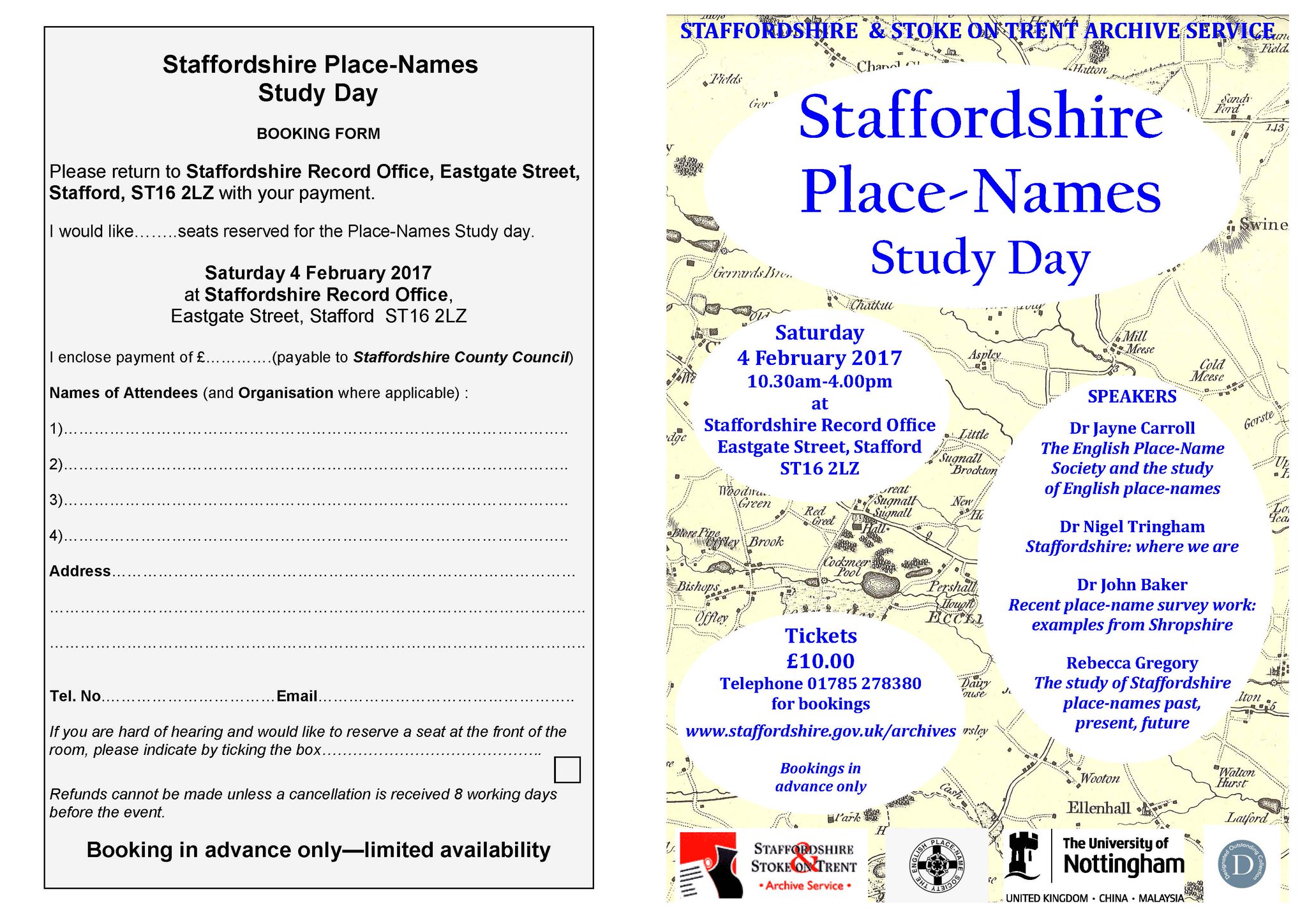
Staffordshire Place-Names Study Day

http://www.nottingham.ac.uk/research/groups/ins/events/2016-17/04-02-2017-staffordshire-place-names-study-day.aspx

Interested in ? Want to get involved in the latest research? Join us for a study day in Stafford on 4th February to find out more.


Location
Staffordshire Record Office
Date(s)
Saturday 4th February 2017 (10:30-16:00)
Contact
Staffordshire Record Office, 01785 278380


Join us at the Staffordshire Record Office for a study day introducing an exciting new volunteer project on Staffordshire place-names, run by the Record Office and the Institute for Name-Studies. Jayne CarrollJohn Baker and Rebecca Gregory from the INS will be giving talks, as well as Dr Nigel Tringham, County Editor for the Victoria County History of Staffordshire.
There will also be opportunities to discover research conducted as part of The Place-Names of Shropshire project, and to see some of the documents we'll be using in our Staffordshire work.
Download the booking form and reserve your place today!


Thursday, October 6, 2016

Richard Coates on the Radio

http://www.snsbi.org.uk/pdf/SNSBI_Newsletter_13.pdf


Richard Coates, Professor in Linguistics at the University of the West of England, and a well known SNSBI member featured in the Radio 4 programme Word of Mouth. 


Michael Rosen talks to Dr Laura Wright about her new research on popular house names, from Foo Choo Villas to Nutty Hagg to Orchard Cottage, and what this tells us about our history. 

She's uncovered why some houses have names but some have numbers, and what this tells us about our history. 

Place names expert Professor Richard Coates joins them to talk about the origins of these words in the UK. 

The programme can be downloaded or heard as a pod cast at 
http://www.bbc.co.uk/programmes/b012qtbf

Saturday, January 31, 2015

The Rude British Place Name Quiz

http://www.buzzfeed.com/robinedds/the-rude-british-place-name-quiz#.yxXbvR2Ez

We found some of the rudest, most disturbing place names in Britain, and then made up some of our own. Can you tell the difference?
  1. 2. Correctly identify the former waste tip in Greater Manchester.
  2. 3. Which one of the following is an unfortunately named town in Dorset?
  3. 4. Which of these is a real place in Ross and Cromarty?
  4. 5. Which one of these would you find in the New Forest?
  5. 6. Which one of the following is a residential street in Haydock, Merseyside?
  6. 7. Believe it or not, one of these is a real road in Lincolnshire. But which one?
  7. 8. What do the English call the Welsh village of Aberllynfi?
  8. 9. Richard Whitely was honorary mayor of which town?
  9. 10. Correctly identify the Essex village.
  10. 11. Which of the following is a real place in rural Northamptonshire?
  11. 12. Which one of these is a village located 6 miles from Newcastle?
  12. 13. Which of these is a clifftop valley between Durdle Door and Swyre Head in Dorset?
  13. 14. In which Dorset village did Prince Harry once stay in with his then girlfriend, Chelsy Davy?
  14. 15. Which of these would you find in Stockton-on-Tees?