Showing posts with label Professor Richard Coates. Show all posts

Sunday, November 10, 2019

Your City's Place-Names: Cambridge

Amazon

by Richard Coates (2019)
This is latest publication within the series of books from the English Place-Name Society. It deals with the main place-names found on modern maps of some of England's largest towns and cities, and also includes some lost or forgotten older names which were once locally important.

Product details

  • Paperback: 128 pages
  • Publisher: English Place-Name Society (16 Oct. 2019)
  • Language: English
  • ISBN-10: 1911640003
  • ISBN-13: 978-1911640004

Thursday, October 6, 2016

Richard Coates on the Radio

http://www.snsbi.org.uk/pdf/SNSBI_Newsletter_13.pdf


Richard Coates, Professor in Linguistics at the University of the West of England, and a well known SNSBI member featured in the Radio 4 programme Word of Mouth. 


Michael Rosen talks to Dr Laura Wright about her new research on popular house names, from Foo Choo Villas to Nutty Hagg to Orchard Cottage, and what this tells us about our history. 

She's uncovered why some houses have names but some have numbers, and what this tells us about our history. 

Place names expert Professor Richard Coates joins them to talk about the origins of these words in the UK. 

The programme can be downloaded or heard as a pod cast at 
http://www.bbc.co.uk/programmes/b012qtbf

Saturday, January 31, 2015

Database of UK surnames has reached 45,000 entries dating back to the Middle Ages

http://www.medievalists.net/2014/04/14/database-uk-surnames-reached-45000-entries-dating-back-middle-ages/?utm_content=buffere6e6e&utm_medium=social&utm_source=twitter.com&utm_campaign=buffer

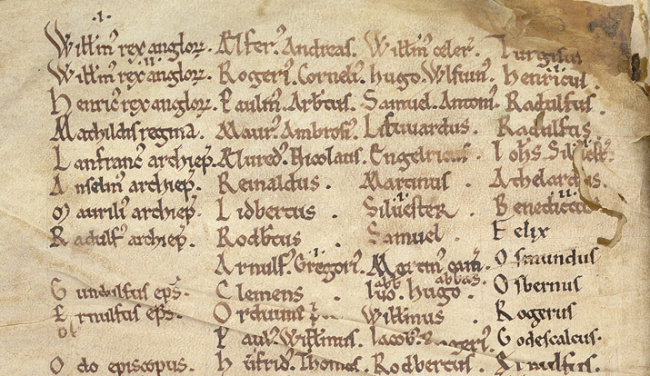
The ‘Family Names of the United Kingdom Project’, which is being carried out by a team at University of the West of England – Bristol, has reached a key milestone with the completion of the first phase of the database with 45,000 surnames researched and explained. The full dictionary of surnames is due to be published by Oxford University Press in 2016.
list of names
Professor Patrick Hanks and Professor Richard Coates have led a team of researchers which includes historical linguists, medieval historians, lexicographers and expert advisers on Irish, Scottish, Welsh, and recent immigrant names. The team analysed records from published and unpublished sources dating from the 11th to the 19th century to enable new and detailed explanations of names to be provided, which will be more reliable and up to date than those currently available. Each entry includes the frequency of the name, its main location, origins and references to documents in The National Archive, Parish Registers, and other sources, illustrating early occurrences of the name.
Professor Richard Coates explained, “There is widespread interest in family names and their history. Our research uses the most up-to-date evidence and techniques in order to create a more detailed and accurate resource than those currently available. We have paid particular attention, wherever possible, to linking family names to locations. Surnames are part of our identity, so most people are interested in knowing about their names. My main interest is in the linguistic side, in the language of origin and the original meaning of the names, but this research is interdisciplinary, drawing also on history, family history, place-name study, geography and official statistics.”
Professor Patrick Hanks added, “We very much hope that our database will be used in schools as well as by genealogists and the general public. I have found that by studying the origins of their own name and those of their classmates, children can be inspired to want to find out more about language and history in general.” 

Surnames covered in the research range from the very common to less well-known names with unusual origins.
The colourful name of Threadgold, with 730 bearers has its origins in the old English words for ‘thread’ and ‘gold’ for an embroiderer who used golden thread. It was first recorded in 1166 and now has numerous variants including the Norfolk name Trudgill. Most English surnames have several variant spellings. The Family Names project has tracked these down and explained them.
A far more common name, Parkin (Perkin, Parkyn, Parken, Perkins) first recorded in 1309, derives from Middle English Pere(s), from Norman French P(i)ere(s). The name has a wide geographical spread across Great Britain with 12,220 bearers of the name. Parkin is also the name of a popular cake common in Northern England.
One of those bearers is PhD student Harry Parkin, who was one of the team working on the project. Harry says, “It has been a fascinating project to work on. Drawing on linguistic and historical expertise we have been able to track and record the origins of many unusual and common names. Knowing the origins of my own name, gives me a sense of being connected to those other people in the past, even if we are not directly related. I think when it becomes available this database will be an interesting addition to the tools out there for genealogists, family historians, historical linguists, and anyone interested in learning more about their family name”.
The study included not only names of English and Scots origin but also names of Irish, Gaelic, Welsh, and Cornish origin as well as Huguenot and Jewish. Special procedures were developed to study recent immigrant names (i.e. those appearing after 1881) such as Indian, Chinese and a range of Muslim names, with the cooperation of overseas consultants.
The main product of the research will be a database accessible like an online dictionary, to be published by Oxford University Press in 2016, who also intend to publish it in book form. Each entry has separate fields which include: the meaning of the surname, the linguistic origin, the geographical origin, the distribution at the time of the 1881 census, and the modern numbers and distribution.
In January 2014, AHRC awarded UWE a further grant to continue the project so that surnames in the UK with more than 20 current bearers (instead of the present 100) could be included.
Source: UWE Bristol

Saturday, November 24, 2012

Professor of Onomastics Richard Coates

The next "hero of Onomastics" is Professor Richard Coates. Firstly, I have the privilege to know him personally, and in October 2012 I have been even invited for a job interview within his project FaNUK, which I will present a bit later. Secondly, as far as I know, in the European tradition and context, Prof. Coates is actually one among only two Professors of Onomastics in the UK (another one is already presented Prof. Carole Hough from the University of Glasgow, see below). For the rest of the Europe I can mention just some names with the same title: Prof. Jürgen Udolph, Prof. Enzo Caffarelli, etc


From wiki:


"Richard Coates (born 16 April 1949, in Grimsby, Lincolnshire) is an English linguist. He is professor of linguistics (alternatively professor of onomastics) at the University of the West of England, Bristol. From 1977 to 2006 he taught at the University of Sussex, where he served as professor of linguistics (1991–2006) and as Dean of the School of Cognitive and Computing Sciences (1998-2003). From 1980-9 he was assistant secretary and then secretary of the Linguistics Association of Great Britain. He has been honorary director of the Survey of English Place-Names since 2003, having previously (1997–2002) served as president of the English Place-Name Society which conducts the Survey.


From 2002 to 2008, he was secretary of the International Council of Onomastic Sciences, a body devoted to the promotion of the study of names, and elected as one of its two vice-presidents from 2011-14. He was elected a fellow of the Society of Antiquaries in 1992 and of the Royal Society of Arts in 2001.
His main academic interests are proper names (from both the historical and the theoretical perspective), historical linguistics in general, the philology of the Germanic, Romance and Celtic languages, regional variation in language, and local history. He is editor of the Survey of English Place-Names for Hampshire and principal investigator of the AHRC-funded project Family Names of the United Kingdom (FaNUK), running from 2010-14, of which Patrick Hanks is lead researcher.

Prof. Coates has written books on the names of the Channel Islands, the local place-names of St Kilda, Hampshire and Sussex, the dialect of Sussex, and, with Andrew Breeze, on Celtic place-names in England, as well as about 400 academic articles, notes, and collections on related topics. In 1998, he introduced a new etymology of the name London, deriving it from the pre-Celtic Old European *(p)lowonidā, meaning 'boat river' or 'swim river', i.e. 'river too wide or deep to ford', and suggested that this was a name given to the part of the River Thames which flows through London; from this, the settlement gained the Celtic form of its name, *Lowonidonjon, by suffixation. His main contribution to linguistic theory is The Pragmatic Theory of Properhood, set out in a number of articles since 2000. (By the way, I have been the first who explained and introduced this theory in French in my PhD thesis of 2009!!!)

He is also the author of Word Structure, a students' introduction to linguistic morphology (Routledge), and of online resources on Shakespeare's character-names and on the place-names of Hayling Island.

Coates has often been cited as a lookalike of former The Velvet Underground singer Lou Reed, with whom he shares a striking resemblance."

The last sentence sounds interesting enough. Let's compare. Here is Lou Reed:


Well, well, well, I doupt a lot. There are some resemblant features, but they are not so striking like that...