Showing posts with label British surnames. Show all posts

Wednesday, August 15, 2018

Expert on British surnames Dr George Redmonds of Lepton has died

Examiner byRobert Sutcliffe


He had a wonderful gift for languages and study says former Wakefield MP David Hinchliffe


An internationally recognised historian who specialised in the origin of surnames and place names has died aged 82.
Dr George Redmonds, of Lepton, died in Huddersfield Royal Infirmary on Friday, August 10. The funeral service will be held at St John’s Church, Lepton, on Wednesday, August 29, at 2pm.
He was born in Bradford, and taught for several years at Huddersfield New College and gave up his secure job as a senior lecturer at the former Huddersfield Polytechnic to become a freelance historian in 1974, earning a living through his local history publications.
His widow, Ann-marie, nee Burke, recalls them determining at the time that if they could earn £40 a week they would manage and she helped the family income through a pottery shop. The couple met at a jazz club in Northumberland Street in October 1962 and got married at LindleyMethodist Church, on 27 July 1963.
They went on to have three children and two grandchildren. Ann-marie said: “We know that he is well-known in the academic world, but we knew him as a wonderful husband, dad and grandad and however much he is missed by others, we will miss him more.”
George studied at Birmingham University before teaching modern languages in London, Nairobi, West Germany, (as was), and his native Yorkshire. He was awarded a PhD at Leicester University in 1970 for his research into Yorkshire surnames , and in 1973 his work was published as Volume 1 of the English Surnames Series.
David Hinchliffe, who was MP for Wakefield between 1987 and 2005, said: “Dr Redmonds’ family and place name work was based on the apparently simple proposition that the only way to find real meaning and understanding was to look at their very earliest written appearances. “His language skills enabled him to master the complexities of medieval Latin to remarkable effect, from which came significant findings on the origins of family names.
“Along with his good friend, Dr David Hey, Prof Stanley Ellis and others, George Redmonds was arguably one of the scholars who, in the late 20th century, helped validate the study of Yorkshire’s local history as a serious and important activity. “He lectured extensively to local history classes and societies and family historians, travelling to Australia, New Zealand and the USA to speak on the origins of English surnames. He enjoyed showing visitors to this country from abroad the locations from where their surnames came.
“Along with other local historians, Cyril Pearce and Jennifer Stead, he helped to produce many editions of the journal Old West Riding which ran from 1981-1995. It was seen as a vehicle for the growing number of amateur historians to publish their work.
“In 2001 he presented the BBC Radio 4 Series Surnames Genes and Genealogy.
“His many published works included Surnames and Genealogy: a New Approach (1997), Names and History (2004), Christian Names in Local and Family History (2004) and, along with Turi King and David Hey, Surnames, DNA and Family History (2011). “In 2015, Dr Redmonds produced his extensive Dictionary Of Yorkshire Surnames with thousands of entries, giving the names’ linguistic meanings, geographic origins and distribution.

“Throughout his many years researching records, often from the medieval period, he kept meticulous notes of what he found, which enabled him also to produce The Vocabulary of Coal Mining In Yorkshire, 1250-1850 in 2016 and A Vocabulary of Wood, Wood Workers and Wood Management in Yorkshire last year. His Yorkshire Historic Dictionary is also due to be published in the near future.
“Away from his research work, Dr Redmonds and his wife were staunch supporters of the Huddersfield Giants rugby league team.”


Saturday, March 21, 2015

Upgrades for the Surname Atlas

http://www.archersoftware.co.uk/satlas01.htm

logo

Surname Atlas

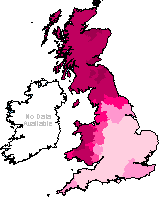
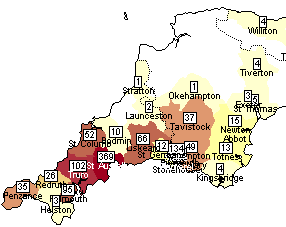
The British 19th Century Surname Atlas is a fully interactive CD-Rom product that displays floodfill-style distribution maps for all of the surnames and forenames found in the 1881 census of England, Scotland and Wales. Using the program is simplicity itself: just insert the CD in your drive and wait for it to load. Then enter a surname in the data entry box and hit enter. A map for that surname appears almost instantly, similar to the example shown here for the surname Cunnington. For more examples, see the Example Maps page.


These are some of its features:
  • Display any of the 400,000+ surnames & variants that appear in the 1881 census. In many cases the maps will indicate the probable geographical origin of a surname.
  • Similarly plot any of the 160,000+ forenames, and view their popularity through time.
  • Aggregate data by county or district.
  • Plot data as actual numbers, or a density ('per 100,000' of the population).
  • Include any collection of name variants on each map.
  • Investigate surname elements using wildcards (e.g. *thorpe)
  • Display lists of surnames characteristic of particular counties
  • Show one or four surname maps at any one time.
  • Zoom and pan the maps to frame exactly the area you want to see.
  • Configure colours schemes, boundaries & numeric ranges.
  • Print maps, or export to the Windows clipboard.

The original version of Surname Atlas was launched in April 2003 and the current version in March 2015. See the Upgrades page to see what's changed.
It's attractively priced at only £15 and is available direct from Archer Software - see Supply Details.

System Requirements

These are fairly modest - a PC running Windows 8/7/Vista/XP/98, CD-Rom drive, 16Mb memory, screen set to 1024x768 pixels or greater.

Saturday, January 31, 2015

Database of UK surnames has reached 45,000 entries dating back to the Middle Ages

http://www.medievalists.net/2014/04/14/database-uk-surnames-reached-45000-entries-dating-back-middle-ages/?utm_content=buffere6e6e&utm_medium=social&utm_source=twitter.com&utm_campaign=buffer

The ‘Family Names of the United Kingdom Project’, which is being carried out by a team at University of the West of England – Bristol, has reached a key milestone with the completion of the first phase of the database with 45,000 surnames researched and explained. The full dictionary of surnames is due to be published by Oxford University Press in 2016.
list of names
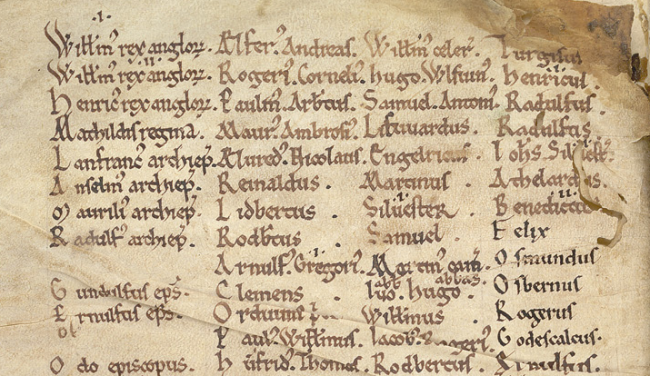
Professor Patrick Hanks and Professor Richard Coates have led a team of researchers which includes historical linguists, medieval historians, lexicographers and expert advisers on Irish, Scottish, Welsh, and recent immigrant names. The team analysed records from published and unpublished sources dating from the 11th to the 19th century to enable new and detailed explanations of names to be provided, which will be more reliable and up to date than those currently available. Each entry includes the frequency of the name, its main location, origins and references to documents in The National Archive, Parish Registers, and other sources, illustrating early occurrences of the name.
Professor Richard Coates explained, “There is widespread interest in family names and their history. Our research uses the most up-to-date evidence and techniques in order to create a more detailed and accurate resource than those currently available. We have paid particular attention, wherever possible, to linking family names to locations. Surnames are part of our identity, so most people are interested in knowing about their names. My main interest is in the linguistic side, in the language of origin and the original meaning of the names, but this research is interdisciplinary, drawing also on history, family history, place-name study, geography and official statistics.”
Professor Patrick Hanks added, “We very much hope that our database will be used in schools as well as by genealogists and the general public. I have found that by studying the origins of their own name and those of their classmates, children can be inspired to want to find out more about language and history in general.” 

Surnames covered in the research range from the very common to less well-known names with unusual origins.
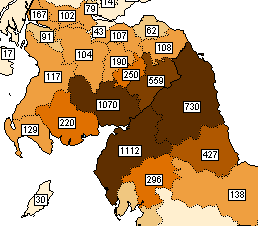
The colourful name of Threadgold, with 730 bearers has its origins in the old English words for ‘thread’ and ‘gold’ for an embroiderer who used golden thread. It was first recorded in 1166 and now has numerous variants including the Norfolk name Trudgill. Most English surnames have several variant spellings. The Family Names project has tracked these down and explained them.
A far more common name, Parkin (Perkin, Parkyn, Parken, Perkins) first recorded in 1309, derives from Middle English Pere(s), from Norman French P(i)ere(s). The name has a wide geographical spread across Great Britain with 12,220 bearers of the name. Parkin is also the name of a popular cake common in Northern England.
One of those bearers is PhD student Harry Parkin, who was one of the team working on the project. Harry says, “It has been a fascinating project to work on. Drawing on linguistic and historical expertise we have been able to track and record the origins of many unusual and common names. Knowing the origins of my own name, gives me a sense of being connected to those other people in the past, even if we are not directly related. I think when it becomes available this database will be an interesting addition to the tools out there for genealogists, family historians, historical linguists, and anyone interested in learning more about their family name”.
The study included not only names of English and Scots origin but also names of Irish, Gaelic, Welsh, and Cornish origin as well as Huguenot and Jewish. Special procedures were developed to study recent immigrant names (i.e. those appearing after 1881) such as Indian, Chinese and a range of Muslim names, with the cooperation of overseas consultants.
The main product of the research will be a database accessible like an online dictionary, to be published by Oxford University Press in 2016, who also intend to publish it in book form. Each entry has separate fields which include: the meaning of the surname, the linguistic origin, the geographical origin, the distribution at the time of the 1881 census, and the modern numbers and distribution.
In January 2014, AHRC awarded UWE a further grant to continue the project so that surnames in the UK with more than 20 current bearers (instead of the present 100) could be included.
Source: UWE Bristol