Showing posts with label Greek names. Show all posts

Sunday, February 25, 2024

CfP "Onomastics of the Northern Regional type of Greek pronunciation"

 link

IN MEMORY OF HARALAMBOS P. SYMEONIDIS

The Board of Directors of the Greek Onomastic Society unanimously decided to publish a commemorative volume of «ΟΝΟΜΑΤA» journal in honor of the spiritual memory of the recently deceased Haralambos P. Symeonidis, this great Linguist, Dialectologist, and Onomastician who undoubtedly marked linguistic studies in Greece with his rich and multifaceted work. 

The theme of the volume will be "Onomastics of the Northern Regional type of Greek pronunciation". 

The Greek Onomastic Society invites its members and any other researcher interested to submit for approval, by September 30, 2024, an original scientific article of onomastic content, referring to areas of Greece where Northern phonetics prevail, in order to be published in the aforementioned commemorative volume. The article, accompanied by the contact details of the authors (full name, affiliation, contact phone, and email address), must be sent to the members of the Editorial Committee.


Monday, March 21, 2016

Conference "Onomastic Change in the Greco-Roman World"

http://www.lgpn.ox.ac.uk/announcements/index.html

Conference Announcement


The Lexicon of Greek Personal Names is holding a conference in the Ioannou School, 66 St Giles, Oxford on April 5 and 6, 2016, on ‘Onomastic Change in the Greco-Roman World’.


The provisional programme is:

Tuesday, April 5
Dr Torsten Meissner
9.00 Welcome

9.15 Torsten Meissner, "Greek or Minoan? Names and Naming Habits in the Aegean Bronze Age"


10.15 Christof Schuler, “Lycian, Persian, Greek, Roman: Chronological Layers and Structural Developments in the Onomastics of Lycia."


11.15 Coffee


11.45 Denis Knoepfler, "Les quatre saisons de l'onomastique béotienne (et plus particulièrement thespienne)."

Hatzopoulos
      
12. 45 Lunch break
      
2.30 Miltiades Hatzopoulos, "Aigeai and Pella: an Onomastic Tale of Two Cities in Macedonia."


3.30 Stephen Lambert , "Demokrates the Dr Stephen Lambert Democrat?"


4.30 Tea
      

5.00 Jean-Sebastien Balzat, “The Adoption of Roman Onomastics in the Greek Cities."


       Wednesday, April 6

9.15 Heikki Solin, “On the Survival of Greek Personal Names in Magna Graecia under Roman Rule.”


10.15 Dan Dana, “Onomastic Interactions: Greek and Thracian names.”


11.15 Coffee
      
11.45 Athanasios Rizakis, “Acculturation in the Greco-Roman East: Cultural and Legal Implications of the Use of Roman Names.”


12.45 Lunch break
      

2.30 Sylvain Destephen, "Global Christianisation and Local Onomastics : Rise and Decline in late Antiquity."
      
3.30 Jaime Curbera, ‘What Satyr-Names can tell us about Greek Onomastics and Vocabulary. ’


4.30 Tea

5. 00 Thomas Corsten, “Name Changes by Individuals.”


     All are welcome to attend without charge, but please contact robert.parker@new.ox.ac.uk if you plan to attend.  

Saturday, January 2, 2016

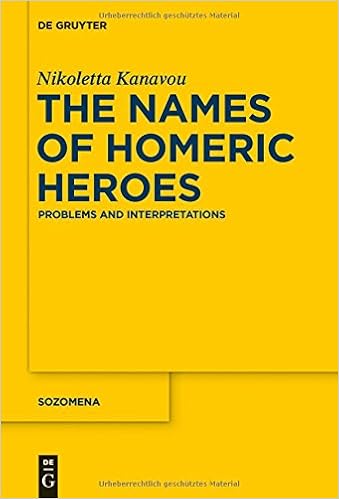
The names of Homeric heroes

http://www.degruyter.com/view/product/449614


The Names of Homeric Heroes: Problems and Interpretations (Sozomena) (Englisch) 30. September 2015


The purpose of this book is to contribute to the appreciation of the linguistic, literary and contextual value of Homeric personal names. It considers both epics and is structured around the character and action of selected heroes in their Homeric contexts. It offers a survey of modern etymologies, set against ancient views, in order to shed light on the parameters surrounding the use of names in Homer and on their reception by ancient audiences.

This is an old topic, which famously interested Plato, and an object of constant scholarly attention from the time of ancient commentators to the present day. The book begins with an introduction to the particularly complex set of factors that affect all efforts to interpret Homeric names. The main chapters are structured around the character and action of selected heroes in their Homeric contexts (in the case of the Iliad, a heroic war; the Odyssey chapter encompasses more than one planes of action). They offer a survey of modern etymologies, set against ancient views on names and naming, in order to reconstruct (as far as possible) the reception of significant names by ancient audiences and further to shed light on the parameters surrounding the choice and use of personal names in Homer. An Appendix touches on the underexplored career of Homeric personal names as historical names, offering data and a preliminary analysis.