Showing posts with label Names. Show all posts

Saturday, May 9, 2026

Names, Places, Laws, and Literature: Acta Onomastica, Vol. 67/1 (2026)

 The new issue of Acta Onomastica - Vol. 67, No. 1 (2026) - arrives with thirteen peer-reviewed articles spanning urbanonymy, historical toponymy, anthroponymy, literary onomastics, etymology, and socio-onomastics across a remarkably broad geographic and linguistic canvas, from Ukraine and Romania to Hungary, Slovakia, Czech Bohemia, and the Carpathian Basin.

The issue opens with a theoretical contribution by Ján Bauko on toponomastics and translatology, examining the translation of urbanonyms in bilingual environments - a question of growing relevance wherever minority languages and official nomenclature compete for the same street signs. Andrea Bölcskei and Gábor Mikesy then turn to Hungarian place names as evidence of historical relations between Moravians, Czechs, and Hungarians - a reminder that toponyms are political archives as much as linguistic ones.

Jaroslav David offers what may be the issue's most theoretically ambitious contribution: a new perspective on the honorific motive in place naming, revisiting a concept central to modern urbanonymy with fresh analytical tools. David appears again near the end of the issue, co-authoring with Anna Laura Kolláth a study of how street name changes in Miskolc, Hungary between 1989 and 1993 were reflected in the regional newspaper Észak-Magyarország - a case study in how the press mediates the politics of renaming after regime change. David also contributes a review of Slovenská onomastická terminológia by Iveta Valentová and colleagues, a major terminological reference for Slovak onomastics.

Jana Davidová Glogarová and Tereza Klemensová explore the proprial landscape of postmodernism through the prose of Czech writers Michal Ajvaz and Miloš Urban - a literary onomastics study that asks what proper names do in fiction when reality itself becomes unstable. Žaneta Dvořáková and Andrea Bartíková take a legal-historical angle, tracing the history of regulations and laws governing surnames in the Czech lands and examining expert surname assessments and court disputes - a study that bridges onomastics and legal history in ways rarely attempted.

Oliviu Felecan contributes a socio-onomastic study of Czechs and Slovaks in Romania, exploring how naming practices reflect identity, minority status, and cultural memory in a diaspora context. Ilona Janyšková and Helena Karlíková tackle the methodological challenges of etymologising proper names in etymological dictionaries - a metatheoretical reflection on how onomastics and historical linguistics interface at the lexicographic level.

From Ukraine, Olga Klimkina examines the names given to new residential developments in Kyiv through the lens of speech influence theory, and Tetyana Kosmeda, Oksana Kovtun, and Vitaliya Papish analyse verbal innovations derived from anthroponyms - the productive, often subversive process by which proper names become verbs in Ukrainian. Judit Kozma, Zsófia Ludányi, and Dorottya Jakab present a corpus-based study of morphological variation in Hungarian proper names, drawing on inquiries received by the Hungarian Language Consulting Service — the most-viewed article in this issue, reflecting the practical demand for normative guidance on name inflection.

Two contributions round out the toponymic section: František Kožíšek investigates the origin of the Czech toponym Hladové vody (Hungry Waters), and Martina Zirhutová maps the distribution of the appellative borovice (Scots pine) and its dialectal variants in minor place names across Bohemia.

The issue closes with a tribute by Soňa Wojnarová to the life anniversary of Miloslava Knappová - one of the most important Czech onomasticians of the twentieth century - a review by Martina Ptáčníková of Justyna B. Walkowiak's two-volume Nazwy ulic Poznania, onomastic news compiled by the editorial team, and Žaneta Dvořáková's overview of 25 years of advisory activity by the Department of Onomastics of the Czech Language Institute (2000–2025).

The full issue is freely available at asjournals.lib.cas.cz/actaonomastica.


Česky

Jména, místa, zákony a literatura: Acta Onomastica, ročník 67/1 (2026)

Nové číslo časopisu Acta Onomastica - ročník 67, číslo 1 (2026) - přináší třináct recenzovaných studií, které pokrývají urbanonymii, historickou toponymii, antroponymii, literární onomastiku, etymologii i socioonomastiku na pozoruhodně širokém geografickém a jazykovém záběru: od Ukrajiny a Rumunska přes Maďarsko, Slovensko a česky mluvené Čechy až po karpatský prostor.

Číslo otevírá teoretický příspěvek Jána Bauka věnovaný toponomastice a translatologii - konkrétně překladu urbanoným v bilingválním prostředí, otázce stále naléhavější všude tam, kde si menšinové jazyky a oficiální nomenklatura konkurují na stejných uličních tabulích. Andrea Bölcskei a Gábor Mikesy pak využívají maďarská místní jména jako pramen poznání historických vztahů mezi Moravany, Čechy a Maďary - doklad toho, že toponyma jsou politickými archivy stejně tak jako jazykovými.

Teoreticky nejambicióznější příspěvek čísla přináší pravděpodobně Jaroslav David: nabízí novou perspektivu honorifikačního motivu v pojmenování míst a přistupuje k tomuto ústřednímu pojmu moderní urbanonymie s novými analytickými nástroji. David se v čísle objevuje i jako spoluautor: společně s Annou Laurou Kolláth zkoumá, jak byl v regionálním deníku Észak-Magyarország reflektován přejmenovávání ulic v Miskolci v letech 1989–1993 - případová studie o tom, jak tisk zprostředkovává politiku přejmenování po změně režimu. David rovněž přispívá recenzí terminologické příručky Slovenská onomastická terminológia Ivety Valentové a kolektivu.

Jana Davidová Glogarová a Tereza Klemensová se věnují propriální krajině postmodernismu v prózách Michala Ajvaze a Miloše Urbana - literárněonomastická studie, která klade otázku, co vlastní jména dělají v beletrii, když se samotná realita stává nestabilní. Žaneta Dvořáková a Andrea Bartíková přistupují k tématu z právněhistorické perspektivy: sledují vývoj předpisů a zákonů o příjmeních a analyzují znalecká posuzování příjmení i soudní spory - studie, která propojuje onomastiku a právní dějiny způsobem, k němuž se badatelé příliš často neuchylují.

Oliviu Felecan přispívá socioonomastickou studií o Češích a Slovácích v Rumunsku, v níž pojmenovávací praktiky zrcadlí otázky identity, menšinového postavení a kulturní paměti v diaspoře. Ilona Janyšková a Helena Karlíková se zamýšlejí nad metodologickými úskalími etymologizování vlastních jmen v etymologických slovnících - metateoretická reflexe styčné plochy onomastiky a historické lingvistiky na úrovni lexikografie.

Z Ukrajiny přichází příspěvek Olgy Klimkinové o názvech nových zástaveb v Kyjevě nahlížených prismatem teorie řečového vlivu, a studie Tetyany Kosmedy, Oksany Kovtun a Vitaliji Papish analyzuje verbální inovace odvozené od antroponym — produktivní, často subverzivní proces, jímž se vlastní jména stávají slovesy. Judit Kozma, Zsófia Ludányi a Dorottya Jakab předkládají korpusovou studii morfologické variace maďarských vlastních jmen na základě dotazů zaslaných Jazykové poradně - nejčtenější příspěvek tohoto čísla, dokládající praktickou poptávku po normativních doporučeních ohledně skloňování jmen.

Toponymickou část doplňují dva příspěvky: František Kožíšek pátrá po původu jména Hladové vody a Martina Zirhutová mapuje rozšíření apelativa borovice a jeho nářečních variant v pomístních jménech v Čechách.

Číslo uzavírá příspěvek Soňi Wojnarové k životnímu jubileu Miloslavy Knappové - jedné z nejvýznamnějších českých onomastiček dvacátého století — recenze dvousvazkové práce Justyny B. Walkowiak Nazwy ulic Poznania od Martiny Ptáčníkové, onomastické zprávy a poznámky redakčního týmu a přehled Žanety Dvořákové o poradenské činnosti oddělení onomastiky ÚJČ AV ČR za posledních pětadvacet let (2000–2025).

Celé číslo je volně dostupné na asjournals.lib.cas.cz/actaonomastica.

Thursday, October 3, 2024

Names, History, Future: How Onomastics in Kazakhstan is Changing

 link

A republican seminar titled “Ұлттық ономастика: Ізденіс пен тәжірибе” (National Onomastics: Research and Practice) was held in Almaty, Kazakhstan, in the end of September. Organized by the Ministry of Culture and Information of the Republic of Kazakhstan, the event focused on pressing issues within the field of onomastics, which deals with the study of names, and explored ways to improve regional efforts in this area.


The seminar’s agenda covered a range of key topics, including updates to methodological guidelines and legislative changes regarding the centralization of onomastic processes. One of the most important discussions centered around updated lists of significant historical figures (“Тарихи тұлғалар”), geographical names (“Жер-су атаулары”), and traditional names (“Дәстүрлі атаулар”), reflecting the country’s ongoing efforts to preserve and enhance its cultural identity through its naming conventions.

Attended by a diverse group of professionals, including Members of Parliament, renowned scholars, and regional leaders in the field of onomastics, the seminar highlighted the importance of names not just as identifiers, but as integral parts of Kazakhstan’s historical and cultural legacy. Among the key participants was Rustam Ali, Chairman of the Committee on Archives, Documentation, and Book Affairs, who emphasized the significance of standardizing naming practices across the country.


As Kazakhstan continues to evolve, the field of onomastics plays a crucial role in maintaining a connection between the past, present, and future. The updates and discussions from this seminar are expected to contribute significantly to the ongoing work of preserving historical memory while modernizing the country's approach to name-related issues. Whether it’s the naming of places, figures, or traditional objects, onomastics remains a key cultural marker that will guide Kazakhstan’s future identity.

This event serves as a reminder that names are much more than mere labels—they are a reflection of heritage, culture, and history, and play a vital role in shaping national consciousness.

Tuesday, April 6, 2021

Call for papers: Special Issue of "Names" about Toponyms and Literaryscapes

 Newsletter

Although toponyms are often taken for granted in our daily lives, they carry considerable potential for acquiring personal and social meanings depending on their contexts and co-texts of use. These multilayered meanings are often utilized by authors as literary resources for evoking associations or invoking evaluative positioning.

Papers accepted for this special issue will explore how the meanings of place-names—be they real or fictional - may be effectively harnessed to shape literary settings within specific works or by specific authors. Examples of themes that can be addressed include - but are not limited to - toponyms choice/invention and their connotations; toponyms in translation; toponyms in literary theory; and toponyms and intertextuality.

Proposal Submission Process: 

  • Abstract proposals (max. 500 words) should be sent as an email attachment (PDF format) to Vice President, Dr. Luisa Caiazzo (luisa.caiazzo@unibas.it). 
  • Proposals should include a preliminary list of references. 
  • Proposals should include “NAMES 2021” in the subject line of the email. 
  • All submissions must include an abstract title, the full name(s) of the author(s), the author(s) affiliation(s), and email address(s) in the body of the email and NOT in the abstract. 
  • DEADLINE: Proposals must be received by 8pm GMT April 15, 2021
  • Authors will be notified about the results of the blind review on or by May 10, 2021. 
  • The deadline for final papers is July 31, 2021. 

For further information, please contact ANS Vice President, Dr. Luisa Caiazzo (luisa.caiazzo@unibas.it) or Names Editor-in-Chief, Professor I. M. Nick (nameseditor@gmail.com). 

Thursday, June 27, 2019

Call for book chapter proposals: Names, Naming, Identity, and the Law


Professor I. M. Nick, Editor-in-Chief of NAMES and Immediate Past President of the American Name Society, has issued a call for book chapter proposals on the topic of Names, Naming, Identity, and the Law. This call is for chapter proposals that critically address one of the following two sub-areas:

SUB-AREA ONE: the relationship between names, naming, the law and one of the following areas of identity: gender identification, sexual orientation, ethno-racial classification, family status, political affiliation, socio-economic attainment, religious denomination; nationality and citizenship, etc.


SUB-AREA TWO: the analytical methods used by private industry and/or governmental agencies to covertly or overtly extrapolate information about name-bearers’ potential identity using onomastic data.
The focus of this publication is placed upon nations where English is used as either a national or official language. However, chapter proposals that draw comparisons with other geolinguistic areas are also welcome. Proposals may explore any type of name (e.g. personal names, place names, trade names, brand names, etc.). The intended readership for this publication is made up of university students in advanced courses (upper undergrad/grad) as well as researchers in the disciplines of linguistics, language policy, law, history, sociology, government and politics. Despite the interdisciplinary appeal of this publication, this volume is primarily intended for students and scholars in language/linguistics. Researchers are encouraged to contact Dr. Nick with any questions regarding the suitability of envisioned themes. (mavi.yaz@web.de)
Proposal Submission Deadline: January 5, 2020

Monday, January 23, 2017

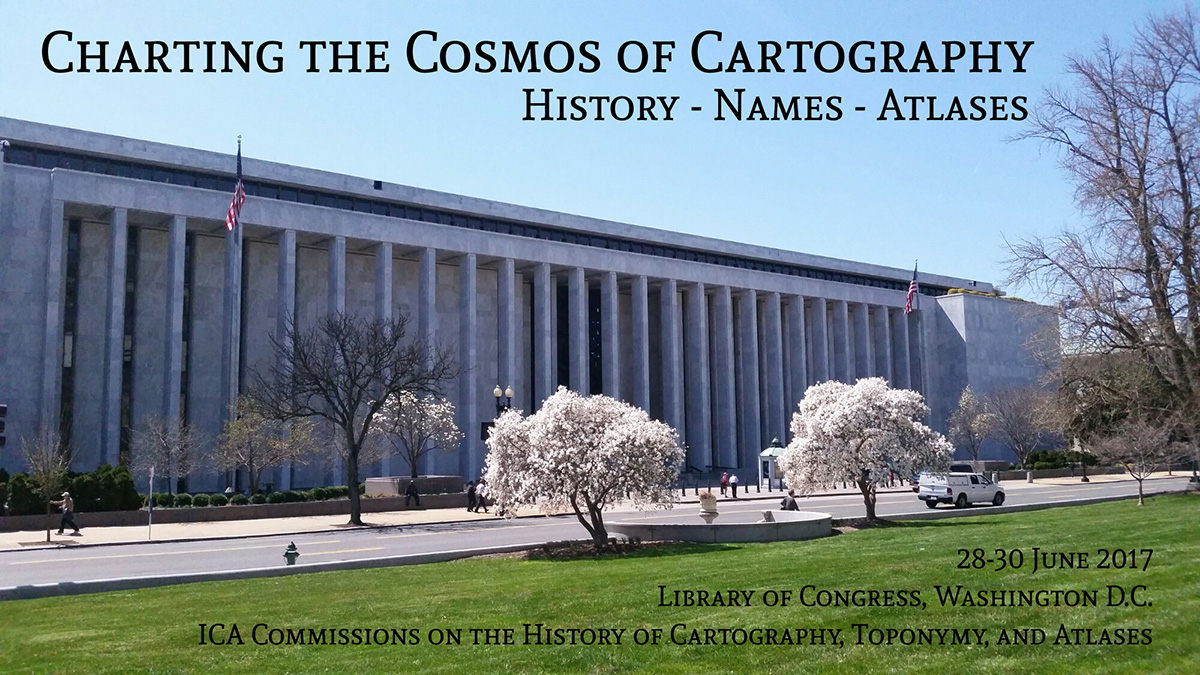
Call for Papers: Charting the Cosmos of Cartography: History, Names, and Atlases

http://icaci.org/invitation-to-the-ica-pre-conference-workshop-charting-the-cosmos-of-cartography-history-names-atlases/

Invitation to the ICA Pre-Conference Workshop Charting the Cosmos of Cartography: History – Names – Atlases


loc-madison-building-banner

In conjunction with the 28th International Cartographic Conference, held in Washington DC on 2–7 July 2017 (http://icc2017.org/), the Library of Congress’ Geography & Map Division and the three ICA Commissions on the History of CartographyToponymy, and Atlases would like to invite you to attend their joint pre-conference Workshop Charting the Cosmos of Cartography: History – Names – Atlases.
The workshop will be held at the Library of Congress (Madison Building) in Washington DC (USA), from Wednesday, 28 June to Friday, 30 June 2017.

Call for Papers

  • Deadline for submissions: 15 February 2017
  • Notification of acceptance: 15 March 2017
Participants are invited to submit abstracts on any topic of merit addressing at least one of the subjects of the partnering ICA Commissions. The abstracts should be between 200 and 500 words long, written in English and provided as a Word file using this template. A brief biographical note should also be provided at the end of the abstract. Each author, either as sole author or co-author, may only submit one paper proposal; each paper has to be an original contribution that has not been published or presented before.
All submissions must be sent electronically via the online submission system. When submitting, authors will also be asked to indicate their interest to write a full paper after the conference which – if enough authors are interested – will be published in a dedicated conference volume.
Please find more information and updates on the workshop website: history.icaci.org/washington-dc-2017

Friday, April 17, 2015

“Made-Up” Names

https://dmnes.wordpress.com/2015/04/15/made-up-names/

People who study contemporary baby names often like to talk about “made-up” names, whether unusual names found in late 20th and early 21st C America or more “traditional” made up names coming from late 19th and early 20th C literature. Now, if you think about it, all names are, at the root, “made-up”. But if you want to make a distinction between names which are drawn from identifiable word or concept — for example, Bona (Latin ‘good’) or Heather (a plant word) — and names which are constructed without regard for their meaning, such as Germanic Everbern deriving from themes meaning ‘boar’ and ‘bear’, or dithematic names which are constructed on the basis of the themes of the parents’ names, for example when Aclehardus and Teudhildis have a son named Teuthardus and a daughter named Aclehildis, then you could argue that the latter are ones that are truly “made-up” in the relevant sense.
But just as there are many names which people think are medieval but in fact are modern, many names which people think are modern coinages actually have a much older history. When I came across this article, on 17 Baby Names You Didn’t Know Were “Totally Made Up”, a few days ago, I was surprised at how many of these so-called modern “made-up” names are actually not.
Wendy: The received wisdom is that J.M. Barrie coined this name for Peter Pan. In fact, a Wendy Oxford was christened in 1615 in Harston, Cambridge, England. So, not quite medieval, but far older than the 20th C.
Cedric: Like Wendy, this is commonly cited as a coinage of Sir Walter Scott for Ivanhoe. It, too, goes back to (at least) the early 17th C. Cedric Holle was christened in 1613 in Plymouth, Devon, England, and Cedric Jorye was christened in 1626 in the same city.
Miranda: This name occurs in Périgueux, France, in 1366-1367.
Amanda: This name can be found in England in 1221.
Dorian: This name can be found in Paris, France, in 1421 — where it occurs as a feminine name, rather than a masculine one.
CoraCora and the diminutive Corina are both found in Imola, Italy, in 1312. The name Corella, found in Valencia in 1510, may also be a diminutive of Cora.
In the comments on the article, someone offers Stella as another modern coinage; but Stella can be found in Rome in 1527.
So there’s a brief round up of names which many people think are modern, but which are actually medieval (or at least early 17th C).

Thursday, October 16, 2014

В Перми супружеская пара назвала сына Люцифером

http://echo.msk.ru/blog/echomsk/1419614-echo/

1436142

В Перми супружеская пара назвала сына Люцифером, сообщила ТАСС начальник Кировского отдела ЗАГС, в котором был зарегистрирован ребенок, Татьяна Тужилина.
"Мальчик родился 11 сентября, родители решили назвать его Люцифером, соответствующее свидетельство мы выдали им 25 сентября. Мы проводили с ними беседу, говорили, что ребенку может быть некомфортно с таким именем в современном обществе, но родители настояли на своем. К тому же запретить регистрировать ребенка с таким именем у нас нет никаких законных оснований", - сказала Тужилина.
По ее словам, это самое необычное имя, которым когда-либо называли детей в Перми.

Tuesday, August 12, 2014

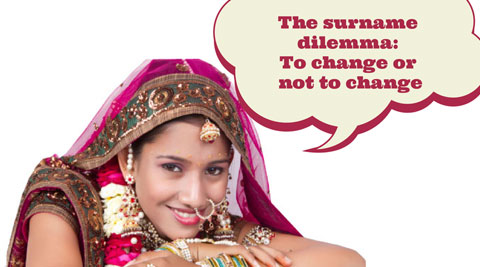
The tricky issue of women’s surnames

http://indianexpress.com/article/lifestyle/the-tricky-issue-of-womens-surnames/

Written by Leher Kala | Mumbai | June 30, 2014 3:31 pm

SUMMARY

Fifty years after the feminist movement took off in the West, we’re still grappling with the problem of married versus maiden names.
surname-main

According to a Government Resolution issued by the Women and Child Welfare Department (WCWD) recently, women in Maharashtra will now have the option of using either their fathers’ or husbands’ names in all official documents. Children can now mention names of both parents, or remove the father’s completely if they choose.
I guess it would be too much to expect the WCWD to consider that some women may prefer to drop both, their father’s and husband’s names, and choose a new, random one. It’s not a bad idea to create an option for that as well. The fact that the husband’s name is no longer a requirement should be celebrated, it was an aggravating reminder that the state believes wives are the property of husbands. Fifty years after the feminist movement took off in the West, we’re still grappling with the problem of married versus maiden names and pondering the eternal question: why choose?
Changing your name for a woman should be entirely a matter of choice, not compulsion or expectation that it usually is in Indian families. It should be appreciated for being as much a romantic leap of faith as marriage. It’s not about feminism but about something that’s been fundamental to your existence for over 20 years, your identity—-which you’re suddenly taking a huge chance on for no conceivable benefit, unless you’re marrying a Gandhi or Kennedy.
I like short, swift names with little fuss. But I like convenience best and I couldn’t imagine going through the effort of changing my name on my passport, driving licence, credit cards and so on. In the same spirit, I have no objection to being called by my married name as well. Officially, according to law, we’re all supposed to conduct business and file taxes under one name only. The trend currently for newly married, educated women in India are three excruciatingly long, clumsy and unwieldy, sometimes-hyphenated names.
Interestingly, in a survey conducted among American college students, only 10 per cent agreed that “a woman keeping her name was less committed to her marriage”, an unspoken view that I suspect holds prevalence in India. People don’t get how the rules have altered, if only subtly. Women are marrying later everywhere, after they’re well established in the working world. Often they’re making significant contributions to the family kitty, as well as carrying the additional responsibility of bearing children.
In our heads, if not in reality, our names carry some equity, especially if we’re already well-entrenched in a career, say, like journalism. And in the era of social media, it’s not just journalists who are worried about bylines. There’s your digital identity to consider as well. Imagine the painstaking task of changing an e-mail ID, Facebook and Twitter profile names. The stakes, once again, are loaded against women: in case of a divorce, you have to go through the mortifying torture of changing your name back again.
In India, however, taking on a spouse’s name is not seen as retro or old fashioned but as a sign that you’re making more of an effort to be a couple. Even the most emancipated of men don’t wonder about this gender-biased tradition which has no real utility at all, other than a sense of family identity that can be created in so many other more significant ways. It’s the same reason people have extravagant weddings with flowery prose as vows —- it’s almost like the belief is if you do all that, it’s all it takes — and the marriage will work spectacularly. Giving up your own name is complicated at many levels, and unfortunately, it doesn’t come with a guarantee that everything will be alright.

Sunday, September 22, 2013

The most frequent Ukrainian Surname

Какая самая распространенная украинская фамилия? - Вопрос-ответ - Аргументы и Факты Украина

Top-10 according the Ukraine Census 2001:

1. Shevchenko (158.462)
2. Mel'nik (158.042)
3. Kovalenko (134.291)
4. Bondarenko
5. Tkachenko
6. Kravchenko
7. Koval'chuk
8. Koval'
9. Shevchuk
10. Savchenko

First 9 surnames are occupational ones (Sewer, Milner, Smith, Сooper, Weaver, Cutter, Blacksmith, Forger, Tailor) and only the 10th is patronymic (from Savva).


Thursday, June 6, 2013

Place Names: 1912 vs. 2012

NameFreak!: Place Names: 1912 vs. 2012: Parents have been using place names as their children's names a lot over the years. I compared the Top 1000 for 1912 with 2012 and th...

Monday, May 6, 2013

Onoma 49 / Call for Papers


http://www.icosweb.net/index.php/Current_news/items/onoma-49-call-for-papers.html


Onoma 49 (2014): Names and religion

Guest editor Per Vikstrand, Uppsala


Call for papers

Names and religion are intimately bound together on several levels and in several ways. As regards personal names, these often reflect the religious conviction of the name givers. It would be not entirely wrong to assert that in the Christian world most personal names rely on the Bible or Christian tradition in the form of saints or missionaries for their existence. In the Indo-European languages, personal names with religious associations are a common trait and such names make up an important part of the anthroponomasticon in many languages.


A large amount of place names emanates from tales and myths in which supernatural beings of different kinds are connected with significant places in the landscape. This seems to be a global phenomenon. But place names, made obscure by the passing of time and language change, can also act as agents for stories and myths, woven around a reinterpretation – if you like a “folk-etymology”– of the name in question. From such names there is only a short step to the mythological names – that is names of persons, beings and places in the myths. The etymologies of mythological names are often invoked to enlighten characters or deeds in the stories of which they form a part. It is my belief that an onomastic approach to such name – based on the understanding that they actually act as and must be treated as names – have much to contribute to the understanding of myths.


The subject of names and religion has as far as I know never been approached in an international forum. Although much work has been done on a regional basis, very little knowledge on the subject trickles over the barriers of languages and we are in want of global and inter-language perspectives. This number of Onoma is a first, humble attempt at bridging over this omission of knowledge.

I invite scholars in the field of onomastics, history of religion and anthropology (and others that might feel called upon) to submit studies of different aspects of the theme names and religion. It is my firm belief that the glimpses of knowledge from different cultures and religions thus provided can enrich our understanding of the complex relationship between names, naming, myths and religious beliefs. I would especially like to encourage studies that deal with indigenous religions and languages outside the Christian and Islamic cultural spheres. Studies concerned with ancient European cultures such as the Greek, Roman, Celtic or Old Norse would also be most welcome, as would, of course, investigations with a more contemporary approach.

If you would like to participate in this issue of Onoma, please submit a title and a short abstract by September 1, 2013, to per.vikstrand@sofi.se.

Accepted authors will be informed by October 1, 2013, and deadline for the articles will be February 28, 2014.