Showing posts with label Elian Carsenat. Show all posts

Wednesday, March 20, 2019

Mylist Platform Thrives with Onomastic Diversity via NamSor

link


NamSor software, which determines Ethnicity, Origin and Gender of an individual based on their name and surname, has delivered tremendous results to the company; Mylist in Dubai. Mylist is a Gift & Reward e-commerce platform that allows you to create online gift lists for: weddings, birthdays, baby showers, and other social events. Operating in Dubai, a global city known for its diverse cultural communities, the Company is looking to benefit from the cultural wealth of one of its most valuable assets: its customer database!

Follow the link to read and find out how big data onomastics adds value to the business model. 

Tuesday, January 20, 2015

Applying onomastics to scientometrics

http://namesorts.com/2015/01/20/namsor-presented-during-symposium-on-academic-excellence/


NamSor presented during Symposium on Academic Excellence

Our friend Tania Vichnevskaia of the French National Institute for Health (INSERM) presented the paper ‘Applying onomastics to scientometrics‘ yesterday at IREG ​​International symposium or​​ganised by University of Maribor and Shanghai Jiao Tong University.
NamSor as a private start-up company has been solicited in 2014 by a European country to help measure the ‘brain drain’ affecting its competitiveness in the BioTech sector and to produce a global map of its scientific Diaspora (who are they, where are they and what are they doing). The objective was to build up the country’s scientific international cooperation and to engage its Diaspora.
Serendipity led analysts to discover interesting patterns in the way scientists names affect co-authorship and citation – not just for this particular country, but globally.
Last year, during ICOS2014 conference at Glasgow University, we presented how data mining millions of scientific articles in PubMed/PMC LifeSciences database uncovered amazing patterns in the way scientists names correlate with whom they publish, and who they cite in their papers.
We were interested to mine the large commercial bibliographic databases (Thomson WoS, Scopus) because they offer better data quality on citations and useful additional information, compared to PubMed:
- firstly, they have the full name in addition to the short name cited with just initials; this significantly reduces the error rate of onomastic classification
- secondly, they link scientists to research institutions (affiliations) and geographies (country of affiliation) ; this allows additional analysis on the topic of Diasporas and brain drain, comparing -for example- the research output of Chinese / Chinese American scientists in the US with that of scientists of Mainland China;
- thirdly, those databases have a larger coverage in terms of scientific disciplines, allowing comparison between different fields of research.
So collaboration started between NamSor and bibliometric experts at INSERM –the French National Institute for Health- to evaluate and visualize the effects of migration, Diaspora engagement and possibly cultural biases in Science.
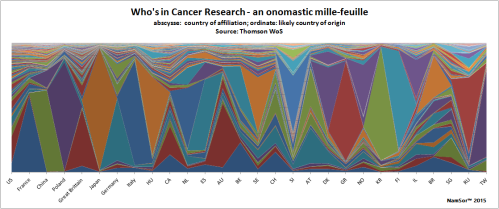
We’ll publish the slides later today or after the conference. As a teaser, what does the ‘onomastic millefeuille‘ of the global Cancer Research community look like?
201501_ThomsonWoS_CancerResearchOn this same topic:
The agenda of the Symposium is presented below
​​​​​​​2nd Maribor Academicus Event
​​International symposium  or​​ganised by University of Maribor and Shanghai Jiao Tong University
within the IREG Project on Academic Excellence
19-20 January 2015, Maribor, Slovenia
Higher education can importantly benefit from the rankings and league tables when used in a context with clear perspective of what ranking actually reflects (Prof. Jan Sadlak, President of IREG)
Active participants at the conference will be:
  •            Prof. Jan Sadlak, President of IREG,
  •            Prof. Gero Federkeil, CHE (Coordinator of Multi-Ranking),
  •            Prof. Nian Cai Liu,  Jiao Tong University in Shanghai (Author of the Shanghai ranking list),
  •            Prof. Seeram Ramakrishna,  National University of Singapore,
  •            Prof. Santo Fortunato,  Aalto University,
  •            Prof. Karin Stana Kleinschek, University of Maribor,
  •            Prof. Henryk Ratajczak, member of Czech Academy of Sciences,
  •            Prof. Edvard Kobal, Slovenian Science Foundation,
  •            Roberta Sinatra, PhD, Northeastern University,
  •            Tania Vichnevskaia, French National Institute for health (INSERM),
  •            Prof. Andrée Sursock, Senior Adviser at EUA,
  •            Prof. Øivind Andersen, University of Oslo.
About NamSor
NamSor™ Applied Onomastics is a European vendor of Name Recognition Software (NamSor sorts names). NamSor mission is to help understand international flows of money, ideas and people. NamSor launched @FDIMagnet,  a consulting offering to help Investment Promotion Agencies and High-Tech Clusters leverage a Diaspora to connect with business and scientific communities abroad.
http://namesorts.com/onomastics/fdi-magnet/

Friday, January 9, 2015

What’s in a suspect terrorist name?

http://namesorts.com/2015/01/08/whats-in-a-suspect-terrorist-name-cherif-kouachi-said-kouachi-and-mourad-hamyd/

CharlieHebdo_Header

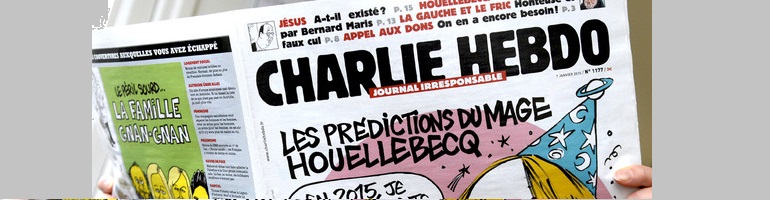
A year and half ago, terrorism stroke Boston and there was a confusion about the origin of the terrorists, the Tsarnaev brothers. Czech Republic? The Russians hitting on US soil? Not quite. Yesterday, terrorism stroke Paris and the same confusion exists: are the suspect terrorists from Chechnya, from Syria, from Egypt, from France?
Two of them have French nationality, yet their names reflect a north-African origin.
Can applied onomastics help in a manhunt? Not likely. But it can help in preventing such events from occurring, months in advance.
Applied onomastics, the science of proper names, have been used before by security agencies: LAS software (acquired by IBM) was helping the CIA in the 80’s to keep tab on the KGB, recognizing Slavic names in databases; after 9-11, a lot of attention was directed towards improving name matching to reduce false positives in terrorist watch lists.
Is it ethical to mine personal names to analyze global terrorism trends, or to target individual people as potential terrorists? Firstly, it’s two different things. Secondly, we have to consider what’s at stake here.
Being French myself, I remember as a kid watching Cabu on TV in Dorothée’s Récré A2 show. This man entertained me as a kid, made me think as an adult with his provocative caricatures. He has been killed along with his friends and colleagues. In addition, a symbol was badly injured: Charlie Hebdo was symbolic of the Freedom of the Press in France. It is a free thinking and highly provocative newspaper – which just couldn’t exist in many countries that don’t have the same tradition of ‘laïcité’ (separation between the Churches and the State). The stakes are high: it’s not just the French, the very heart of France was targeted by the terrorists.
Two French police officers have also been brutally murdered, doing their duty. Again their name tells a moving story, Franck Brinsolaro and Ahmed Merabet. Anyone can be a victim of terrorism.
Protecting France, the French people of all origins as well as the visitors of France requires collecting and processing intelligence. Understanding the sociology of criminal networks is critical and can be the difference between life and death. Even more so when France is involved in military operations abroad – all having ethnic or religious components (Mali, Libya, Syria…)
Nationality (and hence indirectly possibly race, ethnicity or religion) can play a specific role in decision making, in the context of asylum, immigration, customs, general policing, including counter-terrorism. The distinction between the language ‘discriminatory ethnic profiling’ rather than the more common ‘ethnic profiling’ to describe the practice of basing law enforcement decisions solely or mainly on an individual’s race, ethnicity or religion demonstrates the European Union recognition for the security forces need to understand and recognize the complexity of the relationships that exist between nationality, geography, and more subjective concepts such as: ethnic origins, cultural backgrounds, civilizations, religions.
Citation: (2007) 1133-Guide-ethnic-profiling_EN : Towards More Effective Policing, a guide by the European Union.
It doesn’t mean onomastics should be used as a tool to target migrants (the ‘délit de sale geule’). We must defend our values, not reny them. In fact, a great danger comes from people newly converted to Islam, going to fight in Syria or elsewhere.Gilles Le Guen, originally a sailor from Brittany, went to fight in Mali under the name of Abdel Jelil ( عبد الجليل ). Recognizing names from Brittany closely related to a network of names in Arabic (or conversely) themselves closely related to terrorist groups should definitely ring bells.
There is a strong concern about the security of the French Jewish people too.
So far, the French security forces have been reluctant to use advanced data mining techniques and ‘digint’ and prefer to rely on their excellent capabilities in ‘humint’ (infiltration of terrorist groups). There are reasons for that. It’s not a matter of technical capability.
  1. The French constitution states: France is ‘one and undividable’ (« La France est une République indivisible, laïque, démocratique et sociale »). This lead to the following interpretation: the French state should remain colour blind, not see the internal sociology of France. As a consequence, there are very few statistical tools available to measure –for example- the level of discrimination towards migrants in France (including second generation), or to measure to which extend different populations have equal access to public services, or to evaluate the security risk specific to certain populations.
  2. Lost digital sovereignty: France (and Europe as whole) is struggling to build up its digital sector. In “Big Data”, France has good tech but doesn’t have the Data. The main French Internet companies are either a former state monopoly (SNCF -the train company- is the leader in digital commerce; PagesJaunes, the main competitor of Google in digital advertising for companies, is formerly a France Télécom division), in serious trouble (Viadeo) or on the path to be acquired by a US company – with few exceptions (controversial Illiad, …) The current situation is intolerable for France: not only the GAFA (Google, Apple, Facebook, Amazon) make huge benefits and don’t pay much tax, but they don’t employ many people in France and they know more about France that the French statistics agency (INSEE). So, France has to rely on cooperation with foreign security agencies (mainly US) to obtain vital information in matters of Police or national security. The French government is trying to get leverage by heading the fight against the GAFA on Data Protection and Tax at the EU level, which has lead to the French Data Protection agency to gain a huge power: the CNIL is feared by all French police and intelligence agencies where it has career ending powers.
It will take courage and efforts in France to change political views on this, but it’s essential both to build a sustainable digital ecosystem as well as to overcome France deep identity crisis. France has a huge potential: it has strong universities in social sciences, excellent engineers as well as mathematicians, it can still attract talents from many countries. But security is of the essence: no world class scientist will go to work in Saclay –the scientific and high-tech cluster to be built South of Paris- if they don’t feel safe commuting in the suburban train or in the city. This security must be granted to all: French of all origins, French Jews, migrants, tourists… In the 21st century, that will require to combine human intelligence and automated intelligence – Humin and Digint.

Wednesday, December 31, 2014

Happy to welcome you on the last day of 2014 and on the first day of 2015


Dear readers! This is Dr. Evgeny Shokhenmayer, happy to welcome you on the last day of 2014, here on 
www.e-onomastics.blogspot.com. I would be very surprised if many people visited my blog on New Year’s Eve. Surely you have friends and family to celebrate everything you achieved in 2014 and to share your hopes for 2015.


I don’t want to keep you from the table full of delicious food and from watching the fireworks, so instead of my usual long speech I’ll just say this…

2014 was an amazing year for me, and for e-Onomastics. This blog yet again broke all records receiving over 132 000 visits and getting over 960 posts. Our Google Onomastics community grew from 0 fans to over 25 and counting!

For me personally the biggest achievement of 2014 was presenting and posting from ICOS 2014 in Glasgow together with Elian Carsenat. It took more than one year of research, thousands names' analysis and hard work, but finally it’s done! I'm proud of taking part in NamSor™ Applied Onomastics Software in quality of linguistic expert. We are very excited because it will enable more name recognition software's application to classify and categorize wide range of various names! Our next step will be to undertake the surnames analyses of casualties in memory of the centenary of the WWI 1914-1918. 


I truly am grateful to everyone who contributed to e-Onomastics Blog in 2014, to all the visitors who came here searching for the latest names-related updates, to all the linguists who used this website and recommended it to their colleagues, to everyone who referred their friends here to get help with onomastics, to people who sent their feedback and helped us to improve. Your support means more than I can put into words.

I love you all, and hope you have a wonderful 2015!


onomastically yours,

Evgeny


Monday, November 10, 2014

Popular baby names in Tripura, Incredible India

http://namesorts.com/2014/11/10/popular-baby-names-in-tripura-incredible-india/


Incredible India is the name of successful place marketing initiative launched in 2002 by the Indian Government using the incredible diversity of India in terms of colors, landscapes, people, languages etc. to promote tourism in India. Because of this same diversity, Indian onomastics are a tough nut to crack. At NamSor, we’ve opened a free API to predict the gender of personal names according to the various languages and cultures (Andrea Rossini is male, Andrea Parker is female, Jean Durieux is …). We’ve already made it very accurate for most countries.
Still, we have a lot of work to do on Indian names, as the precision of Gendre APIv0.0.17 for India is not yet at the right standard. We aim for 95 to 99% accuracy and 95 to 99% recall, in every country where possible.
countrysample sizePrecision FPrecision MRecall
fr3816798%98.9%100%
ru3776999%95.9%99%
es3357699%99.0%100%
de2877898%99.3%100%
tr1586693%94.2%99%
pl13485100%99.9%100%
gr1322797%96.4%99%
it1277598%98.8%100%
ir1147088%90.6%98%
us1096094%97.4%99%
in967760%84.0%73%
cz8980100%99.7%100%
hu840395%99.0%100%
br808891%95.6%99%
rs662299%96.0%99%
ua630099%97.3%99%
This work is important. The status of women in India is a very current issue. At NamSor, we believe in the value of open data mining initiatives -such as Gender Gap Grader- to advance the empowerment of women worldwide. So we work hard to understand how names vary in different states of India, different regions. For example, below are the most frequent male/female names in the state of Tripura.
Keep posted for the next version of GendRE API, as it will have much better precision to predict the gender of Indian names.
In the meantime, further reading:

Most popular female and male names in Tripura, India

NameFemaleMaleTotalGender
Sabita636466370Female
Pradip950775086Male
Kalpana44814481Female
Anita4424134437Female
Rina418264188Female
Ratna4133134146Female
Ratan2041124132Male
Narayan1141024113Male
Namita407964085Female
Uttam1940434062Male
Sbapan639813987Male
Dilip739033910Male
Dipali389863904Female
Bishbajit1238533865Male
Gita38533853Female
Tapan937983807Male
Anjali36173617Female
Ranjit735083515Male
Sanjit1434433457Male
Sbapna34293429Female
Lakshi3366293395Female
Soma33473347Female
Sabitri32873287Female
Kajal193013493279Both
Suman5832183276Male
Shipra32443244Female
Purnima31683168Female
Sunil631193125Male
Sujit1431033117Male
Rita31113111Female
Sumitra3088103098Female
Bimal1030863096Male
Shefali30913091Female
Ajit1230503062Male
Aarati30223022Female
Anjana298382991Female
Malati29632963Female
Babul829522960Male
Archana29152915Female
Samir928522861Male
Gautam28402840Male
Gopal928132822Male
Dipak27912791Male
Rekha27562756Female
Dulal727362743Male
Basanti27272727Female
Shyamal1127112722Male
Minati26772677Female
Manik2126442665Male
Shilpi263272639Female
Sima261962625Female
Bikash1025692579Male
Sanjay25402540Male
Subhash25292529Male
Sajal6824432511Male
Abhijit824882496Male
Litan2624652491Male
Parimal1624652481Male
Pratima24212421Female
Anima23742374Female
Manju2309502359Female
Bina23442344Female
Sandhya2327102337Female
Anil23212321Male
Mamata230382311Female
Ruma22992299Female
Rabindr22952295Male
Rajib922632272Male
Biplab722502257Male
Sukumar22422242Male
Abdul22302230Male
Chandan1322122225Male
Shikha22132213Female
Rajesh21962196Male
Manoranjan21952195Male
Milan14357522187Both
Nirmal921732182Male
Sarasbati21772177Female
Raju4621172163Male
Aparna21462146Female
Zarna20612061Female
Rakhi2044102054Female
Mayarani20332033Female
Tapas20302030Male
Rakesh1020092019Male
Jyotasna20052005Female
Jayanti198571992Female
Santosh19501950Male
Subrat19181918Male
Ranajit19171917Male
Sandhyarani19121912Female
Bijay2218451867Male
Suchitra1833151848Female
Mira18461846Female
Haradhan18151815Male
Kabita178481792Female
Niranjan17921792Male
Gitarani17721772Female
Pramila176161767Female
Manika17401740Female

Friday, August 22, 2014

Onomatometric analysis of China's scientific power

I feel I am ready for the forthcoming International Congress of Onomastic Sciences in Glasgow! I will try to keep in touch what it's happening there and will post from the "Caledonian Confederacy")))

Recently, I (Dr. Evgeny Shokhenmayer) have finished the analysis of Chinese surnames and linguistic expertise process for our talk on Thursday, 28th August. It will be presented in co-authorship with Elian Carsenat and his brilliant NamSor™ Applied Onomastics.


Please, read the teaser:
http://namesorts.com/2014/08/20/is-china-really-becoming-a-science-and-technology-superpower/


Is China really becoming a science and technology superpower?

Every now and then we hear stories about the making of China as a scientific superpower. How it overtook France in the global University Rankings:
‘In the 2014 edition of the world 500 top research universities, China keeps progressing. China has 9 universities among the top 200 (77 in the USA, 20 in Great-Britain, 14 in Germany, 8 in France). The trend is impressive: in 2004, China had only one University in the to 200.’ Source: LesEchos.fr
How it keeps increasing its volume of scientific publications produced:
‘The increased share of scientific publications produced by China (+231% between 2002 and 2012) is another indicator of the Chinese scientific growth. According to Ghislaine Filliatreau [of the French OST], it’s not only just an augmentation in volume but also in quality.’ LesEchos.fr
In China really becoming a scientific superpower? It may be so. We should however be careful how we interpret bibliometric information (volume and quality of scientific publications). There could be huge cultural biases currently unaccounted for, impacting international bibliometric rankings.
For example, let’s look at Scimago Journal and Country Ranking, an index based on the Scopus® database (Elsevier B.V.). China is already the second country in the world according to the number of scientific publications produced between 1996 and 2003. But if we consider the number of citations excluding self-citations, then China comes after Spain. The reason is that the ratio of citations per citable document (excluding self-citations) is lower than average.
Scimago Country Rankings
Next week, at ICOS2014 (the 25th International Congress of Onomastic Sciences and premier conference in the field of name studies), we will exploresome of the cultural biases at play in LifeSciences. A presentation of PubMed (MedLine/PMC) data mining using NamSor software, conducted with onomatologist Dr. Evgeny Shokhenmayer, will take place at Glasgow University on the 28th of August.

Onomastics to measure cultural bias in medical research (ABSTRACT)

This project involves the analysis of about one million medical research articles from PubMed. We propose to evaluate the correlation between the onomastic class of the article authors and that of the citation authors. We will demonstrate that the cultural bias exists and also that it evolves in time. Between 2007 and 2008, the ratio of articles authored by Chinese scientists (or scientists with Chinese names) nearly tripled. We will evaluate how fast this surge in Chinese research material (or research material produced by scientists of Chinese origin) became cross-referenced by other authors with Chinese or non-Chinese names. We hope to find that the onomastics provide a good enough estimation of the cultural bias of a research community. The findings can improve the efficiency of a particular research community, for the benefit of Science and the whole humanity.
About Evgeny Shokhenmayer
Dr. Evgeny Shokhenmayer (MoDyCo, Paris 10), editor of e-Onomastics, online blog focused on onomastics research and publications.
http://e-onomastics.blogspot.fr/
About NamSor
NamSor™ Applied Onomastics is a European vendor of Name Recognition Software (NamSor sorts names). NamSor mission is to help understand international flows of money, ideas and people. NamSor launched @FDIMagnet,  a consulting offering to help Investment Promotion Agencies and High-Tech Clusters leverage a Diaspora to connect with business and scientific communities abroad.
http://namesorts.com/onomastics/fdi-magnet/