Sunday, June 25, 2017

Международный аэропорт в Астане переименован в честь президента

KVNews

Теперь гости казахстанской столицы будут прилетать в «Нурсултан Назарбаев». 


Накануне стало известно об изменениях в топонимике столицы Казахстана: глава правительства Бакытжан САГИНТАЕВ подписал постановление о переименовании международного аэропорта города Астаны в честь президента республики. Теперь аэропорт называется «Нурсултан Назарбаев».
Как сообщают федеральные «Известия», переименовать аэропорт в честь лидера страны предлагали ещё 8 лет назад, мотивируя это тем, что «бренды «Казахстан» и «НАЗАРБАЕВ» неразделимы». Одним из примеров приводили George Bush Intercontinental Airport в Хьюстоне в США, который был назван в честь Джорджа Буша-старшего.
Подчеркнем, что почитание лидера государства в Казахстане принимает формы культа: в честь президента переименовывают улицы, парки, аулы, новые города — например, Нуркент, в Панфиловском районе на казахстанско-китайской границе. «Назарбаев университет» был создан по инициативе Нурсултана Назарбаева в 2009 году. По всей стране открыты «Назарбаев Интеллектуальные школы». Библиотека Первого Президента открылась на базе «Назарбаев Центра» в 2014 году, в стране есть благотворительный фонд им. Назарбаева.
Отметим, что в России такая практика не распространена. Правда, в 2017 году одна из участниц праймериз «Единой России» предложила переименовать город Барнаул в Путинград, но её инициатива была оценена неоднозначно, вызвав отклики от иронии до возмущения.
Фото © rikatv.kz

Thursday, June 22, 2017

Call for Papers: "Theorizing Contacts in the Roman Empire"

Classical Studies

THEORIZING CONTACTS IN THE ROMAN EMPIRE

UNIVERSITY OF EDINBURGH, 8-9 December 2017

We live in a multicultural world, in which every community develops in constant interaction with others. A series of theoretical models have been developed to explain these contacts, which in recent years have been utilized to understand the ancient world. In the context of the Roman empire, these theories are typically used to examine the interactions of various indigenous populations with their rulers. These kinds of studies were once grouped under the heading “Romanization”, though the increased questioning of the term’s validity has given rise to a diverse range of alternatives. These are often drawn from modern theoretical backgrounds: multiculturalism and multilingualism are two recent concepts employed in this realm.

The aim of this conference is to assess the validity and scope of a variety of some of these models, with a particular focus on multilingualism and multiculturalism. By promoting and facilitating dialogue between disciplines, we shall aim to provide effective tools for different fields’ approaches in parallel (e.g. historical and linguistic). This has already been done very successfully in a few cases (e.g. ‘code-switching’), though greater interaction remains a desideratum. It is hoped that the participants will thereby open the discussion for a ‘theory of contact’ in the Roman world.

We invite scholars from a range of fields, including epigraphists and papyrologists, philologists, legal historians, and archaeologists to consider if and how the multiculturalism and multilingualism models can be applied in the following areas:

• Language: onomastics; ancient bilingualism; language preservation and change.
• Law: the interaction between native and Roman law; issues of status.
• Literature: the response of Roman and Greek authors to “others”.
• Art and visual culture: interactions of Roman and indigenous styles; religious and cult imagery.

Papers that consider the role of the individual within these topics are especially welcome.
Confirmed Speakers: Andrew Wallace-Hadrill (Cambridge), Alex Mullen (Nottingham), Olivia Elder (Cambridge), Christian Djurslev (Edinburgh)

Proposals: We welcome proposals from scholars at any stage of their career. PhD students, early career and independent researchers are highly encouraged to participate.

Papers will be 25 minutes long, followed by 10 minutes of discussion. For your proposals please include title, name(s) of speaker(s), affiliation(s), an abstract of 300 words, and a select bibliography. Please send to roman.contacts@ed.ac.uk.

Posters on particular case-studies or specific concepts will be accommodated in a designated poster session and prizes will be awarded to the three best entries. Proposals for posters should have the same format as that of the papers. Please, use POSTER as the “Subject” of your email.

The deadline for all proposals (papers and posters) is 28th February.
For further information please contact the organizers: Kimberley Czajkowski (k.czajkowski@ed.ac.uk) and/or Andreas Gavrielatos (a.gavrielatos@ed.ac.uk).
---
(Photo: "Handwritten" by A. Birkan, licensed under CC BY 2.0)

Public lecture: Old English Place-Names and the Communication of Traditional Ecological Knowledge

Public lecture: Old English Place-Names and the Communication of Traditional Ecological Knowledge - 19 Sept 2017, British Academy, London


Place-names are used to communicate Traditional Ecological Knowledge (TEK) by all indigenous, aboriginal and First Nations people. Here and for the first time, English place-names are examined through a TEK lens. Specifically, place-names formed in Old English—the language of the Anglo-Saxon—and coined between c. 550 and c. 1100 A.D., are explored. This naming horizon provides the basic name stock for the majority of English towns and villages still occupied today. While modern English place-names now simply function as convenient geographical tags Old English toponymy is shown here to exhibit close semantic parallels with many other indigenous place-names around the world. Seeing Old English place-names as a hitherto unrecognized and unexploited repository of TEK may have exciting and important consequences. By identifying the climatic and meteorological correspondences that can be drawn between the period of place-naming and the present day, this paper explores how early medieval water and woodland names might offer new perspectives on, and perhaps solutions to, flooding, the most serious environmental threat currently facing the UK.

Jones, Richard L.C.. "Responding to Modern Flooding: Old English Place-Names as a Repository of Traditional Ecological Knowledge." Journal of Ecological Anthropology 18, no. 1 (2016)


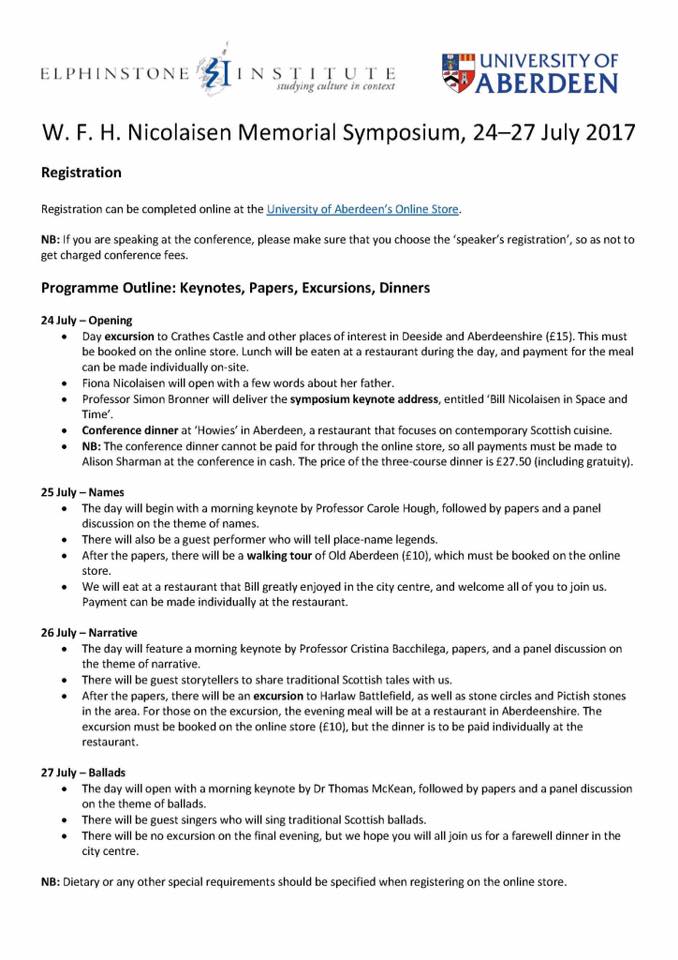
W. F. H. Nicolaisen Memorial Symposium

Elphinstone Institute

The Elphinstone Institute will host a symposium in memory of much-missed Emeritus Professor W. F. H. Nicolaisen (1927-2016).
The conference of international scholars will be opened by the renowned folklorist, and onetime Nicolaisen student, Professor Simon Bronner, and will feature keynotes from Professor Carole Hough (University of Glasgow), Professor Cristina Bacchilega (University of Manoa, Hawai'i), and Dr Thomas McKean (Elphinstone Institute, University of Aberdeen). The three days will be devoted to three key themes in Nicolaisens's work: Names, Narrative, and Ballads, and will demonstrate his enormous international influence in the fields of Onomastics and Folklore.

Dates of Event
24th July 2017 – 27th July 2017
Last Booking Date for this Event
21st July 2017
Venue
The Sir Duncan Rice Library, Craig Suite
Contact
elphinstone@abdn.ac.uk
Tel: 01224 272996

Monday, June 19, 2017

About 245 abstracts submitted for ICOS 2017

26th International Congress of Onomastic Sciences (Debrecen, 2017) 


As is already known, the 26th International Congress of Onomastic Sciences will be hosted by the University of Debrecen (Hungary), between 27 August and 1 September 2017. Approximately 245 abstract submissions were received from more than 250 authors in 43 countries. The abstracts were reviewed by the members of the scientific committee of the Congress. The results of the evaluation were sent to the authors in February and online registration was opened at the end of March. Participants should note that the early-bird registration closes on 19 May 2017, while the final registration deadline is 31 July 2017. News and updates (including a preliminary programme) can be found on the Congress website (http://icos2017.unideb.hu/en/). 

Saturday, June 17, 2017

Multilingual Education and Multilingualism Onomastics in Kazakhstan

GfN


Am 19.6.2017 findet an der Wirtschaftsuniversität Wien das letzte Slavic Research Seminar im Studienjahr 2016/2017 statt. Es sprechen 
Prof. Dr. Gulmyra Madiyeva, 
Dr. Assem Aksholakova, 
Mag. Dinara Madiyeva
allesamt onomastisch ausgewiesene MitarbeiterInnen des Instituts für allgemeine Sprachwissenschaft der Al-Farabi-Kasachische-Nationaluniversität Almaty.
Veranstaltungsdaten: Mo., 19.06.2017, 17:30-19:00 Uhr, Wirtschaftsuniversität Wien, Institut für Slawische Sprachen, Welthandelsplatz 1, Raum D2.2.228.D2.2.228

Arts minister to lobby the ANC to change South Africa’s name

BusinessTech

Arts and Culture Minister Nathi Mthethwa has vowed to lobby the ANC’s National Executive Committee in an open discussion on finding an appropriate name for South Africa, according to a report in the 13 June edition of The Mercury.

Mthethwa who was speaking to party supporters during a cadre’s forum on Sunday, pointed out that South Africa is not the name of the country, but is just “a geographical description of where we are”.
He noted that the ANC had never given itself time to think about the name of the country, and that as his department had power to change the naming of public areas, there was now an opportunity to rename the country to one that was more reflective of the country’s past and its people.
While government had made strides in changing the colonial names of places, there was more to be done in identifying improper names, such as Durban and Empangeni, said Mthethwa.
“To tell the truth, the country does not have a name. It is not there.”
“Benjamin D’Urban named our place, eThekwini, after himself and called it Durban,” he said.
He said he had also recommended a name change for Empangeni because “there is no such name in the Zulu language.”
“The area used to be called Embangweni Wombuso wakwa Mthethwa (infighting over the chiefdom of Mthethwa clans),” he said.

ANC and other responses

Speaking to the Mercury, ANC spokesperson Zizi Kodwa said that the issue of the country’s name would be discussed when it was brought before the ANC and that the ANC had not taken any position on the matter.
“If there was one member of the NEC who spoke somewhere, expressing his own ideas he must bring them to the ANC for discussion.”
“There is currently no discussion in the ANC about changing the country’s name,” said Kodwa.
When asked for a response, EFF spokesperson Mbuyiseni Ndlonzi said his party also did not support the current name of the country, but added that it would be “a futile exercise to rename a country that did not belong to you.”
The DA’s Arts and Culture deputy shadow minister Allen Grootboom said his party could not comment on the matter because it had not been discussed internally.

Thursday, June 15, 2017

Phoenix mayor wants to change racially-charged street names despite homeowner opposition


Early Edition: Should the Philippines be renamed? Historian weighs in (P...

Early Edition: Should the Philippines be renamed? Historian weighs in (P...

Yogi Adityanath Clarifies Over Changing Names Of Prominent Places In Gor...

Teachers Oliveira Marques and Teresa Ambrósio in the toponymy of Lisboa

Lisboa


Two great figures from the national culture now give their names to the streets of Lisboa next to the Alameda da Universidade: Rua Professor Oliveira Marques and Rua Professor Teresa Ambrósio. The ceremony to unveil the toponymic plaques took place on June 7 in the presence of Catarina Vaz Pinto, City Concilor for Culture, André Caldas, President of the Parish Council of Alvalade, Fernando Lima, Grand Master of the Grande Oriente Lusitano, family members, academics and friends of the distinguished.


Wednesday, June 14, 2017

Naming Particulars: A Thirteenth-Century Debate on Whether Individuals Have Proper Names

Medievalists

Naming Particulars: A Thirteenth-Century Debate on Whether Individuals Have Proper Names
By Rachel Anna Bauder
PhD Dissertation, University of Toronto, 2016
Abstract: This dissertation is about a debate that occurred in thirteenth-century philosophy over an apparently bizarre question: Can individuals really have proper names? While scholarly studies have appeared previously on philosophers in the fourteenth century who discussed this question (most notably John Buridan), I show that the question was widespread in the thirteenth century and involved many participants. Historically, I offer the first comprehensive account of how the thirteenth-century debate over the possibility of proper names arose. I argue that it was instigated by Michael Scot’s translation of the Metaphysics and perpetuated by tensions within the new Aristotelian metaphysical and cognitive theories of the 1230’s-1260’s. Philosophically, I offer a detailed analysis of the arguments on both sides of the question, presenting and explicating over 15 arguments for and against proper names, in texts by eight different philosophers: Richard Rufus of Cornwall, Adam Buckfield, Geoffrey of Aspall, Robert Kilwardby, Pseudo-Kilwardby, Roger Bacon, Siger of Brabant, and Richard of Clive.
The questions I ask are the following. First, how was it theoretically possible to doubt the nameability of individuals? To answer this question, I look at the medieval traditions in the language arts. Specifically, I argue that Boethius’s commentaries on Aristotle’s Perihermeneias provide criteria for what counts as a nomen or “name” in a philosophical sense, but those criteria specifically exclude words that might otherwise be regarded as nomina or “nouns” in a grammatical sense.
Granting this distinction, I then ask the second question of the thesis: On what reasonable grounds might a philosopher think that a name of an individual is merely a grammatical “noun” rather than a genuine philosophical “name”? Here the answer seems to be that individuals cannot be named as such because they cannot be understood as such. I investigate two broad motivations in the arguments: (a) human cognitive faculties are not equipped to grasp the individual as such, and (b) individuals are unknowable in themselves because they are composites of matter (which is unknowable) and form (which may be knowable, but which may also be common to many individuals).

Tuesday, June 13, 2017

Call for Papers for colloquium session on Applied Onomastics at AAAL 2018

American Name Society


This is a call for participation in a colloquium session on Applied Onomastics at AAAL 2018, to be held in Chicago, IL, March 24-27, 2018. Names figure prominently in our identities and interactions as individuals, families, groups, organizations, and societies. Factors as varied as geography, culture, socioeconomic status, legal constraints, and marketing strategies influence names and naming. The study of names (onomastics), including personal, place, and commercial names, among others, is both multi- and interdisciplinary. Because of the ubiquity and important functions of names, they are also of “enduring interest to the wider public” (Hough 2016), confirmed by the long tradition of collaboration between academics and non-academics in name studies. The aim of this colloquium is to demonstrate how onomastics can offer practical solutions and insights to issues encountered in a wide range of contexts. Proposals are invited on any topic relating to Applied Onomastics, including but not limited to:
names and education
names and media
names and lexicography / name dictionaries
onomastic aspects of marketing and tourism
onomastic aspects of language planning
name-related policies, regulations and laws
onomastics and forensic linguistics
onomastics and psychology or cognition
name-based data mining and technologies
names and bi/multilingualism
cross-cultural naming practices
societal trends in naming
the relationship between Applied Onomastics and Applied Linguistics
the aims of Applied Onomastics as a field
Please send proposals containing a title, key words, abstract (300 words), and brief summary (50 words) by July 10th, 2017 to Maryann Parada (mparada1 AT csub.edu). the Colloquium Organize. Notifications will be sent by July 20th, 2017.

Monday, June 12, 2017

Namen machen Leute: Wie Vornamen unser Leben beeinflussen

Amazon


Finn ist lustig, Katharina ist erfolgreich, Emilia ist gut aussehend, Jan ist sportlich, und Kevin ist dumm. Namen wecken automatisch Assoziationen in uns, die wir mit einem Attribut verknüpfen bewusst oder unbewusst. Das geht sogar so weit, dass Lehrer Kevin und Justin nicht nur weniger zutrauen als Alexander oder Maximilian, sie benoten sie mitunter auch schlechter. Und das bei gleicher Leistung. Aber woran liegt es, dass wir Menschen anhand ihres Namens beurteilen? Woher kommen die Ströme und Trends? Und mit welchen Namen machen Eltern auf keinen Fall etwas falsch? Namensforscherin Gabriele Rodríguez analysiert Herkunft und Entwicklung von Namen und gibt Tipps für Individualisten, die ihre eigenen Namen kreieren wollen.

Produktinformation

  • Gebundene Ausgabe: 250 Seiten
  • Verlag: Komplett-Media; Auflage: 1 (12. Juni 2017)
  • Sprache: Deutsch
  • ISBN-10: 3831204446
  • ISBN-13: 978-3831204441

Über den Autor und weitere Mitwirkende

GABRIELE RODRÍGUEZ ist die einzige Namenforscherin Deutschlands, die sich auf Vornamen spezialisiert hat, und gehört zum Team der Namenberatungsstelle der Universität Leipzig. Eltern und Standesämter können bei ihr die Zulässigkeit, Schreibweise oder Geschichte von Vornamen prüfen und sich beraten lassen. Rodríguez studierte Philologie in Kasan (Russland) und Romanistik in Leipzig, wo sie seit 1994 Namen erforscht und die Namenberatungsstelle unterstützt.

XI Jornada d'Onomàstica Elda i Petrer - 15 fullet de Petrer i cloenda

Nuova Toponomastica, 2000 cittadini ancora senza indirizzo

Il Messaggero

di Emiliano Papillo

Il comune di Ferentino ha pubblicato un avviso pubblico sul sito istituzionale con il quale richiama oltre 2000 cittadini che, malgrado la muova Toponomastica di fatto realizzata già da un paio di anni, ma ancora in fase di collaudo, non hanno comunicato la variazione di indirizzo. Dovranno recarsi nel piu' breve tempo possibile all'Ufficio Anagrafe del centro ernico. Si tratta per lo piu' di cittadini residente sulla via Casilina, via Morolense, Tofe, Cartiera, Bagni Roana, Forma Coperta, via Stazione. Dovranno recarsi all'Ufficio Anagrafe con un documento di identità, la denominazione della nuova via, del numero civico e con la ricevuta del pagamento del mattoncino con il numero. Ogni variazione di numero con il mattoncino, costa 5 euro. La situazione ed il motivo dell'avviso pubblico è stato spiegato ieri dalla segreteria generale del comune di Ferentino. "Da nostre verifiche risulta che 2000 cittadini, pari a circa il 10% non si sono mai recate al comune neanche quando in fase di realizzazione della nuova Toponomastica dovevano richiedere un foglio momentaneo che annunciava la nuova via ed il numero civico- ha spiegato la segreteria generale di Ferentino- ora la Toponomastica è in fase di collaudo ed i cittadini debbono recarsi al piu' presto al comune per comunicare la variazione. Chi non abbia poi alcun foglio provvisorio deve anche verificare all'ufficio urbanistico il cambio dalla vecchia denominazione della residenza a quella nuova". "Queste operazioni- ha aggiunto la segreteria generale- non comporteranno ulteriori spese per i cittadini in quanto non si dovrà rinnovare la patente di guida, il libretto di circolazione o la carta d'identità, ma ricevere la modifica che verrà affiancata agli attuali documenti. Oltre ad un fatto di legge in quanto ognuno deve comunicare la variazione della residenza o la denominazione della strada e del numero civico, si tratta anche di senso civico per non creare problemi di notifiche, comunicazioni o anche eventuali soccorsi".

Gli attivisti del movimento regionale Animalisti nella giornata di ieri hanno protestato per le condizioni di un mattatoio dove gli animali soprattutto bovini verrebbero trattatati in modo violento dagli operatori del mattatoio. La protesta si è divisa in due fasi: la prima davanti alla sede della Asl di Frosinone, la seconda lungo la via Casilina. Gli animalisti hanno redatto un dossier con il quale denunciano il trattamento degli animali trattati in modo non consono.

XI Jornada d'Onomàstica Elda i Petrer - 14 cloenda Carmel Navarro

Sunday, June 11, 2017

Call for Papers “The Place of Memory and Memory of Place” International Conference


ISPR

“The Place of Memory and Memory of Place”
International Conference


14 October 2017 – Cambridge, UK

Organised by
and

Paper proposals due 30 June 2017


Memory is a major theme in contemporary life, a key to personal, social and cultural identity. Scholars have studied the concept from different perspectives and within different disciplines: philosophy, sociology, anthropology, geography, architecture, urban design, and the interdisciplinary “place studies”. According to Pierre Nora, places of memory or lieux de mémoire refer to those places where “memory crystallizes and secretes itself”; the places where the exhausted capital of collective memory condenses and is expressed. To be considered as such, these sites must be definable in the three senses of the word: material, symbolical and functional, all in different degrees but always present. What makes them a memory site is the interplay of memory and history, the interaction of both factors, which allows their reciprocal over-determination.
“The Place of Memory and Memory of Place” International Conference aims to spark new conversations across the field of memory and place studies. Papers are invited on topics related, but not limited, to:
  • monuments and sites of trauma
  • childhood homes
  • city space and sightseeing
  • burial places (graves, cementaries, necropoleis)
  • ruins and forgotten places
  • heterotopias and heterochronies
  • toponymy and topoanalysis
  • cartography and mapmaking
The conference will bring together scholars from different fields including philosophy, psychology, sociology, anthropology, history, literature, linguistics, architecture, geography and others.
The language of the conference is English.
Paper proposals up to 250 words and a brief biographical note should be sent by 30 June 2017 to: placeofmemory@irf-network.org.
Registration fee – 100 GBP
Conference venue:
The University Centre
Granta Place
Cambridge CB2 1RU, UK

XI Jornada d'Onomàstica Elda i Petrer - 13 Limorti, Castellvell, Amat i...