Wednesday, June 28, 2023

Northern Irish schoolchildren learning about ancient townlands through their names

 link


Several primary schools in the south Lough Neagh area took part with nearly 200 pupils learning about their area through traditional crafts and storytelling sessions.

St Mary's Primary School in Derrymore is located on the south shore of Lough Neagh.

The work produced by its pupils as part of the project remains on display in the school corridors.

They explored the heritage of their townlands from Derrymore, An Doire Mór, which translates to the big oakwood, to Aghacommon, Achadh Camán, which translates to the field of the hurl or hurling stick.


'You can learn a lot about yourself'

After the Plantation of Ulster in the 17th Century, many townlands were written down in English spelling, creating an anglicised form.

In recent years, because of the introduction of postcodes and technology, there have been campaigns to save the original names of townlands.

Some councils have introduced townland road signs.

Meanwhile The Northern Ireland Place-Name Project has been gathering and analysing historical forms of place names since 1987 to try to establish what they originally meant.

Dr Kay Muhr is a place names researcher and current chair of the Ulster Place Names Society.

She delivered a talk as part of the My Townland and Me project.

Saturday, June 24, 2023

Prince Harry and Meghan consider ditching Windsor surname in shock revelation


Prince Harry and Meghan Markle have reportedly been considering adopting a new surname in a major rebrand. The move would see the Duke and Duchess of Sussex 'ditch their Windsor surname' and adopt the Spencer title, a poignant nod to Princess Diana .


Read more here

Wednesday, June 21, 2023

Training on Toponymy started

 link 

Toponymy is the science of naming the earth's features, or place names or locations, taking into account the background, historical connections, cultures, and traditions or customs inherent in a region. The Geospatial Information Agency, along with the Asia South East (ASE) Division and the United Nations Group of Experts on Geographical Names (UNGEGN), collaborated to hold an International Toponymy Training in Kuta, Badung, Bali, starting on Monday (19/6/2023).


International toponymy training was attended by participants from UNGEGN member countries, besides Indonesia. There were 132 participants in the international toponymy training in Kuta, Badung, including from Saudi Arabia, Oman, Jordan, Vietnam, and Laos. During the training, the participants received materials on national institutions, models, and procedures; naming of landforms as cultural heritage; cultural heritage in Bali; and the system for collecting landform names.
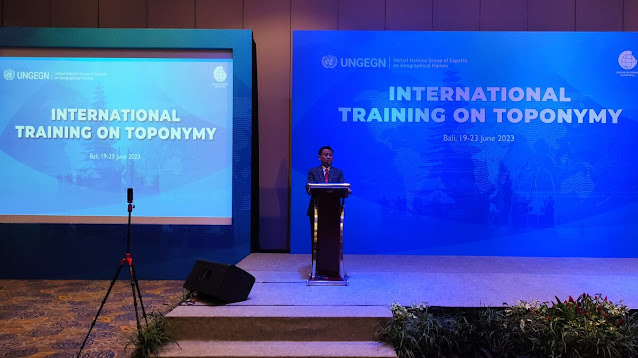

Representative of UNGEGN Secretariat, Cecille Blake, expressed her appreciation to the Geospatial Information Agency (BIG) and the Asia South East (ASE) Division for organizing the toponymy training and selecting Bali as the location for the training. "Toponymy also emphasizes cultural and historical aspects because the naming of locations will become a collective memory of society and cultural heritage," said Cecille Blake regarding the international toponymy training held in Kuta, Badung, Bali, on Monday (June 19, 2023).

The Chairman of UNGEGN Asia South East Division, Nor Zetty Akhtar Haji Abdul Hamid, also expressed her gratitude to the Geospatial Information Agency for organizing the training.


Training ground

Nor Zetty stated that the training activity had been planned since Indonesia's leadership in the UNGEGN ASE Division for the period 2019-2022. However, its implementation was delayed due to the Covid-19 pandemic. "Bali is the right place for the training because participants can directly compare through visits to the location," said Nor Zetty from Brunei Darussalam.

Furthermore, Aris stated that naming a location or geographic feature requires procedures because the naming of a location is also related to formal requirements. Naming a location or place also requires standardization in order to become a standard and not easily changed.

"The local government has the authority to propose the naming of a location because it relates to the value for the region, the cultural roots of the area, and the traditions in the local community," said Aris.

Monday, June 19, 2023

Kazakhstan urged to stop naming after the “mythologized” Soviet figures

 link 

The President of Kazakhstan, Kassym-Jomart Tokayev, proposed to put things in order in onomastics and stop giving objects the names of Soviet figures whose biographies are mythologized. This was reported TASS

The head of Kazakhskan said that it is necessary to identify prominent figures in the history of the state. According to him, these personalities will become key markers of a national identity within the country and beyond.

“It is necessary to stop the practice of naming various objects of the figures of the Soviet period, whose biographies are purposefully mythologized for the sake of someone’s personal interests and preferences,” Tokayev said at a meeting of the National Kurultai.


He added that it is necessary to “put things in order” in onomastics comprehensively and consistently. The head of Kazakhstan stressed that the state should deal with this.

Thursday, June 15, 2023

9th Arab Conference of Arab Experts on Geographical Names

 link 

Geospatial integration between name and Location "importance and impact"

The National Survey Authority (NSA) in the Sultanate of Oman will host the 9TH Conference of Arab Experts on Geographical Names in Muscat under the title "Geospatial Integration Between Name and Location, The Importance and Impact” aiming to attract experts and those who are interested in the field of geographical names and geographical information from inside and outside the Sultanate of Oman.


The Conference details

The conference should have been held in Muscat, from 5-7 December 2022, in coordination with the Presidency of the Arab Division of Experts on Geographical Names and The Royal Jordanian Geographical Centre. But it has been postponed and will be held in Muscat, from 5 - 7 December 2023. 

The Conference Objectives

This conference aims to promote joint Arab work in the following areas:

  • Documenting the geographical names.
  • Standardising the Arabic geographical names.
  • Implementing the Unified Arab System for Romanization 2017.
  • Promoting the work of the national committees and authorities for geographical names.
  • Linking between geospatial information and geographical names.
  • Enabling the Geographical Names.

The Conference topics

The 9th Conference of the Arab Division of Experts on Geographical Names will discuss the following topics:

  • The reality and updates of geographical names in the Arab world.
  • The use of geospatial information applications in monitoring and documenting geographical names.
  • TThe system of standardising the non-Arabic geographical names.
  • Geographical names and other sciences.
  • The role of geographical names in enabling geospatial information.
  • The role of geographical names in the integration of geospatial information.

Conference papers

In the light of the conference topics that have been mentioned above, the conference will discuss many papers specialized in geographical names in the Arab world. The participants from inside and outside the Sultanate can register to participate in accordance with the conditions described on the Arab Division website, by registering and submitting the papers to the specialized technical committee through the participation link above.

Geographical names

Experts define a geographical name as a name applied to a feature on Earth, either (a specific word, combination of words, or expression) in order to refer to a particular place, feature or area having a recognizable identity on the surface of the earth in preparation for its inclusion on the official map. Theses named features include:

  • Populated places such as (cities, towns, villages)
  • Civil divisions such as (provinces, States)
  • Natural features such as (mountains, lakes, seas)
  • Constructed features such as (dams, airports, highways)

The National Survey Authority represents the Sultanate of Oman in regional and international committees and conferences concerned with geographical names. The National Survey Authority is also concerned about all the geospatial activities in the sultanate of Oman, including the responsibility of the geographical names, in terms of ensuring the correctness of them in each map and the literal transfer of the names of places and geographical features from Arabic to English using the unified Arab system for the transliteration of Arabic letters to the Roman (Latin) letters, which is called Romanization. In order to achieve that, the team specialized in geographical names at the National Survey Authority conducts field visits to collect geographical names as well as coordinating with the Ministry of Interior, governorates and governors’ offices to approve geographical names in preparation for their inclusion in its database and use in the map.

Nambudiri Brahmin ancestral house names

Jayaprakash Mallay is presenting his eBooks MALAYALA BRAHMIN AUTOCHTHON THEORY as well as NAMBUDIRIES OF SOUTH INDIA. 


They are all about Nambudiri Brahmin origin and descent traced to an alternative perspective of the fishermen dimension. Nambudiri Brahmins of Kerala in South India are a priestly class of people elevated from a fishing sailing class of remote antiquity. 

Using multidisciplinary approach of Social History, Cultural Anthropology, and Ethno Linguistics this pioneering effort of Jayaprakah Mallay chalks out an interesting discourse through a major theoritical trejectory of Social Mobility concern in Mediaeval Kerala. His fresh insights on single pattern of Nambudiri Brahmin ancestral house name on fish and related sea creatures through etymological derivative is no sheer wild wizardry of words that spill a beguiling spell of Narwhal, turtle, prawns and spawns is what makes Mallay's seminal findings marathon, monumental and unique. 

He first published his book in the print media in 1995 and was praised both by the Press and the Parlour. His finely textured and meticulously researched revised and enlarged edition appears as an eBook in 2O19. You may kindly visit him at : https://mallayj.blogspot.com/


Personal names & socio-political changes - naming trends in the capital of Albania


ANS 2023, January 22, 2023 "Personal names and socio-political changes - a study of naming trends in the capital of Albania, Tirana (1907-2017)" by Linda Mëniku (University of Tirana, Albania) Personal names reflect changes in societal values, personal tastes, and cultural diversity. In this paper, we use information from the Institute of Statistics of Albania (http://www.instat.gov.al) about the top 5 names, to compare the patterns of personal names in Tirana, the capital of Albania to the general patterns of personal names in Albania from 1907-2017 and to explore how the political and social changes have influenced the name choices. Vogues in name usage can be easily shown through the top 5 names, by plotting the rise and fall in their popularity over time. We analyze the connection between naming trends and important historical events in Tirana (before being proclaimed the capital of Albania, 1907-1920, and afterwards) and in Albania: the Independence of Albania, the end of the Second World War, the Communist regime and the transition period after 1990. The data show that trends in personal names can provide important perspectives on political and cultural changes in Albania. LINDA MËNIKU is a Linguistics Professor at Tirana University, Albania. She teaches at the Departments of Linguistics and Journalism, at the University of Tirana, where she specializes in discourse analysis, text linguistics, Albanian as a foreign language, and media discourse. She has been teaching Albanian courses at Arizona State University, CLI, since 2003. She is the author of “The Gheg Reader,” published by Dunwoody Press, “Discovering Albanian,” published by Winsconsin University Press and “Colloquial Albanian,” published by Routledge.

Tuesday, June 13, 2023

Le nom de baptême aux XVe et XVIe siècles

 lien 

Quémener Pierre-Yves (aut.)

Cet ouvrage aborde la question complexe des motivations de la prénomination à l’époque de la Renaissance. De nombreuses études ont été publiées depuis une quarantaine d’années sur l’anthroponymie française. Les chercheurs se sont appliqués à collecter des données et à établir des statistiques. Mais il ne s’agit plus ici de comptabiliser mais d’expliquer. Pour ce faire, ce livre multiplie les comparaisons. Il étudie les évolutions sur une période longue et compare les choix de prénomination dans différentes régions pour établir une synthèse générale. 

Il remet en cause les conceptions courantes sur la prénomination et offrent de nouvelles hypothèses explicatives. Il réfute l’idée selon laquelle le nom de baptême était principalement la marque d’une dévotion religieuse et met en avant les ressorts fondamentaux de la prénomination : assurer à l’enfant les meilleures chances de survie, de bonheur et de prospérité et l’intégrer dans un réseau de relations sociales.

Avec le soutien de l'Université d'Angers.

  • Sommaire
    La conception du nom du Moyen Âge à l’époque moderne
    Évolution et typologie des répertoires onomastiques
    L’influence de la littérature en nomination
    Les références religieuses
    Les traditions familiales et le compérage
    L’anthroponymie féminine, révélatrice des structures familiales
 Version Papier
À paraître
28,00 €

Wednesday, June 7, 2023

Namenrecht und Namenwechsel


Willkommen zur zweiten Folge des Podcasts "OnomastikOn"!
Im Rahmen dieser Folge werden die Themen Namenrecht und Namenwechsel besprochen: Habt ihr euch schon mal gefragt, wer darüber entscheidet, ob der Name eines Neugeborenen zulässig ist? Was muss man heute und musste man früher bei der Namengebung beachten? Unter welchen Bedingungen ist ein Namenwechsel zulässig? Das und vieles mehr gibt es in der zweiten Folge zu hören.
Heute ist Frau Dr. Dietlind Kremer, Leiterin der Namenberatungsstelle der Universität Leipzig und
Onomastik-Dozentin, zu Gast. Wir wünschen euch viel Spaß!

THE UNIVERSITY OF MICHIGAN NAME STORIES PROJECT

 link 

The University of Michigan Name Stories Project was developed by Angelé Anderfuren (Lecturer in the UM – Ann Arbor English Department Writing Program). It was partially funded by the University of Michigan – Ann Arbor LEO Inclusive Teaching Professional Development Fund.

This project aims to pique the curiosity about the world we inhabit everyday, encouraging viewers and participants to look closer and consider not only where they are, but the history of that place and what it meant then, now, and will mean for the future. The project shares the stories behind names. It inquires about the history of the names of places on and around the UM-Ann Arbor campus, exploring the people the places are named after, as well as the history of the names themselves. The project also includes student explorations of their own name histories.

The initial stories in this project were developed and written by Angelé Anderfuren. Additional stories will be written and edited by students in English 125 classes, overseen by Angelé.

50 Jahre Österreichische Namenforschung


Hochkarätig besetzt war die Jubiläumstagung 50 Jahre ‚Österreichische Namenforschung‘ im Adalbert-Stifter-Institut Linz. Petra-Maria Dallinger, Direktorin des Adalbert-Stifter-Instituts des Landes Oberösterreich konnte die führenden Namenforscher aus Österreich, Deutschland, Schweiz und Ungarn begrüßen. Bestens organisiert vor Ort und moderiert hat diese zweitägige Tagung Sprachforscher Stephan Gaisbauer vom Stifter Institut mit seinem Team. Peter Ernst, Universität Wien, ist der Herausgeber der jubilierenden Zeitschrift „Österreichische Namenforschung“. Er ist voll des Lobs für die sprachwissenschaftlichen Aktivitäten des Stifterinstituts: „Das Stifterinstitut ist nicht nur eine erste Adresse der Sprachwissenschaft, sondern auch bekannt für die Gastfreundschaft. Wie Peter Ernst informierte, wird künftig die Zeitschrift „Österreichisches Namenforschung“, als Buch herausgegeben. Die Linzer Jubiläumstagung erscheint somit in Buchform. 


Weitere Informationen erhalten Sie über den folgenden Link 

Die Vortragenden:
PETER ERNST (Wien): Eine kurze Geschichte der Zeitschrift ‚Österreichische Namenforschung‘
WOLF-ARMIN FRHR. VON REITZENSTEIN (München): Die Zeitschrift ‚Blätter für oberdeutsche Namenforschung‘
ALBRECHT GREULE (Regensburg): Namen – im Zeichen von Migration, Popularisierung und Digitalisierung. Versuch einer Standortbestimmung
THOMAS LINDNER (Salzburg): Das ‚Historisch-etymologische Lexikon der Salzburger Ortsnamen‘
ELISABETH GRUBER-TOKIĆ / GERHARD RAMPL (Innsbruck): Flurnamendokumentation Tirol: derzeitiger Stand & Zukunftsperspektiven
WOLFGANG JANKA (Regensburg): Die ortsnamenkundlichen Projekte der Kommission für bayerische Landesgeschichte
HUBERT BERGMANN (Wien): Zur ‚Orthoepie‘ österreichischer Familiennamen
HARALD BICHLMEIER (Jena): Vorstellung erster Ergebnisse des Projekts Sprach- und Kulturdynamik in einer Frontiergesellschaft: Neue Perspektiven auf Nordostbayern und Westböhmen im frühen Mittelalter (Universität Heidelberg / Universität Prag)
MARIETTA CALDERÓN (Salzburg): Onomastik in der deutschsprachigen Romanistik und damit verbundene Interdisziplinarität sowie aktuelle Desiderata
ULRIKE THUMBERGER (Wien): Eigennamen in österreichischen Songs und ihr Beitrag zur Konstruktion nationaler Identität
MARGARETE PLATT (Wien): Flurnamen − aus dem Mittelalter ins 21. Jahrhundert17:15–18:30 Pause
KARL HOHENSINNER (Linz): Auf der Suche nach ‚Orla‘: Ortsnamen im Werk Adalbert Stifters
MARTIN HANNES GRAF (Zürich): Perspektiven der Namenforschung in der Schweiz
Simone BERCHTOLD SCHIESTL (Bern): Der ‚Familiennamenatlas der Deutschschweiz‘
MÁRTA MÜLLER (Budapest): Hodonymische Namensgebungsnormen im Ofner Bergland
FLORIAN JORDAN (Klagenfurt): Dokumentation von mündlich überlieferten slowenischen geographischen Namen in Kärnten – Verschriftlichung und Standardisierung
HEINZ-DIETER POHL (Klagenfurt): Kärnten/Koroška − 1000 Jahre gemeinsames slowenisches und deutsches Namengut
EMANUEL KLOTZ (Innsbruck): Neues zu den slawischen Ortsnamen in Osttirol

Wednesday, May 31, 2023

Virtuelle Namen in Videospielen: Gastvortrag Siegwalt Lindenfelser

 Link 

nOObdOwn und ZornigerVoldemort: Virtuelle Namen in Videospielen: Gastvortrag Siegwalt Lindenfelser

Am 21.06. hält Siegwalt Lindenfelser von 09:15 – 10:45 Uhr einen Gastvortrag im Rahmen der Vorlesung „Namen“ von Barbara Schlücker. Sie sind herzlich zur Teilnahme eingeladen!

Namen in Videospielen stellen eines der jüngsten Stiefkinder der Onomastik dar. Im Vortrag wird zunächst deren Verortung diskutiert und eine eigene Klasse virtueller Namen vorgeschlagen. Im Zentrum steht dann eine graphematische und semantische Fallstudie zu Benutzer-, Gilden- und Städtenamen im browserbasierten Aufbauspiel Forge of Empires.

Der Vortrag findet in Hörsaal 14 statt. Eine digitale Teilnahme via Zoom ist ebenfalls möglich.

Sociální aspekty fungování vlastních jmen


Friday, May 26, 2023

Workshop "Personennamen in Migration"

 Link

Internationale Tagung am Germanistischen Institut am 1. und 2. Juni / Anmeldung bis Samstag, 20. Mai 


Schülerinnen und Schüler wie Kevin und Chantal werden tendenziell schlechter bewertet als Maximilian und Charlotte. Im Kontext von Migrationsgeschichten markieren Namenswechsel, etwa aufgrund erfahrener Diskriminierung, eine Zäsur und mitunter einen Identitätswechsel. Diese Beispiele zeigen: Personennamen sind weit mehr als Bezeichnungen, um Individuen voneinander zu unterscheiden. Sie implizieren zugleich soziale Kategorien – etwa Gender und Generation, aber auch Religion, soziale Herkunft und ethnische Zugehörigkeit. Damit kann der Name zu Prestige oder Stigmatisierung führen und Auslöser für Diskriminierung und soziale Ungleichheit sein.

Der Workshop "Personennamen in Migration: Onymische Indizes hybrider sozialer Zugehörigkeiten" am Germanistischen Institut der Universität Münster bringt am 1. und 2. Juni 2023 zu diesem Thema erstmals europäische Sprachwissenschaftlerinnen und Sprachwissenschaftler zusammen, organisiert von den Linguistinnen Prof. Dr. Antje Dammel, Dr. Katharina König und Dr. Theresa Schweden. Er widmet sich sozioonomastischen, variationslinguistischen und kulturanalytisch-linguistischen Fragestellungen. Ziel ist, neben der internationalen Vernetzung der Forschenden, die Entwicklung einer einheitlichen Methodologie. Der Workshop wird gefördert durch den Internationalisierungsfonds des Fachbereichs Philologie und den WWU-Internationalisierungsfonds.

Veranstaltungsorte sind die Räume VSH 116 und 118 am Schlossplatz 34, 48143 Münster. Interessierte können sich noch bis Samstag, 20. Mai, per E-Mail an schweden@uni-muenster.de anmelden.


Mittwoch, 31. Mai 2023

19.00: Warming Up im "Klemens" 

Donnerstag, 1. Juni 2023

09.00-9.30 Uhr

Antje Dammel, Katharina König, Theresa Schweden (Münster)

Begrüßung und fragengeleitete Einführung

Namenwechsel historisch

09.30-10.30 Uhr

Simone Busley (Mainz)

„Von Johann Jakob Müller zu João Müller – Namen und Identität der Deutschstämmigen in Brasilien von der Auswanderung bis heute“

10.30-11.30 Uhr

Anna-Maria Balbach (Münster)

„Namenwechsel bei Auswanderung Deutscher in die USA“

11.30-12.30 Uhr

Eva-Maria Thüne (Bologna)

„Änderung und Anpassung von Namen nach erzwungener Emigration, Fallstudie: die Kinder des Kindertransports (1938/39)”

12.30-14.30 Uhr

Mittagspause

14.30-15.30 Uhr

Simona Leonardi (Genua)

„Namenverwendung zwischen Wechsel und Bewahrung unter Einwander*innen aus deutschsprachigen Gebieten in Palästina/Israel“

Namenwechsel heute

15.30-16.30 Uhr

Rita Luppi (Bologna)

„Namenswechsel in der 2. Generation der Israel-Migrantinnen“

16.30-17.00 Uhr

Lea Beck (Münster, studentischer Vortrag)

„Namenwechsel in Island“

20.15 Uhr: Abendessen im "Töddenhoek"

Freitag, 2. Juni 2023

Theoretische und methodische Perspektiven auf Namenwechsel

09.00-10.00 Uhr

Mirjam Schmuck (Kopenhagen)

Namenwechsel von Migrant:innen in Dänemark

10.00-10:30 Uhr

Evelyn Ziegler (Duisburg-Essen)

 „Zugewanderte und ihre Namen: zwischen Authentizitätsmarker und sozialer Exklusion‘“

10:30-11.00 Uhr

Miriam Lind (Mainz)

 „Onymische Staatsbürgerschaft? Die Gouvernementalität von Personennamen im Nationalstaat“

11.00-12.00 Uhr

Antje Dammel, Katharina König, Theresa Schweden (Münster), Eva Thüne (Bologna)

 „Namen in Migration: Konzepte und Methoden, Perspektiven und Herausforderungen“

12.00-14.00 Uhr

Mittagspause

14.00-16.00 Uhr

Abschlussdiskussion und Ergebnissicherung

Diskutantin: Evelyn Ziegler (Duisburg-Essen)

Anschlussvorhaben: Vernetzung und Publikation

XXVIII Jornadas de Historia de Jerez

 link  


El lunes 29 de mayo tendrá lugar en el Museo Arqueológico de Jerez la inauguración de la XXVIII edición de las Jornadas de Historia de Jerez que organizan el Centro de Estudios Históricos Jerezanos (CEHJ), junto al Centro del Profesorado de Jerez, y cuentan con la colaboración una vez más del Ayuntamiento y de Diario de Jerez. Tituladas 'Todos los nombres de Jerez. Hasta Regia-Astah, Cerit- Seritium-Xerez… La historia a través de la toponimia', se desarrollarán hasta el 2 de junio. 


Programa de las Jornadas

• Lunes 29 de mayo
19:00 horas
Presentación y entrega de documentación a los inscritos.19:30 horas
José Antonio Correa Rodríguez(Universidad de Sevilla. Filología latina. Profesor Emérito)Ponencia: 'La lengua tartesoturdetana y los topónimos Asta y Jerez'. 
• Martes 30 de mayo
19:30 horas
José Ángel Zamora López (CSIC. Instituto de Lenguas y Culturasdel Mediterráneo y Oriente Próximo). Ponencia: 'Lengua y epigrafía fenicia en el Suroeste peninsular'.
• Miércoles 31 de mayo
19:30 horas
Agustín García Lázaro (Centro de Estudios Históricos Jerezanos.Profesor). Ponencia/Visita guiada: 'Toponimia del marco de Jerez'.(La organización pondrá a disposición de los inscritos un autobúspara el desplazamiento. Se facilitará previamente datos de la ruta,hora de salida y otros detalles de la misma).
• Jueves 1 de junio
19:30 horas
Alicia Arévalo González (Universidad de Cádiz. Arqueología). Ponencia: 'Leyendas monetales y toponimia en las emisiones antiguas de Iberia/Hispania'.
• Viernes 2 de junio
19:30 horas
Elena Moreno Pulido (Universidad de Cádiz. Arqueología). Ponencia: 'Monedas romanas. Su aporte para el conocimiento de la toponimia hispana'.
Inscripciones: para el profesorado de centros públicos se harán en la sede del profesorado de Jerez (CEP), en la Alameda de Cristina, o bien a través del teléfono: 671599619 o mail:mbarbuz758@g.educaand.esPara el resto de interesados, hay que dirigirse al Museo Arqueológico de Jerez: 956 149560 o mail: francisco.barrionuevo.museoarq@aytojerez.es.
Las Jornadas cuentan con la coordinación del CEP: Miguel Barrones Buzón/ CEHJ: Ramón Clavijo Provencio. La sede de las Jornadas será la Sala Julián Cuadra del Museo Arqueológico Municipal.

II Premio de Investigación 

Además, el CEHJ ha abierto el plazo para la segunda convocatoria del Premio de Investigación Centro de Estudios Históricos Jerezanos. Podrán optar al premio todos aquellos trabajos de investigación que, con rigor y método científicos, versen sobre temas relevantes de Historia de la ciudad de Jerez de la Frontera y sucomarca. La fecha máxima de recepción de los trabajos será el 9 de octubre de 2023, y el fallo se hará público dentro del año de la convocatoria.