Showing posts with label onomastic software. Show all posts

Thursday, December 23, 2021

New NamSor onomastics app!

NamSor is a European company applying digital onomastics to gender and migration studies since 2012. They launched their new website recently, which is easier to use by non-IT people (onomasts, geographers, sociologists, social scientists, statisticians, ...)

If you like our content and would like to support e-onomastics, check-out NamSor services via our affiliate link below.
They've been a long partner of us, cited in many of our blog posts. 
They've supported dozens of large scale studies with the World's top universities (Harvard, INSEAD, Chicago University, ...)

They offer a wide range of name classification services,
- to recognize personal names (anthroponyms) from place names (toponyms) or brand names;
- to infer the most likely gender of a personal name, with a probability estimate;
- to guess the likely country of origin of a name;
- to recognize aspects of 'race'/ethnicity for diversity analytics
and more.
Here is a direct link to the app, 
https://namsor.app/?via=eugen 


Wednesday, March 20, 2019

Mylist Platform Thrives with Onomastic Diversity via NamSor

link


NamSor software, which determines Ethnicity, Origin and Gender of an individual based on their name and surname, has delivered tremendous results to the company; Mylist in Dubai. Mylist is a Gift & Reward e-commerce platform that allows you to create online gift lists for: weddings, birthdays, baby showers, and other social events. Operating in Dubai, a global city known for its diverse cultural communities, the Company is looking to benefit from the cultural wealth of one of its most valuable assets: its customer database!

Follow the link to read and find out how big data onomastics adds value to the business model. 

Tuesday, January 15, 2019

Nimisampo – paikannimistön tutkijan työpöytä

link

KUTSU JULKISTUSTILAISUUTEEN

Helsingin yliopiston digitaalisten ihmistieteiden keskus HELDIG ja humanistinen tiedekunta sekä Kotimaisten kielten keskus Kotus kutsuvat Teidät julkistustilaisuuteen:
Nimisampo –
paikannimistön tutkijan
työpöytä

Perjantaina 1.2.2019, klo 14:00–16:00
Tiedekulma, Think Lounge, Yliopistonkatu 4, Helsinki,


Tilaisuudessa avataan ja esitellään uusi, linkitettyyn avoimeen dataan perustuva data- ja verkkopalvelu Nimisampo – paikannimistön tutkijan työpöytä
paikka-aineistojen nimien julkaisemiseksi ja tutkimiseksi verkossa digitaalisten ihmistieteiden keinoin.
Järjestelmä on toteutettu Aalto-yliopiston ja Helsingin yliopiston HELDIG-keskuksen Semanttisen laskennan tutkimusryhmässä (SeCo).

Ohjelma 14:00–16:00

  • Nimisampo – idea ja sen toteutus. Eero Hyvönen, Helsingin yliopisto (HELDIG) ja Aalto-yliopisto
  • Kotuksen nimiarkisto-hanke: data ja sen digitointi. Helinä Uusitalo, Kotus
  • Paikkatyyppiontologian luominen. Tiina Aalto, Helsingin yliopisto
  • Nimisampo-sovellus. Esko Ikkala, Helsingin yliopisto (HELDIG) ja Aalto-yliopisto
  • Nimisammon datapalvelu Linked Data Finland -alustalla. Jouni Tuominen, Helsingin yliopisto (HELDIG)
  • Aiempien vuosikymmenten nimistöntutkimusta Nimisammon taonnassa. Jaakko Raunamaa, Helsingin yliopisto
  • Nimisammon käyttö nimistöntutkimuksessa: esimerkkinä paikannimien variaatio. Terhi Ainiala, Helsingin yliopisto
  • Kuohuviiniä ja verkostoitumista

Wednesday, November 7, 2018

Un logiciel spécial pour la transcription des noms

lien

ERREURS DANS LA TRANSCRIPTION DES NOMS À L'ÉTAT CIVIL

La solution du Haut Conseil de la langue arabe

Par 
L'objectif de ce logiciel est de mettre un terme aux erreurs commises par les employés de l'état civil.
Le président du Haut Conseil de la langue arabe, Salah Belaïd, a fait savoir hier qu'un logiciel spécial pour la transcription des noms et prénoms sera mis prochainement à la disposition des employés de l'état civil. «Ce logiciel, réalisé en collaboration avec le ministère de l'Intérieur, est fondé sur le système de numération (des chiffres à la place des lettres). Il suffit à l'employé de l'état civil d'écrire des chiffres pour qu'il accède à la transcription exacte d'un nom ou d'un prénom donné», a expliqué Salah Belaïd en marge du Séminaire national sur l'onomastique tenu à la Bibliothèque nationale d'El Hamma.
«L'objectif de ce logiciel réalisé sous forme Excel est de mettre un terme aux erreurs caractérisant à présent la transcription des noms», dira le professeur Salah Belaïd, ajoutant que d'autres logiciels sont en phase de finalisation, concernant la signification des noms des villes et des lieux publics.
La démarche du Haut Conseil de la langue arabe vise à l'élaboration d'une banque de données unifiée concernant la signification des lieux. «La connaissance de la signification exacte d'un lieu contribue à la consolidation de la culture des Algériens concernant leur pays. Chose qui renforcera par la suite les liens de fraternité et la fibre nationaliste», soulignera en outre le conférencier. Pour Salah Belaïd, l'élaboration de telles plates-formes est une urgence. «Il n'est pas normal que des villes et hameaux conservent encore des noms d'anciens colonisateurs après plus de 50 ans d'indépendance de l'Algérie», a-t-il insisté. S'exprimant par ailleurs sur l'appellation qui sera privilégiée dans la débaptisation des villes en question, Salah Belaid indiquera que les noms amazighs et de la civilisation musulmane seront privilégiés. Par ailleurs, en présentant des communications à cette occasion, de nombreux enseignants universitaires et chercheurs ont souligné la nécessité de corriger les noms de certaines villes et lieux publics.
«La France, qui a colonisé en dernier l'Algérie a choisi sciemment des noms dévalorisants et insultants pour nommer certaines villes et quartiers», a fait observer Souad Bouhdjar enseignante à l'université de Saïda, passant en revue de nombreux exemples de villes, de hameaux et de quartiers dont l'appellation doit être changée en urgence. Présentant pour sa part une communication, Fatima Louati, enseignante à l'université de Tlemcen et membre du laboratoire de la toponymie du Monde arabe, a indiqué que l'Algérie figure parmi les derniers pays arabes ayant consacré des études à la toponymie. Elle a fait savoir dans ce sens que le Sud algérien est quasiment inconnu en termes de signification des lieux, de même également pour les wilayas du centre du pays.
«Les régions des wilayas de l'Est et de l'Ouest sont plus ou moins connues», précise-t-elle. Fatima Louati a fait observer en outre que l'anthropologie est enseignée uniquement dans quelques universités.
«L'absence de cette spécialité est à l'origine de l'absence d'études et de recherches concernant la toponymie», note-t-elle. Il est à rappeler que le séminaire sur l'onomastique va se poursuivre aujourd'hui. De nombreuses conférences sont au menu.
Le séminaire sera sanctionné par des recommandations.

Sunday, January 21, 2018

Explorer les toponymes officiels de la CTQ avec les tables de fusion Google

geopratic

Vous avez un intérêt pour les toponymes ? Si oui, je vous propose une façon pratique de parcourir les 127 875 toponymes officiels de la Commission de toponymie du Québec (CTQ) en utilisant les tables de fusion Google (documentation en anglais seulement).
Trois affichages sont disponibles :
  1. Le mode Tableau
  2. Le mode Fiche individuelle
  3. Le mode Carte géographique (mode recommandé)
La meilleure façon de parcourir ces milliers de toponymes est de les filtrer par type d’entité et par toponyme. Pour ce faire vous utilisez le bouton « Filter ». Il est présent dans les 3 modes d’affichage.
Ainsi vous pourrez explorer les toponymes d’un des 461 types d’entité distinctes ou appliquer un filtre sur tous les toponymes portant votre nom de famille par exemple. À l’ouverture de la table de fusion des toponymes, des filtres ont été appliqués, à titre d’exemple, au type d’entité et au toponyme.  Ils peuvent être modifiés pour satisfaire vos propres critères.
On retrouve de tout dans les types d’entités : Les fosses à saumon, les districts électoraux en passant par les seigneuries, les anses, les hameaux ou les toponymes de plus de 62 000 lacs.
N’hésitez pas à utiliser le lien donnant accès à la fiche de la Commission de toponymie. De nombreux lieux sont très bien documentés.
Les données proviennent de Données Québec.

Thursday, November 30, 2017

A Xunta propón a recollida colectiva toponimia cun novo programa

Cultura Galega

Toponimízate inclúe unha aplicación para móbil e conferencias


A Secretaría Xeral de Política Lingüística presentaba esta mesma mañáToponimízate, unha nova campaña que se desenvolverá nos concellos adheridos á Rede de Dinamización Lingüística. A Coruña, Arteixo, Boqueixón, Lousame, Melide, Miño, Vedra, Palas de Rei, Sober, Viveiro, O Carballiño, Ourense, Cangas, O Grove e Silleda acollerán, no seo deste proxecto, conferencias do filólogo Vicente Feijoo, especialista en toponimia e membro do Seminario de Onomástica da Real Academia Galega. Nas mesmas abordaranse cuestións xerais sobre a toponimia galega e a súa importancia como patrimonio inmaterial canda a explicacións sobre os nomes de lugar de cada concello.

Ademais, o proxecto desenvolve unha aplicación para teléfono móbil que permitirá a calquera usuario recoller e localizar topónimos contribuíndo así á base de datos sobre toponimia do país. A iniciativa ten entre os seus obxectivos "a chegarlle á cidadanía de cada concello valiosa información sobre a historia do galego falado na súa contorna e sobre os modos de vida dos seus antepasados" a través dos nomes de lugar, "fomentar o uso da lingua galega entre a xente máis nova" ao empregala para se comunicar na recollida de topónimos, fomentar o emprego da nosa lingua nas novas tecnoloxías ou "fornecer os técnicos municipais das ferramentas necesarias que lles faciliten a tramitación de expedientes relacionados coa planificación e xestión do territorio", segundo recolle o web de Política Lingüística.


Obxectivos

Os obxectivos deste programa son múltiples e atinguen tanto á veciñanza coma aos técnicos municipais:

  • Achegarlle á cidadanía de cada concello valiosa información sobre a historia do galego falado na súa contorna e sobre os modos de vida dos seus antepasados, os feitos hisóricos que foron relevantes para eles e as características da paisaxe no momento en que se bautizou cada anaco da súa terra ou cada braza do seu mar. Porque en Galicia todo está nomeado e cada nome ten unha historia que contar, un anaco de historia local que non figura nos libros e que aos veciños e veciñas lles gustará coñecer.
  • Fornecer os técnicos municipais das ferramentas necesarias que lles faciliten a tramitación de expedientes relacionados coa planificación e xestión do territorio do termo municipal, nos que deben empregar os topónimos normalizados, así como a posta en valor e promoción turística da paisaxe e dos elementos do patrimonio material e inmaterial que posúen.
  • Fomentar o uso da lingua galega entre a xente máis nova, pois promoverase que sexa esta a lingua en que interactuen cos seus avós e veciños para preguntarlles polos nomes de lugares e as lendas a eles asociados. Tamén empregarán o galego coas novas tecnoloxías para subir toda esa información a internet. Os topónimos naceron en galego e así deben usarse, tal como se manifesta no artigo 10 da Lei 3/1983 de normalización lingüística.
  • Fomentar a presenza do galego nas tecnoloxías da información e da comunicación. A toponimia moderniza a nosa lingua, porque a imos traballar cunha APP que presentará as últimas novidades en sistemas de información xeográfica e porque abriremos unha ventá ao mundo a través de internet para dar a coñecer a singularidades de cada concello.
  • Xerar dinámicas de traballo que promovan as relacións entre a sociedade, entre as asociacións veciñais e culturais e as administracións. Trátase de buscar a participación de toda a comunidade nun proxecto cultural común, facendo un traballo cooperativo entre varias xeracións, poñendo en valor a sabedoría dos máis vellos, a intrahistoria de cada concello e a conservación do patrimonio inmaterial (tradicións, folclore, coplas, lendas... asociadas aos topónimos). Isto creará un sentimento de identidade colectiva compartida e de continuidade.


Monday, March 7, 2016

Onomasticon - Personal Names Transcription System

http://kalmasoft.com/KMAPS/moltrns.htm

MAPSOno Family MembersRelated DatabasesOther software of interest
Personal Names Transcription SystemDatabase of Arabic Given NamesGeographical Names Romanization System
Personal Names Romanization SystemDatabase of Arabic SurnamesGeographical Names Transcription System
Personal Names Arabicizing SystemDatabase of Arabic Whole NamesGeographical Names Arabicizing System
Personal Names Retreiving SystemDatabase of Names of Arabic OriginsGeographical Names Retrieval System
Arabic Names Location SystemDatabase of Non-Arab Names 
Database of Unique and Indigenous Names 
 Database of Famous Names and Celebrities 

This is a universal multilingual cross transcription system that is capable of generating high accuracy transcription between more than 30 language pairs, a system that uses sophisticated techniques of processing both the input name and the phonetic conventions of the target language, thus producing a wide range Latin and non-Latin based languages versions of the name by taking care of all the complexities of their phonetic systems. All EU official languages, Slavic languages, Russian, Semitic languages e.g. Hebrew, and Hamito-Semitic e.g. Amharic and Tigrinya, Farsi, Hindi are among the target languages to name just a few.Depending on the intended field of application, the system can transcribe names between any pairs of the supported languages but can also transcribe using some 23 transcription/transliteration standards for 16 languages including (UNGEGN, ALA-LC, DIN, SATT, ISO, Nihon-Shiki, Kunrei-Shiki, Transliteration) for Arabic, Russian, Japanese, Korean, Chinese, and Greek for example.
personal names transcription tree
MAPS Name Transcription
A screenshot of the MAPSOno interface, you can view the technical specifications. You may also DOWNLOAD Evaluation copy.

  The sample given below contains multilingual text. Without proper rendering support, you may see question marks, boxes, or other symbols instead of the correct intended characters, you may either get the suitable fonts from our lingual support page or download the PDF version for which no extra arrangement will be needed.

ID
ArabicIPAGreekFrenchGermanSpanishRussianHindiJapaneseTigrinyaHebrew
01خَلْفَان/xalfa:n/ΧαλφανKelfaneKalfanJalfanХaлфaнखल्फान्ハルファーンኵልፍንתָלְפָאן
02وَدِيع/ɶadi:ʕ/ΩαδεαOuediaWadijaWadeaOaдиaवदीअワヅーアወዲህוָדִיעָ
03شَهِيرَة/ʃahi:ra/ΣαεραChehiraSchahiraChahiraШaxирaशहीराシャヒーラሻህረשָׁהִירָה
04مُعْتَز/muʕtaʒ/ΜωταζMoutezMuetazMotazMутaзमुतज़्ムータズሙታዠמֻעְטָזְ
05طَارِق/tˁa:rɪq/TαριγTarikTarikTariqТaрикतारिक्ターリクጣሪቅטָארִק
06مُؤْتَمَن/muʔtaman/ΜωταμανMoutemeneMuetamanMotamanMуtamaнमुतमन्ムータマンሙታማንמֻטָמָן
07دُرِّيَّة/duri:ja/ΔορεαDouriaDurijjaDuryiaДурйяदुर्रीअヅュリーアዶሪኃדֻרִייָה
08أَبُوصَلاَح/ʔbusˁala:ħ/AβωσαλαxBouselahAbw SalahAbw SalahAбу Caлaxअबु सलाह्アブーサラーフእቡሳላሕאָבּוצָלָאח
09الْحَكِيم/əlħaki:m/AλxακεμElhekimeAlhakimElhakymAлxaкиmअल्हकिम्アルハキームእልሓኪምאָלְחָכִים
10قَذَّافِي/qaða:fi:/ΓαζαφιKedafiGadafyQazafyГaзaфийकज़ाफीガザーヒーጋዛፊקָזָאפִי
11سَعُود/səʕu:d/ΣαοωδSeoudeSawdSawudCaоудसऊदサウードሳዉድסָעֻוּד
12حُسَيْن/ħusəin/ΧοσαενHoucineHusajnHusenXуceнहुसऐन्フセーンሁስንחֻסָיְין
13الْجَابِر/əlʤa:bir/AλγαβιρEldjaberAldschabirElgabirAлгaбиpअल्जाबिर्アルジァービルእልጃቢርאָלְגָאבִּר
14طُعَيْمَة/tˁuʕəjma/ΤοαεμαTouemaToejmaToemaToaйmaतुऐमトアイマጡህማטֻעָיְמָה
15مَسْعُود/məsʕu:d/MασωοδMesoudeMasoudMasoudMacоудमस्ऊद्マスードማሱድמָסְעֻוּד
16شَهْد/ʃahd/ΣαδChahdShahdChahdШaхдशह्द्ツャフドሻድשָׁהד
17عُمَر/ʕumar/ΩμαρOumerUmarOmarОmaрउमर्ウマルሁማርעֻמֲר
18سَنَاء/sana:ʔ/ΣαναSenaSanaSanaСaнaяसनाサナーሳናסָנָא
19جَمَال/ʤama:l/ΓαμαλDjamalDschamalGamalΓαmαлजमाल्ジァマールጀማልגמָאל
20مُنَى/muna:/ΜοναMounaMonaMonaMунaमुनाムナーሙናמֻנָא


Friday, May 29, 2015

Gender Gap in Science based on names

http://gendergapgrader.com/2015/04/preview-gender-gap-in-science/

2015_GGG_WomenInScience_Header_v001f

Last year Maryam Mirzakhani, a Professor at Stanford University who was born and raised in Iran, was the first woman mathematician to be awarded with a Fields Medal (a mathematician’s “Nobel Prize”), along with three other laureates: Martin Hairer (Austrian, based in the UK), Manjul Bhargava (Canadian-American, Princeton University), Artur Avila (Brazilian-French, Paris). Their names alone show how incredibly diverse and international science is today.
And yet, in every country of the world, considerable gender gaps remain in practically every scientific field.

Our Sources

To estimate the overall gender gap in science, we inferred the likely gender of about 1,000,000 scientists referenced in ORCID.org and thousands of the world’s most renowned researchers mentioned inHighlyCited.com.
ORCID is a community-driven registry of researchers, with a Board of Directors including members from MIT, Thomson Reuters, Elsevier, CERN and other important organizations. Its aim is to solve the author and contributor name ambiguity problem in scholarly publications: homonyms, name variants, typos, transliterations, use of initials vs. full scientist name… ORCID provides an API and releases a data dump every year for data mining purposes.
HighlyCited is a web site listing researchers who earned the distinction by writing the greatest numbers of reports officially designated by Thomson Reuters’ Essential Science Indicators as Highly Cited Papers — ranking among the top 1% most cited for their subject field and year of publication. The ratio of women in HighlyCited is a matter of initial demographics (ratio of women studying in a given discipline, evolution over time) and recognition of talent by the scientific community. But as in many professions, other social factors may play a part: attrition rate among women pursuing a scientific career, unconscious gender biases in the way scientists themselves accept a paper for publication or make citations, differences in career paths or grants allocations…

Our Findings – Highlights

Those are some of our main findings. Starting from a theoretical ratio of 50% female and 50% male world inhabitants, we estimate that:
  • Among one million scientists in ORCID.org, 33% are women.
  • In 2001 women scientists were 7% of all researchers mentioned in HighlyCited; the number grew to 13% in 2014.
  • The gender gap in HighlyCited researchers is narrower for social sciences (31% women in 2014) compared to computer science (9% women in 2014).
  • In some fields the gender gap is closing fast: HighlyCited women engineers were 11% in 2014, up from 1% in 2001; same for mathematics 11% in 2014, up from 4% in 2001.
  • In other fields the gender gap is not closing (example: HighlyCited female researchers in Physics were 4% in 2014, compared to 5% in 2001).


Kaisa Snellman | Gender Gap Grader
Commenting on the results, Kaisa Snellman, Professor at INSEAD, said:
“I was positively surprised to see that the gender gap in science has narrowed over the past decade. I find it especially encouraging that the share of women among “highly cited” researchers has almost doubled since 2001. At the same time, when I look around in the hallway, most of my tenured colleagues are male. Across universities, women are more likely to get stuck in lecturer and instructor positions that are often part-time and provide no access to tenure track. Of course, the pay is much lower in these adjunct positions – not to talk about job security. Hopefully the narrowing gender gap among highly cited researchers means that in the future we will see more female professors climbing up the career ladder at the same pace as the male scientists.”

Cedric Villani | Gender Gap Grader
Prominent male scientists promote the idea that science is not just for men. In France, Cédric Villani, mathematician who was awarded a Fields Medal in 2010, participated to a discussion with Zena M. (@ScienceFilles) and said,
“I think I generally had more girls than boys in my class until I specialized in Mathematics, then the ratio dropped abruptly. When I studied at ENS (Ecole Normale Supérieure, Paris) in 1992, I was in class with four female students out of forty. But in 1994, there were either six or seven girls studying mathematics at ENS! A record year, which brought to academics some of our best current mathematicians in France: Laure Saint-Raymond, Nalini Anantharaman, Sylvia Serfati*”.
[* Laure Saint-Raymond received the Irène Joliot Curie 2011 « Young female scientist » prize;
Nalini Anantharaman, Sylvia Serfati were both awarded with the Prix Henri Poincaré 2012]

Elaine Filadelfo (Twitter Data), said:
“Those working in STEM fields have the potential to radically change the lives of many people around the world. Not having adequate gender participation in those fields can hinder the ability of these fields to adequately reach 50% of our population — whether through developing medical treatments for women’s health issues or the development of public infrastructure that better serves families or technology designed with a diverse user-base in mind. Through research into the gender gap, we can work to diagnose and treat the issues preventing women’s equal representation.”
We will curate readers’ comments to update this study for June 18th 2015, to coincide with our talk at InspireFest 2015. This international conference takes place in Dublin, Ireland, and focuses on science, technology and innovation, featuring leaders from the world of STEM. If you are in academics and you would like to share your experience and views, we’ll be grateful. Feel free to connect with us here.

Questions / Topics of Interest:

  • Are you surprised by these numbers? If so, how?
  • In your opinion, what are the biggest challenges that female scientists face?
  • Do you think it’s harder to be recognized as a woman scientist?
  • What can be done to improve these numbers, leading to more gender balance?
  • Do you have anything else to add to the discussion?

How it works

We used NamSor API to infer the gender of scientists’ names, recognizing that Andrea Rossini is likely male, whereas Andrea Parker is likely female. The software is highly accurate for all international names, including names of Africa, India… and it recognizes also that the gender of Chinese and Korean names cannot be determined. The error rate on gender gap estimates is typically less than one percent.

Tuesday, January 20, 2015

Applying onomastics to scientometrics

http://namesorts.com/2015/01/20/namsor-presented-during-symposium-on-academic-excellence/


NamSor presented during Symposium on Academic Excellence

Our friend Tania Vichnevskaia of the French National Institute for Health (INSERM) presented the paper ‘Applying onomastics to scientometrics‘ yesterday at IREG ​​International symposium or​​ganised by University of Maribor and Shanghai Jiao Tong University.
NamSor as a private start-up company has been solicited in 2014 by a European country to help measure the ‘brain drain’ affecting its competitiveness in the BioTech sector and to produce a global map of its scientific Diaspora (who are they, where are they and what are they doing). The objective was to build up the country’s scientific international cooperation and to engage its Diaspora.
Serendipity led analysts to discover interesting patterns in the way scientists names affect co-authorship and citation – not just for this particular country, but globally.
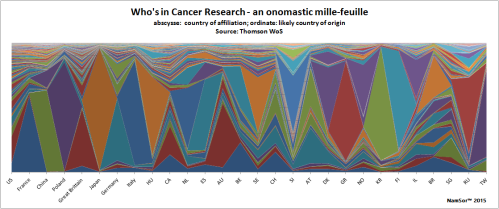
Last year, during ICOS2014 conference at Glasgow University, we presented how data mining millions of scientific articles in PubMed/PMC LifeSciences database uncovered amazing patterns in the way scientists names correlate with whom they publish, and who they cite in their papers.
We were interested to mine the large commercial bibliographic databases (Thomson WoS, Scopus) because they offer better data quality on citations and useful additional information, compared to PubMed:
- firstly, they have the full name in addition to the short name cited with just initials; this significantly reduces the error rate of onomastic classification
- secondly, they link scientists to research institutions (affiliations) and geographies (country of affiliation) ; this allows additional analysis on the topic of Diasporas and brain drain, comparing -for example- the research output of Chinese / Chinese American scientists in the US with that of scientists of Mainland China;
- thirdly, those databases have a larger coverage in terms of scientific disciplines, allowing comparison between different fields of research.
So collaboration started between NamSor and bibliometric experts at INSERM –the French National Institute for Health- to evaluate and visualize the effects of migration, Diaspora engagement and possibly cultural biases in Science.
We’ll publish the slides later today or after the conference. As a teaser, what does the ‘onomastic millefeuille‘ of the global Cancer Research community look like?
201501_ThomsonWoS_CancerResearchOn this same topic:
The agenda of the Symposium is presented below
​​​​​​​2nd Maribor Academicus Event
​​International symposium  or​​ganised by University of Maribor and Shanghai Jiao Tong University
within the IREG Project on Academic Excellence
19-20 January 2015, Maribor, Slovenia
Higher education can importantly benefit from the rankings and league tables when used in a context with clear perspective of what ranking actually reflects (Prof. Jan Sadlak, President of IREG)
Active participants at the conference will be:
  •            Prof. Jan Sadlak, President of IREG,
  •            Prof. Gero Federkeil, CHE (Coordinator of Multi-Ranking),
  •            Prof. Nian Cai Liu,  Jiao Tong University in Shanghai (Author of the Shanghai ranking list),
  •            Prof. Seeram Ramakrishna,  National University of Singapore,
  •            Prof. Santo Fortunato,  Aalto University,
  •            Prof. Karin Stana Kleinschek, University of Maribor,
  •            Prof. Henryk Ratajczak, member of Czech Academy of Sciences,
  •            Prof. Edvard Kobal, Slovenian Science Foundation,
  •            Roberta Sinatra, PhD, Northeastern University,
  •            Tania Vichnevskaia, French National Institute for health (INSERM),
  •            Prof. Andrée Sursock, Senior Adviser at EUA,
  •            Prof. Øivind Andersen, University of Oslo.
About NamSor
NamSor™ Applied Onomastics is a European vendor of Name Recognition Software (NamSor sorts names). NamSor mission is to help understand international flows of money, ideas and people. NamSor launched @FDIMagnet,  a consulting offering to help Investment Promotion Agencies and High-Tech Clusters leverage a Diaspora to connect with business and scientific communities abroad.
http://namesorts.com/onomastics/fdi-magnet/

Wednesday, December 4, 2013

What’s in a Twitter name?


What’s in a Twitter name or handle? Anything: real names, company names, fancy names, pictograms, … the amount of information produced through Twitter is enormous, but it’s possible to filter this ‘bigdata’ in a way to make sense of it. Elian Carsenat created geographic maps of e-Diasporas, by recognizing the Twitter names of geotagged tweets: Irish, Swedish, Russian, etc. He called this Twitter GEOnomastics, borrowing a term from your obedient servant Dr. Evgeny Shokhenmayer (2010).

How does it work? The software accurately recognizes that ‘NamSor Applied Onomastics’ (@NomTri) is probably a trade mark or a company name, whereas ‘Elian Carsenat’ (@ElianCarsenat) is probably a personal name – and most likely a French name. Fancy names are also recognized and filtered out.

The author sees wide applications of such maps. When Captain James Cook explored the seas in the 18th century, having accurate maps could mean life or death for a ship and its crew. Working out latitude had been known for centuries, but measuring longitude was still tricky and inaccurate. In today’s digital world, he sees latitude as ‘recognizing the semantics’ in a message expressed in a particular language and longitude as ‘recognizing the culture’ of the target audience. He's full of curiosity on how and to whom this map can be useful, possibly Twitter itself. Elian Carsenat is going from Paris to Dublin in two weeks to find out : he aspires to meet people at Twitter European Headquarters. Twitter just issued its IPO but is also not clear how to make its money.

Read his next posts to discover more Twitter GEOnomastics maps showing Irish, French, German, Spanish, Russian, Turkish, Swedish, Italian, Dutch e-Diasporas (or cultural influence).

NB. The maps are currently interactive, so you can zoom in and out of a particular territory, however this may be shut down in a month or two.

http://cdb.io/1beWaVB

If you are interested in the Twitter onomastic geotagging, read further here:

What’s in a Twitter name? A glance at the Irish digital Diaspora | NameSorts

http://onomastics.co.uk/whats-in-a-twitter-name/