Showing posts with label onomastic news. Show all posts

Sunday, February 20, 2022

Newsblog „Namenforschung-News“ launched in German

 link and Twitter

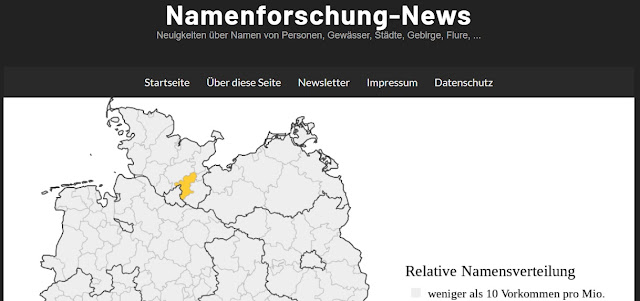
"Namenforschung-News" is a new newsblog that deals mainly with various names actually of everything: people, waters, cities, mountains or fields. This newsblog collects news from other sources. It has been started by an experienced genealogist from Bremen Michael Johne. 

If you want to share any academic names-related news, please contact Michael under info [at] namenforschung [dot] news.

In the German-speaking onomastic world, the "Namenforschung-News" will mostly compete with Onomastik-Blog (run by German Society for Onomastics (Gesellschaft für Namenforschung e.V., GfN) on Website/Twitter/FB; based at the University of Leipzig; about 16-18 news a year), while some news are also published by namenforschung.net (run by members of projects "German Surname Atlas" and "Digital Dictionary of Surnames in Germany" at the Johannes Gutenberg University of Mainz; from 2 to 17 news a year). 


German:

„Namenforschung-News“ ist (technisch betrachtet) ein Newsblog, der sich hauptsächlich mit Namen zu Personen, Gewässer, Städte, Gebirge oder Fluren befasst. Dieser Newsblog trägt Neuigkeiten aus anderen Quellen in dieser Webseite zusammen.

Falls ihr andere Quellen aus dem Bereich der Onomastik (Namenkunde) kennt, die in gewissen Abständen Neuigkeiten veröffentlichen und auf einem gewissen akademischen Grad bewegen, dass würde ich mich freuen, wenn ihr diese unter info [at] namenforschung [dot] news mitteilt.

Saturday, January 22, 2022

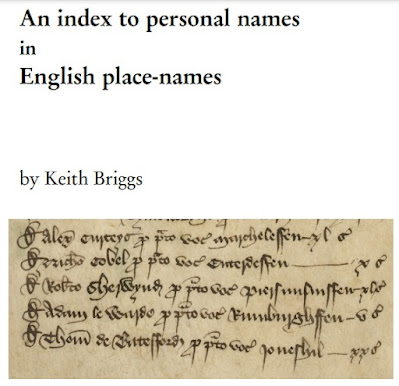
An index to personal names in English place-names

 link

This new book of Keith Briggs was published in April 2021 by the English Place-Name Society. It was launched at the SNSBI spring conference.

Since 2022-01-11 the book (in a slightly corrected version) is downloadable for free.

This index is a finding aid for locating personal names in books about English place-names, primarily those published by the English Place-Name Society (EPNS). The principal purpose is to help researchers evaluate the probability of existence of conjectural personal names when considering new etymologies. The main index is an alphabetical list of those personal names which have been suggested to occur as elements in place-names, disregarding whether or not those suggestions are generally accepted. It should also be emphasized that this is not a list of specific identifiable people; it is an index of name-forms or name-types. The index also contains Anglo-Saxon personal names from additional (non-place-name) sources.

The book contains 12,598 headforms and 16,041 place-name forms in total. 8,057 of the headforms are not in the Prosopography of Anglo_Saxon England (PASE) database. Amongst all headforms, 551 are feminine (4.4%), and 344 headforms not in PASE are feminine (2.7%).

This is (coincidentally) an ultimate baby-name book. Nearly every name is authentic, but not now in use.

To order, please visit the other publications section of the EPNS website.

Senior Project Officer to support Aboriginal place naming in NSW

 Link

NSW is looking for someone to work in the Aboriginal place naming space. An exciting opportunity what with the United Nations Decade of Indigenous Languages upon us 2022 - 2032.


We’re HIRING! We’re looking for a Senior Project Officer to lead initiatives designed to support Aboriginal place naming in NSW. Place naming is identified as an effective way to reawaken Aboriginal languages, unlock past stories and preserve traditions. You will work closely with government agencies and the community to support Aboriginal language revival through place naming. By supporting the use of Aboriginal language in place naming we can reawaken the oldest languages in the world and strengthen NSW First Peoples’ connections with culture and identity. This role can be based at either of our offices – Bathurst or Sydney. Find out more: https://lnkd.in/gT77xv4X #AboriginalPlaceNaming #Aboriginallanguages #Languagerevival #Indigenouslanguages #PlaceNaming #GeographicalPlaceNaming #SurveyorGeneral #makeadifference

Tuesday, August 3, 2021

Maître assistant-e suppléant-e dans un projet de Chaire Unesco en toponymie

 lien 

Maître assistant-e suppléant-e au Département de géographie et environnement

Description du poste

La Faculté des Sciences de la Société et son Département de Géographie et Environnement ouvrent une inscription pour un poste temporaire (3 mois) de Maître Assistant-e suppléant-e à 100%. Les champs concernés par ce poste temporaire en géographie sont la toponymie politique et les border studies.

Ce poste est principalement dédié à la conception et au développement d'un Mooc de niveau Master bilingue dédié aux « dénominations du Monde » et prévu dans le cadre d'un projet de Chaire Unesco en toponymie. Le poste vient également en appui au Master en Géographie politique et culturelle.

Le/la candidat-e séléctionné-e sera appelé-e à:

  • Préparer et développer un Mooc Bilingue (Anglais-Français) sur les « Dénominations du Monde ».
    Prise de contact avec tous les intervenants internes et externes, définition du déroulé, des contenus (en collaboration avec la direction de la chaire), des sous-titrages, des illustrations (avec obtention des droits), des évaluations.
  • Appui au Master en Géographie politique et culturelle sous forme d'interventions ponctuelles sur les cours en géographie politique (3 interventions de 2 heures) et notamment le cours Territoires et Frontières.
  • Personne ressource pour l'appui à la définition étudiante de sujets de mémoire de master de la volée de deuxième année 2021.
  • Réalisation en collaboration avec la chaire en toponymie inclusive d'une proposition de recherche au FNS sur le croisement Borderlands et toponymie politique.


Titre et compétences exigés

Doctorat et recherches en géographie politique ou titre jugé équivalent.
Expérience d'enseignement au niveau universitaire.
Avoir effectué un séjour doctoral ou post-doctoral d'au moins un an dans une autre université étrangère ou pouvoir justifier d'une insertion active dans un réseau de recherche international dans le domaine des border studies et/ou de la toponymie politique.

Entrée en fonction

1er octobre 2021

Contact

Les dossiers de candidature comprenant une lettre de motivation, un curriculum vitae, une copie des diplômes, une liste des publications, ainsi qu'un résumé des recherches personnelles envisagées doivent être déposés exclusivement en ligne en cliquant sur le bouton ci-dessous "Postuler/Apply now", avant le délai indiqué ci-dessus (23h59 heure de Genève).

Des renseignements sur le poste peuvent être obtenus auprès du Professeur Frédéric Giraut, directeur du Département de géographie et environnement.

Informations complémentaires

La durée de l'engagement est de trois mois non renouvelable. Engagement sur fonds du Département de l'Instruction Publique (DIP).

L'Université de Genève offre des conditions d'engagement motivantes dans un cadre de travail stimulant. En nous rejoignant, vous aurez l'occasion de mettre en valeur vos compétences ainsi que votre personnalité et contribuer activement au rayonnement d'une Institution fondée en 1559.

Dans une perspective de parité, l'Université encourage les candidatures du sexe sous-représenté.

Université de Genève
66 boulevard Carl Vogt
1211 Genève

Tuesday, March 30, 2021

NASA is using the Navajo Language for Martian toponyms

 link 

Since its landing on the surface of Mars in mid-February, NASA’s Perseverance rover has been diligently documenting every detail and sending more than 7,000 images back to Earth. A common activity undertaken by surface missions is to assign nicknames to the various landmarks discovered by the rover; this provides the mission team with a common vocabulary with which to discuss their findings. The team for the Mars 2020 mission is working in conjunction with the Navajo Nation to name the various features and geological landmarks discovered on the Red Planet’s surface with words from the Navajo language...

Thursday, February 4, 2021

Borgue Field Names Talk on the 10th February 2021

 link 

Over the last 18 months a small team of local volunteers have collected and mapped nearly 1,000 field names analysing the meaning and possible origin of every name gathered.

Old field names act as a memorial, telling the story of the way the land was farmed and making connections between people and places, past and present.

Speakers Rachel Lucas, John Shields and Michael Ansell will describe how the names were collected and analysed, where you can find the results as well as presenting some of the research behind local field names.

February 10th 7.00pm

To register please contact secretary@kirkcudbrighthistorysociety.org.uk by February 5th.

Your initial email will be responded to, followed by an email confirming registration on 6th. If you don’t receive this email, please contact the same email address again. The invitation will be sent out on the 8th.

Sunday, December 20, 2020

El projecte sobre l’onomàstica d’Assumpció Rehues guardonat amb el III Premi Ramon Amigó

 link

La directora general de Política Lingüística, Ester Franquesa, i la vicerectora de Relacions Institucionals, Cultura i Compromís Social de la Universitat Rovira i Virgili, Cori Camps, van lliurar ahir a la tarda el III Premi Ramon Amigó i Anglès a Assumpció Rehues Estivill, que va presentar un projecte sobre l’onomàstica del Bruc (l'Anoia).

Aquest guardó està convocat per la Fundació URV, a través del Departament de Filologia Catalana, i el dota la Direcció General de Política Lingüística amb 6.000 €. Es concedeix a treballs de recerca que tinguin com a objectiu la confecció d’inventaris de noms de lloc i de persona i, de manera preferent, als treballs que ajudin a acabar de completar l’estudi de l’àrea geogràfica corresponent a l’àmbit de la Universitat Rovira i Virgili. En aquesta edició s’hi havien presentat 9 projectes.

La directora general de Política Lingüística va destacar que la tercera edició d'aquest premi hagi rebut propostes d’altres territoris del domini lingüístic, com ara de la Catalunya del Nord, la Franja de Ponent, les Illes Balears i el País Valencià. També es va felicitar perquè el projecte premiat en la primera edició ja s'hagi editat.

Assumpció Rehues ha de desenvolupar el treball que ha resultat guanyador durant els dos propers anys, del qual en farà seguiment el Departament de Filologia Catalana de la Universitat Rovira i Virgili i l’Oficina d’Onomàstica de l’Institut d’Estudis Catalans.

Wednesday, April 22, 2020

Hard but necessary decision: ICOS 2020 Kraków POSTPONED

ICOS

Dear Colleagues,
The Organizing Committee of the Congress has been closely observing the global outbreak of the COVID-19 disease and its consequences, including those which might impact international conferences scheduled for the summer months of 2020.
In the face of the pandemic spread of Covid-19, after considering and evaluating all the implications, as well as the forecasts on the progress of the disease, the Organizing Committee in Kraków together with the ICOS Board of Directors believe that it is impossible to hold the Congress on the scheduled date. Therefore, we announce the postponement of the Congress to 22-27th of August 2021.
We sincerely regret any inconvenience and hope to meet all of you in less turbulent times in Kraków next year.
In connection with the decision of the postponement of the ICOS Congress to 22-27th of August, 2021, the Early Bird registration has been extended to the 31st of March, 2021.
IMPORTANT!
The Organizing Committee would like to inform you that all registration fees received, abstracts accepted, and the conference programme already prepared for this year will be carried over to 2021.However, we will understand if someone resigns from the Congress or if he or she wants to update his/her abstract. So please inform us about your decision or any changes till the end of 2020.
More information concerning the Congress will appear successively on our website and on Facebook. In case of any question, please contact us at icos2020@ijp.pan.pl
Stay safe!
Best wishes,
Maciej Eder, Barbara Czopek-Kopciuch, Urszula Bijak and the Organizing Committee
Paula Sjöblom and the ICOS Board of Directors

Tuesday, April 2, 2019

New Board of Directors of Greek Onomastic Society (2019-2022)


The new Board of Directors has been elected at the annual general meeting of the Greek Onomastic Society on Friday 15 March 2019. 


The following colleagues are now part of it:

PRESIDENT:                 Tzavaras, O.
VICE-PRESIDENT:      Georgiades, Ger.
SECRETARY:                Vrachionidou, M.
TREASURER:               Papadopoulou, El.
MEMBERS:                   Dalkos, Chr.
                                        Sergis, M.

                                        Hidiroglou, Alk.

Monday, March 4, 2019

Polskie Towarzystwo Onomastyczne powstało w 2018 roku

Polskie Towarzystwo Onomastyczne powstało w 2018 roku. Jest stowarzyszeniem rejestrowym, którego głównym celem jest wspieranie badań nad nazwami własnymi oraz promocja naukowego dorobku onomastów (tj. badaczy zajmujących się nazwami własnymi).


Szczególnym celem Polskiego Towarzystwa Onomastycznego jest upowszechnianie ustaleń polskiej onomastyki.

Towarzystwo skupia przedstawicieli różnych subdyscyplin językoznawczych i innych nauk, dla których nazwy własne są głównym lub pobocznym przedmiotem zainteresowania. Członkiem Towarzystwa może zostać każdy, kto jest chętny działać na rzecz realizacji celów Towarzystwa, niezależnie od posiadanego obywatelstwa czy afiliacji.

Zapraszany do zapoznania się z działaniami PTO oraz z sylwetkami członków Towarzystwa.

Wszystkich zainteresowanych nazwami własnymi serdecznie zapraszamy do wstępowania w szeregi Polskiego Towarzystwa Onomastycznego! Więcej tutaj: https://sites.google.com/site/poltowonomastyczne/home/zostan-czlonkiem

Członkowie

Sylwetki członków PTO (lista niepełna)


Polskie Towarzystwo Onomastyczne skupia obecnie:
pięcioro profesorów tytularnych,

ośmioro doktorów habilitowanych,

siedmioro doktorów

i jednego magistra,
w tym 10 kobiet i 11 mężczyzn z jedenastu uczelni i instytutów naukowych w całej Polsce:

Uniwersytet Kazimierza Wielkiego w Bydgoszczy
Uniwersytet Jagielloński
Uniwersytet Pedagogiczny im. KEN w Krakowie
Instytut Języka Polskiego PAN w Krakowie
Uniwersytet Marii Curie-Skłodowskiej w Lublinie
Katolicki Uniwersytet Lubelski Jana Pawła II
Uniwersytet Warmińsko-Mazurski w Olsztynie
Uniwersytet im. Adama Mickiewicza w Poznaniu
Uniwersytet Rzeszowski
Uniwersytet Warszawski
Uniwersytet Wrocławski.


Członkiem Towarzystwa może zostać każdy, kto jest chętny działać na rzecz realizacji celów Towarzystwa, niezależnie od posiadanego obywatelstwa czy afiliacji.

Sunday, November 4, 2018

In Nōminum Spatio (В пространстве имен). Выпуск 3

link

ISSN 2522-9192 (online)

In Nōminum Spatio (В пространстве имен): Материалы Международных ономастических чтений им. Е.С. Отина / Под. ред. В.М. Калинкина. – Вып. 3. – Донецк: Издание Фонда «Азбука», 2018. – 182 с.

СОДЕРЖАНИЕ
Ономастика
В.М. Калинкин (Донецк). Основоположник ономастического краеведения Донбасса Читать

Перечень опубликованных работ Е.С. Отина по ономастическому краеведению Донбасса 

Ю.П. Брайловская (Луганск). Гидронимия Луганщины Читать

С.Ф. Бут-Гусаім, Т.П. Дыдышка (Брэст, Беларусь).
Аналiз нацыянальна-культурнай адметнасцi рэгiянальнага iменаслову Берасцейшчыны ў дыпломных працах студэнтаў фiлалагiчнага факультэта Читать

Е.Е. Вертейко (Брест, Беларусь). Своеобразие антропонимикона православных жителей Бреста в период ВОВ и оккупации Читать

Т.Р. Галеева (Владимир). Способы словообразования географических названий, исчезнувших с карты (на материале Камешковского района Владимирской области) Читать

О.С. Евсеева (Заборье, Смоленская область). Растительный мир смоленско-витебской приграничной зоны, отраженный в наименованиях топонимических единиц Читать

А.И. Илиади (Кировоград). Неславянская лексика в гидронимии Дона: этимологические этюды. II Читать

Е.В. Киселёва (Донецк). Активность Д. Трампа в Твиттере как катализатор окказионального словотворчества американцев Читать

Л.В. Леванцэвіч (Брэст, Беларусь). Анамастычная лексiка Брэстчыны: узаемадзеянне мовы i культуры Читать

Е.Р. Николаев (Якутск). К вопросу о коннотативности заимствованных русских личных имен в якутском именнике Читать

И.В. Пантелеев (Тула). Названия лесов в эпистолярном наследии А.Т. Болотова и Л.Н. Толстого Читать

А.А. Показанникова (Ровеньки, ЛНР) . Имя Михаил в истории поселка Михайловка Читать

Е.Ю. Просолова (Витебск, Беларусь). Эмоционально-характерологические названия в годонимной системе Белорусского Поозерья: структура, семантика Читать

Р.В. Разумов (Ярославль). Эвсемантические топонимы в системах урбанонимов русских городов Читать

Ж.А. Руденко (Севастополь). Севастопольские экклезионимы на африканском берегу в Бизерте (Тунис) Читать

Поэтонимология

В.М. Калинкин (Донецк). Роль В.Н. Михайлова в становлении и развитии поэтонимологии (литературной ономастики) Читать

Е.С. Василевская (Минск, Беларусь). Особенности личностной номинации в повести Владимира Короткевича «Ладья отчаяния» Читать

И.А. Королёва (Смоленск). Биографизм имен собственных в ранней лирике А.Т. Твардовского Читать

К.Ю. Курс (Смоленск). Особенности употребления онимов, отражающих тему Великой Отечественной войны, в творчестве М.В. Исаковского Читать

О.В. Ланская (Липецк). Имя собственное в пространстве художественного мира Л.Н. Толстого Читать

И.В. Логвинова (Москва). Персонажи-рассказчики в комедии Л. Тика «Кайзер Октавиан» Читать

Е.В. Минина, М.В. Котлярова, К.С. Ковалевская(Горловка). Реальные и вымышленные антропоэтонимы в оригинале и переводе (на материале романа Кена Фолетта «Столпы земли» Читать

Н.В. Усова (Донецк). Мифологическое мышление и «язык собственных имен» Читать

А.И. Овчаренко (Донецк). Экклезио поэто ним как сакральная деталь в рассказе И.А. Бунина «Лёгкое дыхание» Читать

Сведения об авторах 
Summaries 

Wednesday, January 24, 2018

Katharina och namnen


Thursday, November 30, 2017

A Xunta propón a recollida colectiva toponimia cun novo programa

Cultura Galega

Toponimízate inclúe unha aplicación para móbil e conferencias


A Secretaría Xeral de Política Lingüística presentaba esta mesma mañáToponimízate, unha nova campaña que se desenvolverá nos concellos adheridos á Rede de Dinamización Lingüística. A Coruña, Arteixo, Boqueixón, Lousame, Melide, Miño, Vedra, Palas de Rei, Sober, Viveiro, O Carballiño, Ourense, Cangas, O Grove e Silleda acollerán, no seo deste proxecto, conferencias do filólogo Vicente Feijoo, especialista en toponimia e membro do Seminario de Onomástica da Real Academia Galega. Nas mesmas abordaranse cuestións xerais sobre a toponimia galega e a súa importancia como patrimonio inmaterial canda a explicacións sobre os nomes de lugar de cada concello.

Ademais, o proxecto desenvolve unha aplicación para teléfono móbil que permitirá a calquera usuario recoller e localizar topónimos contribuíndo así á base de datos sobre toponimia do país. A iniciativa ten entre os seus obxectivos "a chegarlle á cidadanía de cada concello valiosa información sobre a historia do galego falado na súa contorna e sobre os modos de vida dos seus antepasados" a través dos nomes de lugar, "fomentar o uso da lingua galega entre a xente máis nova" ao empregala para se comunicar na recollida de topónimos, fomentar o emprego da nosa lingua nas novas tecnoloxías ou "fornecer os técnicos municipais das ferramentas necesarias que lles faciliten a tramitación de expedientes relacionados coa planificación e xestión do territorio", segundo recolle o web de Política Lingüística.


Obxectivos

Os obxectivos deste programa son múltiples e atinguen tanto á veciñanza coma aos técnicos municipais:

  • Achegarlle á cidadanía de cada concello valiosa información sobre a historia do galego falado na súa contorna e sobre os modos de vida dos seus antepasados, os feitos hisóricos que foron relevantes para eles e as características da paisaxe no momento en que se bautizou cada anaco da súa terra ou cada braza do seu mar. Porque en Galicia todo está nomeado e cada nome ten unha historia que contar, un anaco de historia local que non figura nos libros e que aos veciños e veciñas lles gustará coñecer.
  • Fornecer os técnicos municipais das ferramentas necesarias que lles faciliten a tramitación de expedientes relacionados coa planificación e xestión do territorio do termo municipal, nos que deben empregar os topónimos normalizados, así como a posta en valor e promoción turística da paisaxe e dos elementos do patrimonio material e inmaterial que posúen.
  • Fomentar o uso da lingua galega entre a xente máis nova, pois promoverase que sexa esta a lingua en que interactuen cos seus avós e veciños para preguntarlles polos nomes de lugares e as lendas a eles asociados. Tamén empregarán o galego coas novas tecnoloxías para subir toda esa información a internet. Os topónimos naceron en galego e así deben usarse, tal como se manifesta no artigo 10 da Lei 3/1983 de normalización lingüística.
  • Fomentar a presenza do galego nas tecnoloxías da información e da comunicación. A toponimia moderniza a nosa lingua, porque a imos traballar cunha APP que presentará as últimas novidades en sistemas de información xeográfica e porque abriremos unha ventá ao mundo a través de internet para dar a coñecer a singularidades de cada concello.
  • Xerar dinámicas de traballo que promovan as relacións entre a sociedade, entre as asociacións veciñais e culturais e as administracións. Trátase de buscar a participación de toda a comunidade nun proxecto cultural común, facendo un traballo cooperativo entre varias xeracións, poñendo en valor a sabedoría dos máis vellos, a intrahistoria de cada concello e a conservación do patrimonio inmaterial (tradicións, folclore, coplas, lendas... asociadas aos topónimos). Isto creará un sentimento de identidade colectiva compartida e de continuidade.


Thursday, November 16, 2017

Call for papers: "Names in Writing" Conference in Sweden

University of Gothenburg

NORNA:s 48th symposium


29–30 November 2018, University of Gothenburg and Institute for Language and Folklore, Gothenburg

Call for papers


The study of writing has gained increasing importance within linguistics and culture studies in recent years. The field has widened substantially focusing not only on graphemics and spelling principles, but also on the mediality of writing, writing practices and social dimensions of writing. Within name studies, the study of writing has not yet been recognized as a field in its own right, even though written names have been a recurring subject of analysis. At the same time, there are studies outside the traditional field of name studies that focus on written names from several of the above named perspectives.
The theme of this symposium is names in writing. It will give scholars a chance to reflect on the significance of writing in the study of names and provide a platform to discuss approaches from different fields.

Topics could include, but are not limited to:

  • The graphemics of names, names and orthography
  • Nomenclature
  • Names in different writing systems
  • Language development in written names
  • Written names in language contact
  • Typography and graphics of names
  • Written name and identity
  • Written name and authority
  • Written names in the public sphere

We invite proposals for 20-minute paper presentations or for posters on any topic related to names in writing, from both modern and historical contexts. Please send an abstract of up to 300 words (excluding references) to namniskrift@sprak.gu.se by 20 February 2018. Include your name, email address and affiliation in your abstract. Feedback and letters of acceptance will be provided by 30 April 2018.

Invited speakers (confirmed):


  • Johan Järlehed (University of Gothenburg)

            • Damaris Nübling (University of Mainz)
        

Conference languages

Nordic languages, English

Publication

We plan to publish conference proceedings using a peer review process. An invitation for submission of contributions will be sent out separately after the conference.

Practical information

Practical information on organizational matters will be published here by January 2018.
The conference is arranged by the Department of Languages and Literatures, Gothenburg University, and Institute for Language and Folklore, Gothenburg. Venue: Olof Wijksgatan 6, Gothenburg ("Gamla hovrätten").

Contact information

Organizing committee

Maria Löfdahl, Institute for Language and Folklore, Gothenburg
Michelle Waldispühl, Department of Languages and Literatures, University of Gothenburg
Lena Wenner, Institute for Language and Folklore, Gothenburg

Contact address