Wednesday, November 16, 2022

Book "Encountering Toponymic Geopolitics"

 link 


Place Names as a Political Instrument in the Post-Soviet States

Edited BySergei Basik
Edition1st Edition
First Published2022
eBook Published1 November 2022
Pub. LocationLondon
ImprintRoutledge
Pages204
eBook ISBN9781003293057
SubjectsGeography, Politics & International Relations

ABSTRACT

This book provides cutting-edge insights on contemporary geopolitical toponymic policy and practice in post-Soviet countries. It examines the political features of place naming as a reflection of contemporary political discourse.

With multidisciplinary insights from leading scholars, chapters explore a range of topics drawing on critical political toponymy and traditional methods. Contributions examine how the toponymic system can act as a symbol of national identity, the regional geopolitics of toponymy, and geopolitical patterns in contemporary renaming. The historical roots of toponymic decolonization are analyzed, as well as indigenous toponymy and politics, and toponymic aspects of people's daily lives. The book explores a wide range of processes in the post-Soviet realm, including power, identity, economy, social order, and how political power is changing/transforming. It considers how these processes are distributed through various geopolitical and political-economic technologies.

Offering empirically rich research from a variety of regions to give insights beyond "Western" perspectives, this book is the first to provide an in-depth exploration of post-Soviet place naming. It will appeal to students and researchers in human geography, politics, sociology, Eastern European studies, onomastics and cultural studies.

Chapter 1|28 pages

Encountering Toponymic (Geo)politics in the Post-Soviet States

Introduction
BySergei Basik

Chapter 2|20 pages

The "Ultimate Toponym" and National Imaginaries in Georgia and Azerbaijan

Inhibiting Imaginaries of Borchali Among Georgia's Azeri-Turks
ByKarli-Jo T. Storm

Chapter 3|17 pages

Nation-Building by Virtue of the Local Renaissance

"Exemplary" Decommunization of Street Names in Vinnytsia, Ukraine
ByOleksiy Gnatiuk

Chapter 5|19 pages

Communist Markers in the Information Space of Post-Communist Society

The Case of Ukraine
ByAleksander Kuczabski

Chapter 6|19 pages

Toponymic Transformation in the Capital Centers of the North Caucasus

The Politics of Identity and Memory
ByValeri Thakahov

Chapter 7|17 pages

Naming the Arctic and Siberia

The Role of Cartographic Agencies in the Soviet Toponymic Policy and Practice
ByNadezhda Mamontova

Chapter 8|16 pages

Radical Memorialization in Kazakhstan

Spaces, Places, and Capitals
ByKulshat Medeuova, Zhomart Medeuov

Chapter 9|20 pages

Onomaturgies of Toponymic Commodification in Minsk, Belarus

ByJani Vuolteenaho, Sergei Basik

Chapter 10|8 pages

Conclusion

Toward the Future Post-Soviet Political Toponymies
BySergei Basik

Saturday, November 12, 2022

IV Jornadas Antroponomásticas in tweets


The IV Jornadas Antroponomásticas were closed on November 9, 2022. It was a great onomastic event dedicated to the integration of people, cultures and languages in Latina America in the light of their names.

Thursday, November 10, 2022

Brdar-Szabó & Brdar: Anthroponymy: More metaphor and metonymy than meets the eye


The lecture series Onomastics Online continued on 10 November 2022 with a presentation given by Professor Rita Brdar-Szabó (Eötvös Loránd University) and Professor Mario Brdar (University of Osijek) with the title "Anthroponymy: More metaphor and metonymy than meets the eye". 0:00 - 2:38 Introduction 2:38 - 43:18 Presentation 43:18 - 1:02:03 Discussion

Wednesday, November 9, 2022

Conference on "Language and Power"

 Onomastics could be a suitable topic for a talk at the Conference on "Language and Power"

 Here is a link to EasyChair for the registration (CFP (easychair.org)).

This is their Facebook link: Language and Power (facebook.com)


Our Call for Papers has been extended! Please submit your abstracts for your 20-minute presentations in a PDF format via EasyChair until 1 pm December 25th, 2022 (https://easychair.org/conferences/?conf=lap2023).

Overview

Given its social nature, language is inextricably linked to power relationships. It can be used to manipulate and persuade, show dominance and, ultimately, establish hierarchies in society. Every person capable of language is, therefore, a subject of a power play, which often becomes a conduit for social inequality. A long-standing opposition between the standard and the vernacular, the language of elitist groups and disadvantaged minorities has been affecting the lives of speakers from a multitude of ethnic, cultural and socio-economic backgrounds. At the same time, language and language practices are also affected by existing power relations: which language shall be chosen as official or national in a state, which variety to teach at school and how to carry out language reforms, – these and other issues have long been challenging academic and practical thought. In the 21st century, with the ever-growing dominance of English, the projected loss of many endangered languages, and the pandemic and wars furthering social disparities, the issues of language-power relationships are gaining ever more significance.

In our conference Language and Power we would like to engage in a critical discussion of the following questions:

  • How can language establish gender equality or postulate the prevalence of a certain gender?

  • How do language-related power structures affect minorities? How can we as scientists support these communities?

  • What are the mechanisms and consequences of the in-group and out-group differentiation based on language?

  • In what way is the government’s political discourse reflected in educational institutions?

  • How can linguistic structures influence our thinking, reinforce, amplify, or combat discourses of oppression?

  • What are the responsibilities of practitioners and scientists with regard to language and power? (for example, in the classroom or when it comes to language reforms)

Abstract submission

We expect contributions addressing, but not limited to, the following topics and themes:

  • Gender linguistics and raciolinguistics

  • Minority language and heritage language issues

  • Language of marginalized groups

  • Language policy, including language planning, education and diversity preservation

  • Standardization and language reform

  • Language ideology in education, political discourse, court, workplace and the media

  • Multilingual development in education

Please submit your abstracts for 20-minute presentations in a PDF format via EasyChair unti1 pm December 25th, 2022 (https://easychair.org/conferences/?conf=lap2023). The abstracts should not exceed 400 words (references are not included in the word count). References, graphs and tables can be provided separately. Please make sure your name and affiliation are NOT included in your abstract or in the additional material you provide. Abstracts should have a clear linguistic focus, even if the work presented is interdisciplinary. The language of the conference is English, but we are looking forward to works dealing with a variety of languages. Notification of acceptance emails will be sent out before January 15th, 2023.

The conference proceedings will be published in a digital format on the publication server of the University of Münster.


Conference fee

The conference fee for participants and attendees is 30 euros, which includes refreshments.


Keynote speakers 

We are happy to announce that the following distinguished researchers will deliver keynote speeches:

Professor Dr. Theodossia-Soula Pavlidou (The Aristotle University of Thessaloniki– joining online

Professor Dr. Galina Putjata (Goethe University Frankfurt am Main)

Professor Dr. John Gray (University College London)


Organizing team

The conference is organized by the members of the Graduate School Empirical and Applied Linguistics, the University of Münster:

  • Polina Kashkarova

  • Oleksandra Kuzmenko

  • Anila Nosheen

  • Sara Serroukh

  • Rieke Siemon

  • David Wirthmüller

Contact

If you have questions, do not hesitate tcontact us: language.power23@uni-muenster.de . You can also find us on facebook (https://www.facebook.com/profile.php?id=100086362235803) and twitter (@LanguageandPow1)!


Monday, November 7, 2022

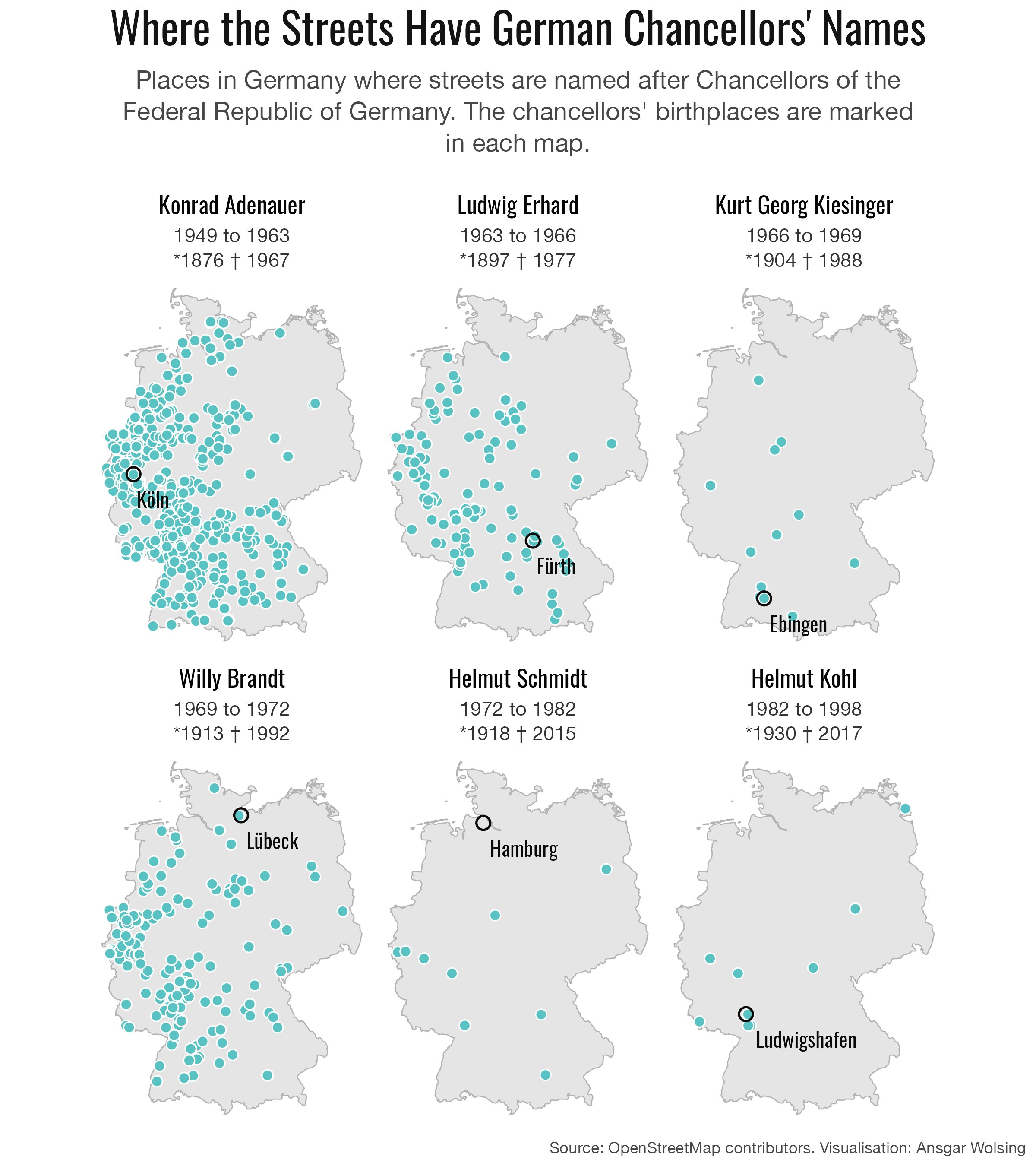
Where the Streets have German Chancellors’ Names

 by Ansgar Wolsing

Towns in 🇩🇪 where streets are named after chancellors of the Federal Republic of Germany.


Konrad Adenauer (CDU, Christian Democrats), the 1st chancellor of West Germany from 1949-63, has the most streets named after him. A divide between East and West is clearly visible.


Willy Brandt, 1st chancellor from the Social Democrats (SPD), has the second most streets named after him. Lots of places in North Rhine-Westphalia, Rhineland-Palatinate, Hesse and Lower Saxony, but only few in Bavaria. 


Given that both passed away recently, only few streets are named after Helmut Kohl (CDU) as of today.


The 'Names and Naming' Oxford Medieval Graduate Conference 2023

 Twitter

We're really excited to announce that The Oxford Medieval Graduate Conference, with the theme of 'Names and Naming', will take place in Oxford and Online on the 20th and 21st of April, 2023! Keep your eyes peeled for a full Call for Papers in the comming weeks!!


Saturday, November 5, 2022

"Namen und Politik" Tagung 2023

 Link 

Bereits 1989 beschreibt Alia die Benennung von Orten und Personen als eine "politische Aktivität universeller Signifikanz" (Alia 1989, IV). Bourdieu (1991: 105) geht davon aus, dass es keine sozialen Akteur*innen gibt, die nicht danach streben, "to have the permanent power to name and to create the world through naming". Dennoch ist mehr als 30 Jahre später die politische Dimension von Namengebung, Namenverwendung und Namenentzug wenig erforscht. Eine Ausnahme bildet die Kolonialtoponomastik, die sich im Zuge postkolonialer Aufarbeitung mit der onymischen Raumnahme in Kolonialgebieten und deren Reflexen in der heimischen Straßennamengebung befasst (z. B. Stolz/Warnke 2018; Ebert 2021). Kolonialpolitischen Regelungen zur Benennung von Personen wird hingegen weniger Aufmerksamkeit zuteil, obwohl diese das Inventar von Ruf- und Familiennamen in einigen Regionen ebenfalls tiefgreifend verändert haben (z. B. Alia 2006, Lindgren 2011).

Namenpolitik außerhalb kolonialer Kontexte spielt bisher wissenschaftlich eine untergeordnete Rolle - eine Ausnahme bildet z. B. der Sammelband von Puzey/Kostanski (2016). Nichtsdestotrotz ist Namenpolitik in vielen Bereichen des Alltags omnipräsent, etwa im Kontext von Migration (wenn bei Einbürgerung die Annahme eines heimischen Namens vorausgesetzt wird), bei der Ehe- und Familiennamenwahl, bei Vorgaben bzgl. der Zulässigkeit von Vornamen (z. B. hinsichtlich Geschlechtsmarkierung oder Anstößigkeit von Namen), bei Namenverboten (z. B. dem Verbot ausländischer Vornamen in einigen Ländern) oder dem Zwang zum Tragen bestimmter Namen (z. B. für die jüdische Bevölkerung im Nationalsozialismus, vgl. Friedländer 1998). Auch im Kontext der Erinnerungskultur spielt Namenpolitik eine große Rolle, wenn etwa Straßen, Plätze und Gebäude nach Personen oder Ereignissen benannt werden - oder wenn diese Namen wieder aberkannt werden, weil die namengebenden Personen in politische Ungnade gefallen sind bzw. Aspekte ihres Lebens zutage treten, die eine solche Ehrung problematisch machen (Nemec/Wenninger 2019). Namen, ihre Vergabe und ihre Verwendung sind somit ein hochgradig politischer bzw. politisierter Gegenstand, der in gesellschaftliche Wertvorstellungen und Machtkonstellationen eingebunden ist.
Diesem Zusammenhang von Namen, Gesellschaft, Macht und Politik möchte sich die Namentagung widmen, die vom 20. bis zum 22.09.2023 an der Akademie der Wissenschaften und der Literatur Mainz stattfinden wird. Eingeladen sind Beiträge aus den Geistes- und Sozialwissenschaften, die sich mit Eigennamen als politischen Instanzen empirisch wie theoretisch beschäftigen.


Organisationsteam:
Dr. Daniel Kroiß (TU Darmstadt/Institut für geschichtliche Landeskunde Mainz)
Dr. Miriam Lind (Universität Mainz)
Lena Späth (Universität Mainz)

Wir bitten um die Einsendung von Abstracts (Länge maximal 500 Wörter) bis zum 31.12.2022 an: namentagung2023{at}uni-mainz.de.


Literatur:

Alia, Valerie (1989): Towards a Politics of Naming. Dissertation, York University, Ontario/Kanada.
Alia, Valerie (2006): Names and Nunavut. Culture and Identity in the Inuit Homeland. New York, Oxford.
Bourdieu, Pierre (1991): Language and Symbolic Power. Ed. and introd. by John B. Thompson. Cambridge.
Ebert, Verena: Koloniale Straßennamen. Benennungspraktiken im Kontext kolonialer Raumaneignung in der deutschen Metropole von 1884 bis 1945. Berlin, Boston.
Friedländer, Saul (1998): Das Dritte Reich und die Juden. Bd. 1: Die Jahre der Verfolgung, 1933-1939. München.
Lindgren, Anna-Riitta (2011): Parallelle personnavn i et trespråklig miljø. In: NOA norsk som andrespråk 27 (1), 33-58.
Nemec, Birgit/Wenninger, Florian (Hgg.) (2019): Geschichtspolitik im öffentlichen Raum: zur Benennung und Umbenennung von Straßen. Göttingen.
Puzey, Guy/Konstanski, Laura (2016): Names and Naming. People, Places, Perceptions and Power. Bristol u. a
Stolz, Thomas/Warnke, Ingo (Hgg.) (2018): Vergleichende Kolonialtoponomastik. Strukturen und Funktionen kolonialer Ortsbenennung. Berlin, Boston.

Friday, November 4, 2022

SPNS AUTUMN CONFERENCE 2022

 link 

5TH NOVEMBER 2022 – ONLINE, VIA ZOOM


The Society’s Autumn Conference will take place ONLINE, via Zoom, on 5th November 2022.

The Conference is free to attend for registered members of the Scottish Place-Name Society.

Becoming a member is easy and affordable – it costs £7 a year or £18 for 3 years. Life membership is also available at a cost of £90. To join, please contact our treasurer, Peter Drummond, at gartsherriepete@gmail.com for details on how to pay via bank transfer.

If you are interested in presenting a paper at the Conference, please read the information at the bottom of the page.

CONFERENCE JOINING INSTRUCTIONS

The joining instructions for the Zoom meeting will become available in due course on a member-only page on this website. To access the Joining Instructions page, please click the green button below.

In order to be able to see the Joining Instructions, you will need to:

  • become a member of the Scottish Place-Name Society;
  • if you are already a member, register an account on this website, using the registration form below.

You only need to register once, and it takes less than a minute to do so. 

Once you have registered, we will confirm your membership and will grant you the relevant access rights. Thereafter, you will be able to log into your account at any time and access the Joining Instructions for any future online conferences. 

One of the main benefits of this new feature is that you will be able to access the joining instructions by logging into your account instead of having them sent via an e-mail. In the past, e-mails have regularly gone into SPAM folders, resulting in attendees not receiving their instructions, not realising this until the morning of the conference (or ever!), and, as a result, not being able to attend.

Note: if you are having issues with the registration process below, please e-mail web@spns.org.uk for assistance. 

Thursday, November 3, 2022

CfP: Dis/continuity in the representation of gender in names across languages

 Editors: Ivona Barešová (Palacký University Olomouc, Czech Republic) and Jane Pilcher (Nottingham Trent University, UK)


We invite you to submit an abstract of 150 words on gender and personal names for inclusion in an online workshop to be held in September 2023. Selected papers will be published in a special issue of a Scopus-listed journal in 2024.


Personal (or given) names in many countries are typically sex-specific, whether this is legally enforced or completely unregulated, and gender-neutral names are rather rare. In some languages, such as English and Japanese, names are not linguistically obligated to indicate a person’s sex category suggesting that the representation of sex and gender in names in these languages is socially motivated. Previous research on name selection in the United States pointed out that gender-neutral names tend to evolve from masculine names and are seen as more advantageous for girls than boys, to whom sex stereotyping is more rigidly applied (Lieberson et al, 2000). However, recent developments suggest that such tendencies change over time and vary across cultures. For example, parenting and baby name websites report and reflect an increasing interest in names which do not indicate a child’s sex or gender. In Japan, not only are gender-neutral names on the rise but a number of them were originally used only for girls. In other languages, such as Czech, gender markings are linguistically obligatory, meaning that choosing to use gender-neutral names may have a larger impact on the language long-term.


Our main goal in this special issue is to advance the present state of knowledge about gender-related personal naming practices especially in contexts, observed in many countries, of recent shifts around gender equality and in conceptualizations of gender as non-binary. We aim to bring together a collection of studies dealing with gender in personal or given names across a range of languages and cultures. Contributions will incorporate the latest findings about current preferences for expressing gender in names, identifying regional and cultural specifics, and their interactions with more general trends.


We welcome contributions exploring recent trends in name selection with respect to gender in any language culture and from a variety of perspectives, and grounded in a range of disciplines – anthropology, linguistics, psychology, sociology, and other fields. Topics might include:

      transitions in gender marking on names

      the emergence of new gender-neutral names

      linguistic expressions of gender in names

       the nature and characteristics of current gender-specific and gender-neutral names

      current gender-related naming practices and their background

      motivations for the bestowal of gender-neutral names

      the influence of a gender-neutral name on the young person’s self-perception

      the perception of gender-neutral names bestowed upon girls/boys


Submissions must be in English and should be original research or general review articles about these topics.

Important dates:

Online workshop abstract deadline: 31 January 2023

Acceptance announcement: 31 March 2023

The date of the online workshop: 22 September 2023

Manuscript submission deadline: 30 November 2023


Abstracts should be e-mailed to ivona.baresova@upol.cz

Please feel free to contact either Ivona or Jane (jane.pilcher@ntu.ac.uk) if you have any queries.

People’s Names: Identities & Inequalities symposium is now publicly available


Personal names are core components of identities – and therefore are also inherently linked to issues of equality and social justice. This free online symposium features a range of international social scientists at different stages of their careers. Their work showcases the opportunities the study of names presents for our understanding of people’s identities and experiences, and how the social science of personal names can help promote social and democratic inclusion and transformation at global, national and local levels. Programme 13.30 – 13.35 Welcome Jane Pilcher, Nottingham Trent University, UK: The People’s Names Research Network 13.35 – 13.55 Paper 1 Emilia Aldrin, Halmstad University, Sweden: Naming Diversity: Textbook name choice as a mirror of evolving cultural & gender constructions in Sweden from the 1920's to the 2010's 13.55 – 14.15 Paper 2 Julia Sinclair-Palm & Westley Partington, Carleton University, Canada: Finding Joy in a Name: Trans youths’ experiences of names & naming practices 14.15 – 14.35 Paper 3 Jane Bryan, Warwick University, UK, Hannah Deakin-Smith & Jane Pilcher, Nottingham Trent University, UK: The (Mis)Pronunciation of Names: experiences of university staff & students in England 14.35 – 14.45 10 min Q & A 14.45 - 14.50 5 mins break 14.50 – 15.10 Paper 4 Francesco Cerchiaro, University of Leuven, Belgium: “What About a Muslim Name?”: religion, ethnicity & family kinship in naming practices among mixed couples with a Muslim partner (in Italy, France and Belgium). 15.10 - 15.30 Paper 5 Federica Guccini, Western University, Canada: Conceptualizing a Decolonial Framework for Language & Naming Practices: A translanguaging approach to names 15.30 - 15.50 Paper 6 Ayokunmi Ojebode, University of Nottingham, UK: Connecting Worlds, Performing Identities: Peeking Through Lens of British-Nigerian Actors’ Names in Hollywood 15.50 – 16.00 10 min Q & A 16.00 - 16.10 10 mins break 16.10 – 16.45 Keynote address - Karen Pennesi, Western University, Canada: (Don't) Say Their Names: Pursuing Social Justice in the Namescape 16.45 – 16.55 10 min Q & A Chaired by Jane Pilcher 16.55 – 17.00 Closing remarks Jane Pilcher