Showing posts with label Sara Uckelman. Show all posts

Thursday, May 14, 2020

How medieval is your name, and why should computer science care?

link

Sara Uckelman speaks about Digital Humanities, Medieval History, and Lexicography
Despite not being a great fan of hermeneutics, Dr Sara Uckelman (Durham University) kindly agreed to visit our department in February 2020 as part of the DHH lecture series to introduce her own digital history project and explain the pitfalls she encountered. She is a medievalist and logician, assistant professor in the Department of Philosophy at the University of Durham, UK, and has been involved in numerous collaborative digital and historical projects.
Her lecture was two for the price of one, really – the first part, interesting enough in its own right, covered her efforts to build an online Dictionary of Medieval names from European Sourcesa largely volunteer-run effort to collate and document personal names found across the continent between 500 and 1600 CE, showing their meanings, variants, evolution over time, and the sources in which they are found. The target audience of such a dictionary is diverse, ranging from historians to re-enactors to parents seeking a name for their child. To fulfil the requirements of this diverse group of potential recipients, the dictionary must be simple and intuitive enough to understand on a first visit. At the same time, the content has to be rigorously checked and documented to ensure its usefulness as a source. Previous versions are kept and all contributors credited, both for version control and to show the evolution of the website itself – thereby documenting the provenance of the data.
However, the talk was not simply an introduction to an interesting project on documenting intangible heritage – it also demonstrated the relevance to the wider field of Digital History, and how the specific challenges to be addressed and overcome in its design and implementation were shared among most, if not all, current digital history projects.
The most central question, which a lot of DH shies away from addressing or even admitting, that she made explicit is “what’s in it for the computer scientists?” Many “interdisciplinary” projects focus on introducing or inventing digital tools for the humanities, which include novel ways to gather, process, evaluate and display their data. For programmers and computer scientists, however, these are often standard user applications rather than innovative research opportunities. This is compounded by the lack of a common vocabulary, including divergent opinions on what constitutes “big data”.
Dr Uckelman offered a few pragmatic ideas for solving this issue, such as fostering a willingness to pay IT consultants for projects rather than expecting it to be research for them.  Finally, she addressed the C²DH audience with the inverse question: what can the humanities contribute to computer science research in return?
Unfortunately, the combined minds of C²DH could not come up with the ultimate solution – but the discussion was fruitful, and demonstrated that the problem of giving computer scientists fruitful avenues of research through the humanities is not unique to our department, but a more general challenge to be addressed by the DH community worldwide.

Tuesday, November 6, 2018

Names Shakespeare Didn’t Invent: Imogen, Olivia, and Viola Revisited

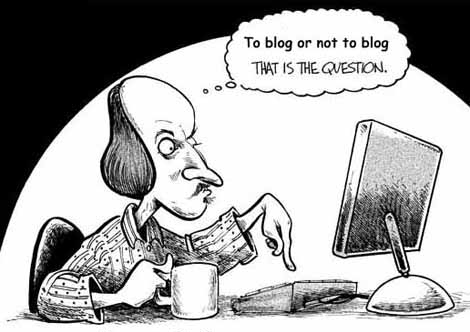
Of course, to blog))) link

Sara L. Uckelman (2018) Names Shakespeare Didn’t Invent: Imogen, Olivia, and Viola Revisited, in Names

DOI: 10.1080/00277738.2018.1490518

by Sara L. Uckelman Durham University, Durham, England

Published online: 29 Oct 2018

Abstract

Just as Shakespeare’s plays left their indelible stamp on the English language, so too did his names influence the naming pool in England at the beginning of the 17th century and beyond, and certain popular modern names are often described as inventions of Shakespeare. In this article, we revisit three names which are often listed as coinages of Shakespeare’s and show that this received wisdom, though oft-repeated, is in fact incorrect. The three names are Imogen, the heroine of Cymbeline; and Olivia and Viola, the heroines of Twelfth Night. All three of these names pre-date Shakespeare’s use. Further, we show in two of the three cases that it is plausible that Shakespeare was familiar with this earlier usage. We conclude by briefly discussing why these names are commonly mistakenly attributed to Shakespeare’s imagination, and the weaker, but not mistaken, claims which may underlie these attributions.

Keywords: Imogen, literary names, Olivia, Shakespeare, Viola


Author information

Sara L. Uckelman works at Durham University and is the editor-in-chief of the Dictionary of Medieval Names from European Sources. Her interests include the personal and place names of pre-1600 Europe, as well the effects of medieval naming practices on contemporary fantasy fiction.

Saturday, April 9, 2016

Protestant names: New Testament influences on men’s names (part 1)


https://dmnes.wordpress.com/2016/01/27/protestant-names-new-testament-influences-on-mens-names/

The list of men’s names drawn from the New Testament is long enough that the DMNES researchers may not get through all of it in one post, but let’s give it a go and see how far they can get. As we did with the woman’s names, we’ll organize these according to linguistic origin — Hebrew, Greek, Roman, and Other — with the exception of two groups of four names.

If there’s one group of Biblical names whose popularity was thoroughly entrenched in Christian Europe from a relatively early date, it’s the names of the four Evangelists: Matthew, Mark, Luke, and John. Two of the names are Hebrew in origin, one is Greek, and one is Roman: And all four were enduringly popular. It is hard to say, given our current data, when their popularity dates from, specifically, but there is clear evidence that there was a sea-change in naming practices across Europe in the 12th C: At the beginning of the century, secular Germanic names are still numerous throughout much of continental Europe, while by the end, John in all its variants is clearly beginning to be favored; this century marks the beginning of ascent to the position of “most popular name”, a position it dominated in pretty much every western Christian culture from then until the late 20th C. The names of the other evangelists were never as popular — in comparison, Luke was relatively rare — but the names were equally embraced by Protestants, Catholics, and Puritans alike.

The other group of four names is mark out by the conspicuous absence of one of them: Of the names traditionally given to the four archangels, only Gabriel, Michael, and Raphael ever made it into common use (all three were used throughout Europe, but only Michael can be said to have been popular). In the more than two decades that I have been researching names, I have not yet found a pre-1600 person named Uriel. (Which is not to say we won’t still, in our research: If there is one thing I have learned over the years, it’s to never say never. If you hunt long enough, you’ll find pretty much any name.)

Names of Hebrew origin

Ananias: In our previous post we noted that Ananias was so closely associated with Puritanism in England that it became a cant term, and we also pointed out that both Ananias and his wife Sapphira are surprising choices of people to name your child after. So it is especially interesting that the one example of this name that we have so far isn’t even from English contexts, much less Puritan. Instead, our single example is French.


Joachim: This name was both the apocryphal name of the father of Mary as well as the name of a number of minor Old Testament characters, so it could be classified as either a NT or an OT name. Evidence that it was the father of Mary more than the Old Testament characters that influenced the use of this name comes from the surprising lack of examples of this name in the three Protestant contexts that we are particularly interested in. We have no English examples, and only one each in Dutch and French contexts. This name was markedly loss popular than a lot of other otherwise obscure Old Testament names.

Nathaniel: The name of one of the disciplines, we find it in 16th C Dutch and English contexts, but it was rare elsewhere and elsewhen (interestingly, hearkening back to our discussion of nicknames, there are a number of 16th C diminutive forms of it in 16th C Estonia). A curious fact about the name: The earlier spelling of the name was Nathanael, more clearly reflecting the Hebrew form, but it was later altered to match the spelling of Daniel.

Tobias: Not strictly speaking a New Testament name, this was the name of the main character in the apocryphal Book of Tobit. The name was rare in England before the Reformation, and we have no French examples, but in the 16th C, it was a moderately popular Dutch name (and continues to be so today).

Zacchaeus: The data we have for this name is singularly curious: A single 16th C citation from England, a single 12th C citation from Germany, two 13th C examples from Italy, and a 13th C example from Poland. Quite why this name was used when and where it was — rare, but dispersed — we wouldn’t even want to hypothesize. However, its English usage does provide some confirmation: It was not used before the 16th C, and became quite common in the 17th, according to Withycombe. [1]

Names of other origin

All the names we consider under this heading are Aramaic, and two of them were originally nicknames.


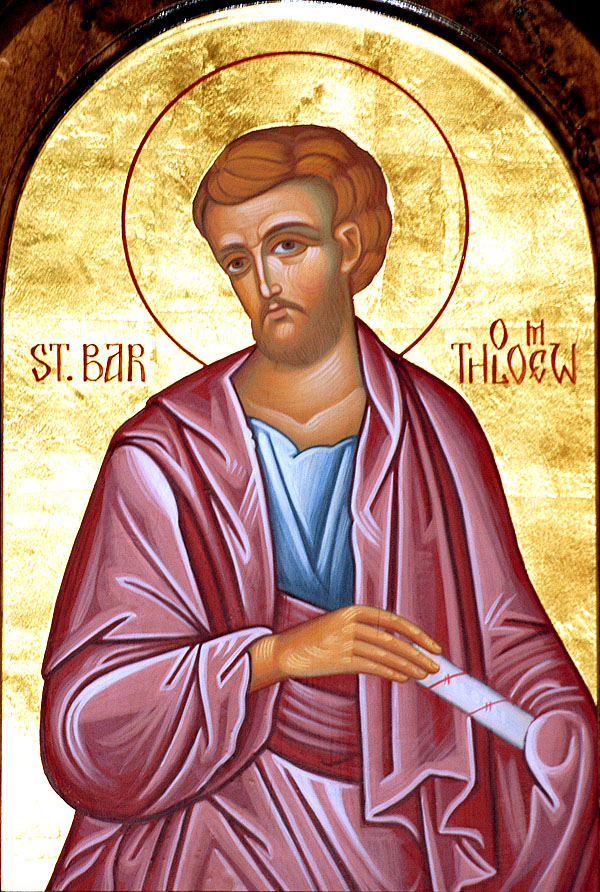
Bartholomew: The patronymic by which the discipline Nathanael was better known. It is instructive to compare the use of this name with Nathaniel above: While Nathaniel suddenly became significantly more popular in the 16th C, Bartholomew was perennially popular throughout Europe. While it is always extremely tricky to speculate about intentions behind the choice of names, one might be tempted to say that Nathaniel could be seen as a Protestant alternative to the popular Bartholomew.

Thomas: Another nickname, meaning ‘twin’, Thomas is one of the few names that can rival John in popularity, in certain data sets at certain times and places, and even when it wasn’t more popular than John, it remains one of the solid choices for a man’s name throughout most of Europe in the Middle Ages.

Thaddeus: This name doesn’t fit any of the patterns we’ve seen so far: It’s the name of an apostle, but it was never popular; it was rare pre-Reformation, but does not seem to have become any more popular afterwards. This is another name where only more data collection will allow us to have a better understanding of when, where, and why it was used.

This gets us through about half the list, so we’ll pick up the names of Greek and Roman origin in the next post!


References


[1] Withycombe, E.G., The Oxford Dictionary of English Christian Names, 3rd. ed. (Oxford University Press, 1977).

Saturday, March 5, 2016

Protestant names: Old Testament influences on men’s names (part 3)


https://dmnes.wordpress.com/2016/01/23/protestant-names-old-testament-influences-on-mens-names-part-3/


In this post the DMNES researchers finish up looking at Old Testament names, and whether they can see evidence of correlation between Protestant influence and the use of these names by men in the Middle Ages. You can read part 1 here and part 2 here.

Manasses: This name, the name of a patriarch and a king of Judah, seems almost designed to ruin all of our hypotheses. It is a relatively obscure Biblical name, and yet we have no 16th C citations of it (yet). Instead, the name was moderately common in France in the 12th and 13th C, with a few examples earlier and a few examples later.

Meshach (entry available in next edition): The second of the three brothers who visited the fiery furnace in the book of Daniel (we saw the first one two posts ago, and the third shows up later in this list), Meshach was spelled Misaac and Mysaac in the Wycliffite Bible of 1395, and the former spelling is also the French spelling; we have one instance of Misaac in Caen in 1563.

Mordechai (entry available in next edition): The name of the father of Esther, we have one example of the name in 16th C France.

Moses (entry available in next edition): Moses wasn’t unheard of in England before the 16th C, its use amongst non-Jews attributable to the popularity of the story of Moses in medieval mystery plays. But in the 16th C, all our examples come from Protestant contexts, with one exception — a Swedish citation of Moisze in 1582. Was this Moisze a Jew? Was he a Protestant? Neither? Who knows!

Nathan: The name of a number of Old Testament characters, we have one example of Nathan in 16th C England.

Noah: Bardsley notes (p. 35) that this name was used in England prior to the Reformation as a result of the medieval mystery plays, but we have not yet collected any English examples. The two examples from 16th C Caen clearly reflect the pattern under investigation.


Sampson: This name was moderately common in France and English in the 12th C, due in part to the 6th C Welsh Saint Sampson who travelled from Wales to Brittany. After a period of reduced use, the name shows up again at the end of the 16th C.

Samuel: The name of the eponymous character of two OT books, Samuel was quite popular among Jews, and the 12th C examples of the name in England that we have are likely borne by Jews. The name experienced a resurgence in French, Dutch, and English contexts in the 16th C.

Shadrach: The third brother from the fiery furnace, our single example of this name was not identified as such until we researched how the name shows up in early vernacular Bible. In the Wycliffite Bible of 1395, the name is spelled Sidrac, which our identifictation of the 1583 English citation of Sidrack that we have certain.

Solomon: The son of King David and author of the Proverbs and some of the Psalms, his name was nearly as popular as his father’s name throughout the Middle Ages; in comparison with other Old Testament names, this name saw a reduction in use in England in the 16th C.

Uriah: The name of a number of minor OT characters, this name was spelled in a variety of ways — Urie, Vrie, and Vrye in the Wycliffite Bible, and Ury, Urye, and Urias (like Josias and Elias that we’ve seen earlier) in 16th C England.

Zachary: This name could be treated as either an OT or a NT name, since it shows up in both, the name of a prophet in the former and the father of John the Baptist in the latter. This name was not exclusive to the 16th C, and what is most curious about it is not when and where it was used, but how it was spelled when it was! The early medieval form in England dropped the Z-, leading to Latin spellings such as Acharias and Middle English spellings such as Acris. Not many names have variants at both the beginning and the end of the alphabet!


With this they’ve come to the end of our tour of the influence of the Old Testament on men’s names in Protestant contexts. Next up: The New Testament!

Saturday, February 27, 2016

Protestant names: Old Testament influences on men’s names (part 2)


Jonathan (entry available in next edition): The name of the beloved friend of King David, Jonathan can be found in Dutch contexts in the 16th C.


https://dmnes.wordpress.com/2016/01/21/protestant-names-old-testament-influences-on-mens-names-part-2/


In this post the DMNES onomasts continue where they left off, with the next installment of Old Testament names and where they show clear influence of the rise of Protestantism in the second half of the 16th C.

Gabriel: The name of one of the archangels, this name was moderately common in France, Italy, and Iberia throughout most of the later Middle Ages, but was rare in England before the 16th C.

Gamaliel (entry available in the next edition): This could be considered an Old Testament name or a New Testament — a minor character by this name appears in each — but either way, this name typifies the pattern that we are investigating. It’s the name of a minor Biblical character, it was essentially unheard of before the end of the 16th C, and in the 16th and 17th C, we can find it used amongst both French and English Protestants.

Gideon: The judges were a popular source for names, and Gideon is another example of this. Our examples are spread across all three of our sources, from the 1560s on.


Hezekiah: The major and minor prophets were another popular source. Our single example of the name, Esechias, shows the typical medieval spelling of names which in modern English are often spelled with -iah (for example, as seen with medieval Elias as compared to modern Elijah) — we’ll see this quirk of spelling again below.

Isaac: The name of the son of the great Hebrew patriarch, Isaac shows up in the medieval mystery plays, so the name was not unheard of in England prior to the 16th C, and outside of England it can be found in the 12th and 13th C, but in the 16th C, it is especially associated with the Protestant contexts that we’ve been investigating.

Isaiah: The name of another prophet, perhaps one of the most important in the Old Testament, we find it in a variety of French spellings in the registers from Caen.


Israel: The name given to the Biblical patriarch Jacob, after he wrestled with God. Unlike the name

Jacob itself (which was, throughout the Middle Ages and after, so popular that there is no plausible way we can appeal to it as evidence for our pattern! A similar story can be told of John, so we will be omitting both from consideration in the present context.), Israel was never so popular, but we have a handful of examples in English and Dutch at the end of the 16th C.

Job (entry available in next edition): Another eponymous character of one of the Old Testament books, Job’s story of perseverance in the face of adversity made it a popular choice after the Reformation for parents seeking meaningful names. However, prior to the 17th C, it still remained rare.


Jonas (entry available in next edition): Better known in modern English in the form Jonah, the medieval form Jonas reflects the Greek spelling of the name. While the name was used rarely in Germany and Switzerland in the 12th and 13th C, in the 16th C, our examples all come from Protestant contexts.


Josaphat: The name of one of the kings of Judah, we have a single example from Caen in 1565.

Joseph: A curious name in that there is no clear time of context in which it was ever especially, or ever especially rare. It, unlike many of the other names that we’ve considered, was not especially taken up by the Protestants.

Joshua: This name is the same in origin as Jesus, but the two names were almost uniformly treated as distinct. The name was never popular, but the handful of instances that we have are all from Protestant contexts.

Josiah: Like Hezekiah above, the medieval spelling of Josiah was generally -ias rather than -iah, and we can see this spelling appearing in Dutch, French, and English.


That’s enough of the list for now, they’ll return to it again in our next post!

Wednesday, February 24, 2016

Protestant names: Old Testament influences on men’s names (part 1)


https://dmnes.wordpress.com/2016/01/20/protestant-names-old-testament-influences-on-mens-names-part-1/

Having looked at women’s names from the Old Testament in the DMNES researchers' previous post, in this one they turn to the men!


Except, first, the rectification of an omission — because they forgot a rather important name in their previous post! She’s a Hebrew girl turned Persian princess, she’s the cause of one of the most important Jewish festivals, she’s the eponymous character of one of the OT books…how could we forget to mention Esther? Spelled Esther, Ester, Hesther, or Hester, the name sprang into popularity in England and amongst Dutch and French Protestants in the second half of the 16th C, being virtually unknown in other linguistic, geographic, and temporal contexts. We have quite a large number of citations, but the entry for the name is not yet ready for publication because the etymology of the name is proving difficult to ascertain. There are plenty of theories — from the Median word astra meaning ‘myrtle’, from the Latin word astra meaning ‘star’, or related to the goddess name Ishtar, ultimately deriving from a root meaning ‘star’ — but we prefer good hard evidence rather than speculation when we can get it. Sometimes, though, conclusive data cannot be found, and we may simply end up having to present what information we have, and its relative merits. I suspect that it will be awhile before we have a satisfactory solution for this name.

Digression aside, let’s look at the men’s names drawn from the Old Testament! There are so many of them, the onomasts are going to have to slit this up into multiple Posts.

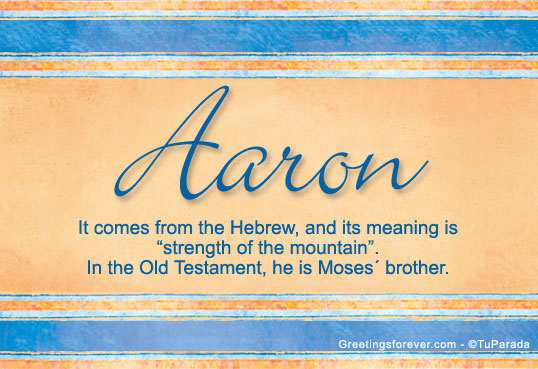
Aaron: The name of the brother of Moses and the first high priest, this name is curious because it doesn’t provide much evidence for the “Old Testament names became more common in the second half of the 16th C” hypothesis — not because it was already in use before then, but because, unlike so many other OT names, it never became common. We have two 16th C English examples and one from the Protestant Church in Caen, but this name was nowhere near as popular as some of the other more “mainstream” OT names. It was occasionally used in England, and elsewhere, earlier, but often by Jews rather than Christians. One exception to this is Wales, where the form Aron was not uncommon in the 15th C. The cause of this is unknown.


Abednego (entry available in next edition): The name of one of the three brothers thrown into the fiery furnace in the book of Daniel (his brothers’ names show up further down in the list!). When we first found the name Abdenago in France in 1565, given the context and the spelling our first thought was of Abednego, but the difference between bed and den seemed difficult to explain — until a bit of sleuthing revealed that in the Wycliffite translation of 1395, the Middle English form of the name was Abdenago. We are not sure when the den form switched to the bed form in English, but this is one of the questions that our investigations into early vernacular translations of the Bible will hopefully illuminate!

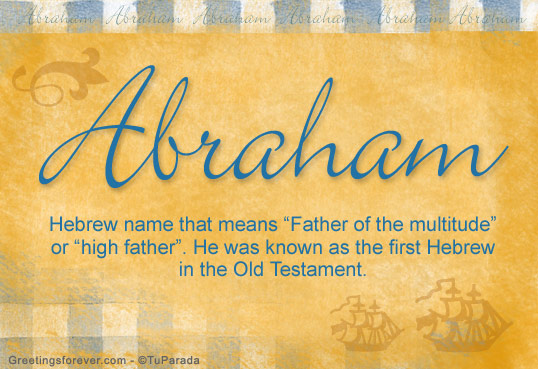
Abraham: The name of the patriarch of Israel, this name can be found as far afield as Hungary, yet it was always rare in France before the 16th C, and almost unheard of in England or the Low Countries before then.


Absalom: The name of the son of king David, this name is a curiosity as the only Protestant uptake of it that we have evidence for is in France; yet, the name was used sporadically before the 16th C across Europe, with most examples found in the 12th-14th C.

Adam: Like the name of his wife (see previous post), Adam was commonly in use throughout Europe before the Reformation. There is little need to explain the universal popularity of this choice!

Adiel: You can be forgiven for not recognizing this name, it was borne by a handful of unremarkable characters recorded in 1 Chronicles (27:25 4:36; and 9:12). The Adiel recorded in London in 1593 can be nothing other than a witness to the Protestant penchant for indiscriminate choice. Obscurity is not an issue, here!

Balthasar: Better known as one of the names of the three wisemen, Balthasar was common outside of England, France, and the Low Countries prior to the 16th C (often in conjunction with forms of
Casper and Melchior — either two or three brothers with these names, or father/son(s) pairs), within our area of focus, there is a clear jump in the uptake of this name in the second half of the 16th C.

Benjamin: While our data doesn’t yet reflect this, the name Benjamin was in use in England througout the Middle Ages, albeit sporadically. It was popular enough to give rise to a surname found as early as the 12th C [1]. Outside of the second half of the 16th, the name was rare throughout Europe.

Caleb: The name of a minor character, this name was rarely used in 16th C England.

David: The name of one of the most important Biblical kings, David can be found quite early throughout Europe in ecclesiastical contexts; the popularity of the 7th C Saint David in Wales is the reason for the popularity of the name in Wales throughout the Middle Ages, and as the name of two kings of Scotland, its use there was also assured. The name was spread widely throughout Europe; this name’s use in the 16th C cannot be attributed exclusively to Protestant influences.

Daniel: The case of this name of an eponymous character of one of the prophetic books is similar to that of David, though here it is clearer that its popularity in England certainly increased in the second half of the 16th C.

Eleazar: This name could be classified as either an OT name (in this form) or a NT name (in the Latinized form Lazarus). While Lazarus and variants are not uncommon in Italy, the specific OT-influenced form Eleazar shows its face in England and France in the second half of the 16th C (the two 12th C instances in the Dictionary are from records relating to the Crusades in the Holy Land, and may be the names of Jews).

Elias: Elias (this spelling reflecting the influence of Greek) was one of the most popular Biblical names in the Middle Ages [2]. We cannot look to the use of this name as evidence for a Protestant pattern, but we can look to something more nuanced: In the 17th C, the spelling Elijah became specifically taken up by the Puritans in England (and the New World) [2]. We have yet to see an example of this spelling in the pre-1600 scope of the Dictionary.

Enoch: The name of an ancestor of Noah who walked with God and “then he was not”: He was taken up to heaven without ever having suffered earthly death. We have one example of it, from the Dutch Reformed Church in 1589.

Ezekiel: The name of a Biblical prophet, we have one example of this from the Protestant Church at Caen in 1561.


The remainder of the alphabet will be covered in future posts, but what we can see from these names alone is that the correlation between the use of OT names and Protestant influences is much lower among men’s names than among women’s names. However, if we look beyond the names of well-known, popular Biblical characters, like Adam, David, Elias etc., it is clear that there is a correlation between the use of obscure Old Testament names and English, Dutch, and French contexts from the second half of the 16th C.

References


[1] Reaney & Wilson, A Dictionary of English Surnames, s.n. Benjamin.
[2] Withycombe, Oxford Dictionary of English Christian Names, s.n. Elias.

Tuesday, December 22, 2015

The DMNES at Leeds IMC 2016

https://dmnes.wordpress.com/2015/12/07/the-dmnes-at-leeds-imc-2016/

We’re very pleased to announce that the DMNES will be back again at next year’s International Medieval Congress at Leeds! 
We have two very interesting sessions lined up on Names and Multiculuralism — one on place names, and one on personal names. Here are the provisional details:

Session 1237: Wed. 06 July – 14.15-15.45

A FEAST OF NAMES, I: PLACE NAMES AND MULTICULTURALISM

Abstract: Many onomastic studies focus on a single time and place, providing a detailed linguistic and social analysis of the names from a narrow data set. While there is no doubt these studies provide valuable information, in this session we seek to move from the meagre diet afforded by a narrow, monocultural approach to the full feast offered when multicultural aspects of names are considered. This session looks at the influence of multiple cultures on the evolution of given names on and off the continent.
Sponsor: Dictionary of Medieval Names from European Sources
Organiser: Sara L. Uckelman, Institute of Medieval & Early Modern Studies, Durham University
Moderator/Chair: James Chetwood, Department of History, University of Sheffield
Paper -a: “Medieval Place Names of Ecclesiastical Reference: A Cross-Cultural Approach”, Andrea Bölcskei, Institute of Hungarian Linguistic, Literary & Cultural Studies, Károli Gáspár Református Egyetem, Budapest

Paper -b: “A Frisian Place Name on the Southwestern Norwegian Coast and Its Relationship to Old Norse bákn and Old Frisian bāken“, Andrea Maini, Department of Nordic & Media Studies, Universitetet i Agder

Paper -c: “Siculo-Arabic Toponyms in the Book of Roger”, Katherine Jacka, School of Humanities, University of New South Wales

Paper -d: “About the Different Hydronymic Layers of the Multilingual Hungary in the Middle Ages”, Erzsébet Győrffy, Department of Hungarian Linguistics, Debreceni Egyetem


Session 1337: Wed. 06 July – 16.30-18.00

A FEAST OF NAMES, II: CONTACT OF CULTURES AND THE EVOLUTION OF GIVEN NAMES

Abstract: Many onomastic studies focus on a single time and place, providing a detailed linguistic and social analysis of the names from a narrow data set. While there is no doubt that these studies provide valuable information, in this session we seek to move from the meagre diet afforded by a narrow, monocultural approach to the full feast offered when multicultural aspects of names are considered. This session looks at the influence of multiple cultures on the evolution of given names on and off the continent.
Sponsor: Dictionary of Medieval Names from European Sources
Organiser: Sara L. Uckelman, Institute of Medieval & Early Modern Studies, Durham University
Moderator/Chair Drew Shiel, Independent Scholar, Maynooth

Paper -a: “You Can Call Me Al-Cuin: A Re-Evaluation of Medieval English Personal Naming, 900-1100”, James Chetwood, Department of History, University of Sheffield

Paper -b: “A Typology of Contact Phenomena in Medieval Personal Names”, Mariann Slíz, Institute of Hungarian Linguistics & Finno-Ugric Studies, Eötvös Loránd University, Budapest

Paper -c: “Þá hálgan: An Etymological and Cross-Linguistic Analysis of Anthroponyms”, Serena Martinolich, Scuola di Lingua e Cultura Italiana, Università degli studi di Genova

Wednesday, December 2, 2015

Talks on the Dictionary of Medieval Names

https://dmnes.wordpress.com/2015/11/24/dmnes-goes-to-bolzano/

Dr. Sara L. Uckelman, editor-in-chief, and Dr. Joel Uckelman, chief technical guru, will be giving talks on the Dictionary and Digital Humanities at the University of Bozen (Bolzano) next month, on Dec. 21, 2015. We’ll post more details on the Events page as they are available.


Saturday, July 18, 2015

The Launch of the DMNES at IMC2015

https://dmnes.wordpress.com/2015/07/08/the-launch-of-the-dmnes-at-imc2015/

Monday afternoon saw the official launch of the Dictionary of Medieval Names from European Sources to a packed audience at the International Medieval Congress 2015 in Leeds.

Photo courtesy of Rob Briggs (@SurreyMedieval)

The editor-in-chief, Dr. Sara L. Uckelman, gave an introduction to theDictionary, providing a brief overview of the who-what-when-where-why-how (see her slides here), and then editorial assistant Dr. Nina Shiel showed how data from the Dictionary can be used — even by non-medievalists — to answer questions such as “How medieval were the names in Sir Walter Scott’s novels?” These two talks were followed up by an extremely lively and productive half hour of discussion.
It was so exciting to present our project to such an interested and enthusiastic audience. We’d like to thank everyone for coming, and encourage everyone to share news of the Dictionary with all their friends, whether medievalists or not:
title bar

Saturday, May 2, 2015

The Dictionary of Medieval Names from European Sources: Filling a Lexicographical Gap

http://onomastics.co.uk/dmnes/

Sara L. Uckelman, Editor-in-Chief, DMNES
Given names occupy a rather specialized semantic status. While the vast majority of given names are, in ultimate origin, derived from or identical to ordinary words in the language and culture of their birth, the semantic value of a given name is not identical to the ordinary word – even in cases where the two are identifiably connected, for example the modern given name Heather and the plant heather – instead, when a word, or a complex formed of words, becomes used as a given name, its semantic status switches to being a designator or label for a person. If this happens often enough, the name can become wholly divorced from the original word, as happens when a word becomes fixed as a name and continues to exist and be used even when the culture of its origin is lost or wholly changed. William remains a meaningful label even in contexts where no one knows that it is derived from Old German willo ‘will’ + helm ‘helmet’.
A strange consequence of this unique semantic status is that given names are routinely omitted from contexts which otherwise strive to provide comprehensive semantic information: Namely, dictionaries. Given names are for the most part systematically excluded from lexicons (exceptions occurring when the given name has re-entered the word pool as a common term, such as ‘guy’ and ‘jill’ as generic terms for a man or a woman). When considering lexicons designed with a primary goal of simply giving semantic information, this exclusion makes sense; because of this relevant way in which given names differ from ordinary words in their semantic content, there isn’t a sensible way to include them. The situation is different, though, when we turn to lexicons that seek to give historical accounts of languages.
Recently there has been significant interest in compiling historical word dictionaries of various medieval languages, cf., e.g., the Middle English Dictionary, various dictionaries of Old French such as those found here, the Dictionary of Medieval Latin from British Sources, the Dictionary of Medieval Latin from Celtic Sources, the Anglo-Norman Dictionary, the Dictionary of the Scots Language, the Dictionnaire Étymologique de l’Ancien Français, etc., and even the Oxford English Dictionary. But none of these include given names, except incidentally, and in these contexts, this lacuna becomes more problematic, as no complete picture can be given of a language that doesn’t take into account given names, how they are spelled, and how they are used. Given names are especially important in the study of vernaculars from periods in which virtually all documentary material is in Latin; because they are often lightly Latinized, given names can provide evidence for regional and dialectal differences which are otherwise obscured by linguistic corpora that focus purely on non-given name words.
The Dictionary of Medieval Names from European Sources was created in part to help fill this lacuna. Headed up by Dr. Sara L. Uckelman of theInstitute for Medieval and Early Modern Studies at Durham University along with an international team involving people in England, Ireland, Norway, Hungary, Iceland, and Australia, the Dictionary is a project to collect, collate, and identify all given names in European sources between 600 and 1600. The first edition, just published, contains over 20,000 citations of over 1,000 different names. New editions will be published on a quarterly basis, each extending the previous with both new entries and new citations in previous entries. Each entry contains etymological and linguistic information; information concerning important people who bore the name (rulers, ecclesiastical leaders, and saints), as this often influenced the use of the name among ordinary people; and other relevant information such as connections with other names, information drawn from other sources, discussion of spelling variants and diminutive forms, etc.
bartholomea
Sample entry
Dictionaries of given names, even ones including historical information, are not new; but with almost no exception, the ones of historical and linguistic merit are specialized to a single language. One thing that the Dictionary provides which is different from any other more specialized project is the ability to easily compare the use of a name across different times, cultures, and languages, to see how the names (and the languages in which they occur) evolve (providing linguistically interesting information) as well as how names spread geographically over time (providing sociological data not otherwise easily available in any form).
A project on such a scale as this can only succeed by taking advantage of the collective knowledge that the Internet makes accessible, and we on the DMNES team have many plans to do that. Already, engagement with other onomasts and medievalists via social media (find us on Facebook;follow us on twitterread our blog) has helped solve a few puzzles, and a future feature that we are excited to roll out is a regular “Do you know this name?” question wherein we provide information about names that we have examples of that we cannot yet identify and solicit help from the masses. The focus on on-line publication, instead of print (though we are considering a print version, perhaps on a yearly basis), allows us to continually work to augment the data without having to wait for the project to be “big enough” to be worthwhile. A project like this is likely to be decades, if not a century or more, in the making, and we are excited to extend our knowledge of medieval names and naming practices at every step of the way.

Saturday, March 14, 2015

DMNES EiC on the radio

https://dmnes.wordpress.com/2015/03/10/dmnes-eic-on-the-radio/


In the morning at 10:10 on March, 10 GMT the Dictionary‘s editor-in-chief, Dr. Sara L. Uckelman, was interviewed by Jonathan Miles on BBC Radio Newcastle about the falling popularity of names like Gary, in a discussion inspired by this article in the Independent.
 Jonathan Miles


Saturday, August 2, 2014

Bad News and Good News on the Dictionary of Medieval Names

http://dmnes.wordpress.com/2014/08/01/bad-news-and-good-news/
After having promised, for some months now, an end-of-September date for the publication of the first edition of the Dictionary, we must unfortunately bring the bad news that we’re pushing back this date to the beginning of 2015.


But the good news is, this delay is because Dr. Sara L. Uckelman, the EiC, 

has recently accepted the offer of a permanent position at Durham University 
and so will be using the next two months to pack up her and her family’s lives in Germany and move to England, instead of the much more enjoyable alternative of working on the Dictionary. But rather than put out something that doesn’t meet our exacting standards, just to meet proposed deadlines, we decided it would be better to delay things by a few months in order to ensure the first edition sparkles.

Oh, I am so happy for Sara! My congratulations!!! Her onomastic corpora are well-known and I am sure she will contribute a lot to the development of onomastics being at Durham University. My best onomastic wishes to Sara Uckelman))) 
I hope one day I will find my permanent place in this cruel onomastic world...