Showing posts with label onomastic dictionary. Show all posts

Thursday, August 14, 2025

Unveiling Culture and History: UB Professors Launch Setswana Personal Names Dictionary


A significant contribution to linguistic research and cultural preservation has been made with the publication of "A Dictionary of Setswana Personal Names" by two University of Botswana (UB) academics, Professor Thapelo Otlogetswe and Dr. Goabilwe Ramaeba.


This new dictionary is a monumental achievement, containing over 8,500 Setswana names. To put this in perspective, this is a much larger collection than the approximately 6,000 names found in the Oxford Dictionary of First Names. The extensive collection was built from a database of over a million names and features a wide range of names, from the most common to the least common.

The dictionary is a valuable resource for anyone interested in the cultural nuances and significance of names. According to Professor Otlogetswe, the book is not just a list of names and meanings, but a tool that helps to explain the history and memories embedded in the names of the Batswana people. This sentiment was echoed by Professor Andy Chebanne, a retired linguistics professor at UB, who described the dictionary as "well-structured" and urged its use in community gatherings, or dikgotla, rather than just in libraries.

The publication is also a major milestone for Botswana and the Southern African Development Community (SADC). Professor Shole Shole, a retired professor from UNISA and Northwest University, praised the dictionary as a critical and inspirational work that places Setswana names on the international stage. This achievement is a testament to the high-quality research being conducted at the University of Botswana, supported by the UB's Office of Research and Development (ORD), and aligns with the institution's strategic goal of becoming a research-intensive university.

Tuesday, September 3, 2024

A Dictionary of Ukrainian Onomastic Terminology

 Research Gate 

  • Publisher: University Book
  • ISBN: 978-617-521-084-0


  • A Dictionary of Ukrainian Onomastic Terminology serves as a comprehensive resource for scholars, linguists, and enthusiasts interested in studying names and naming conventions. This reference work explores the rich tapestry of Ukrainian onomastics, delving into the etymology, usage, and cultural significance of various names. This dictionary offers valuable insights into the historical, social, and linguistic contexts surrounding Ukrainian names by providing detailed explanations and interpretations of onomastic terminology. It serves as an indispensable tool for understanding the intricacies of Ukrainian naming practices and their broader cultural implications. Whether used for academic research, professional purposes, or personal interest, this dictionary is an essential companion for anyone seeking a deeper understanding of Ukrainian onomastics.

    Friday, March 22, 2024

    Dictionary of Family Names in the Visegrad Countries

    Today marked a significant milestone in the exploration of cultural heritage as scholars and enthusiasts convened for an enlightening online onomastic event. Hosted on the digital platform, the event titled "The Dictionary of Family Names in the Visegrad Countries" offered a deep dive into the study of family names within the Visegrad region, comprising Czechia, Hungary, Poland, and Slovakia. Let's take a journey through the key highlights of this enriching gathering.

    Opening Words:

    The event commenced with a warm welcome from Judit Bóna, Vice-Dean of ELTE, Hungary, setting the stage for an engaging discourse on the intricate tapestry of family names.


    Section 1: Unveiling Foundations

    Mariann Slíz from ELTE, Hungary, initiated the proceedings with an insightful introduction to "The Dictionary of Family Names in the Visegrad Countries," laying the groundwork for the subsequent discussions. János N. Fodor and Kitti Hauber, also from ELTE, presented a typological comparison of surname stocks across the V4 countries, offering valuable insights into naming conventions and cultural exchanges. Pavel Štěpán from ÚJČ, Czechia, delved into the delimitation of motivation categories of Czech surnames, shedding light on the underlying factors shaping naming practices. The exploration continued with Małgorzata Rutkiewicz-Hanczewska and Karolina Galewska from UAM, Poland, unveiling the frequency and structural semantics of Polish surnames, providing a comprehensive overview of their cultural significance.

    Section 2: Navigating Cultural Significance

    The second segment of the event offered a deeper dive into the meanings and linguistic origins of common surnames in Slovakia, led by Ján Bauko and Orsolya Hegedűs from UKF. Tamás Farkas from ELTE, Hungary, explored the fascinating intersection of surnames and ethnonyms, drawing lessons from surname stocks to illuminate broader cultural narratives. Veronika Štěpánová from ÚJČ, Czechia, navigated the usability of the Dictionary in language consulting, highlighting its relevance in contemporary scholarship. Annamária Szabó T., also from ELTE, Hungary, provided invaluable insights into incorporating the Dictionary into educational contexts, offering practical guidance for educators and students alike.

    Closing Thoughts:
    As the event drew to a close, participants left with a renewed appreciation for the richness of cultural heritage encapsulated within family names. The journey through the Visegrad countries' naming traditions unveiled a mosaic of historical, linguistic, and sociocultural nuances, underscoring the importance of preserving and understanding our collective heritage.

    As we reflect on the insights shared and connections forged during this remarkable event, we look forward to continued exploration and discovery in the realm of onomastics.

    Wednesday, March 29, 2023

    REFERENCE DICTIONARY OF UKRAINIAN NAMES


    Mondonomo has published a special dictionary edition devoted to the Ukrainian given names, their transliteration and etymology. The work can be considered as the very first Reference Dictionary of Ukrainian Names. This is the definitive scholarly reference for a new generation of Ukraine-centred researchers and amateurs. The dictionary is a celebration of Ukraine’s rich cultural heritage bringing to light the country’s most important names from prehistory to the present. It chronicles the naming patterns within Ukraine at a time when the country’s people, culture, and language are facing destruction and devastation.

    This is a compelling account of Ukraine’s cultural history, told through the prism of a carefully curated selection of key names arguing for a distinctly Ukrainian cultural identity. Organized thematically across nine chapters, the Reference Dictionary contains more than 6.000 Ukrainian given names with their corresponding English pairs, while accompanying information reveal the origin and significance behind the names. About 2.000 pet forms of names weave Ukraine’s dynamic and inextinguishable folk traditions through the dictionary, providing naming texture as well as a sense of the nation’s living history. All in all, it includes over 8.000 up-to-date dictionary entries with Ukrainian script, official Romanized form and non-standard spellings; a guide to Ukrainian pronunciation; and a section on menu terms. This reference is an invaluable tool for researchers, travellers, students, name-givers and businesspersons.

    The content of the Dictionary suggests opportunities for further efforts, making it an exceptional starting point both for academics looking for innovative ideas and common people willing to learn something new about an unfamiliar culture.


    A portion of proceeds from the sale of the Dictionary will be donated to help Ukrainian refugees in need.


    Friday, February 1, 2019

    Contribute to names' pronunciation, or what's Cofactor Ora Named-Entity Dictionary

    link


    The importance of documenting pronunciations
    Without a pronunciation dictionary, it's impossible to guess that Houston Street in New York is pronounced /ˈhaʊstən/, unlike the city of Houston in Texas. These two Houstons are named after different people that pronounced their names differently, but it's only Houston, TX that is listed in most existing dictionaries with the /ˈhjuːstən/ pronunciation. There are countless other homographs that have different pronunciations depending on meaning and that cannot be found in traditional dictionaries. There is at least one Houston in each US state, not even counting street names...
    Ora's solution
    To overcome the limitations of traditional pronunciation dictionaries, Cofactor Ora integrates with the Google Knowledge Graph and lets everyone edit and contribute pronunciations of words: both audio recordings and IPA pronunciation respellings.
    Integration with the Google Knowledge Graph
    Traditional dictionaries cannot unambigously define the location of each Houston with a paragraph or two of text. Referencing an entity in the Google Knowledge Graph, each place name in Ora is linked to a location in Google Maps. In case of people, the Knowledge Graph links to the Wikipedia articles about each person and their social media profiles. This allows Ora to list pronunciations for any number of people, places, and things that ever existed and to outgrow any existing pronunciation dictionary.
    Crowdsourcing pronunciation knowledge
    It would be nearly impossible for a handful of traditional dictionary editors to confirm the correct pronunciations of all people and places on Earth. By allowing everyone to share their pronunciation knowledge, Ora can collect correct pronunciations of any number of named entities. You can learn more about the difference between named entities and regular dictionary headwords here.
    Why your contributions are important
    It's only through collaboration and participation of communities from all over the world and experts from domains of science and industry that Ora can acheive it's goal of becoming the largest pronunciation dictionary of named entities. Being a free and ad-free source of structured pronunciation data, Ora helps raise awareness of language preservation and promotes linguistic research.
    Go ahead and experience Ora now

    Tuesday, August 14, 2018

    Краткий этимологический топонимический словарь

    2-е издание словаря можно приобрести в издательстве URSS: Москва, Нахимовский проспект, 56. Метро Профсоюзная. Тел. +7 (499) 724 25 45.

    В словаре в доступной форме с позиций современной топонимической науки рассмотрено происхождение географических названий (топонимов). Проанализировано их употребление в памятниках письменности русского языка и других исторических источниках. Критически оценена трактовка топонимов в различных словарях и специальной литературе. Пересмотрено или уточнено происхождение ряда географических названий. Предложены этимологии для топонимов, не имевших до сих пор убедительного объяснения. Даны рекомендации, касающиеся правильного употребления топонимов в широкой речевой практике. Показана локализация топонимов на древних и современных картах. Словарь адресован как специалистам - филологам, историкам, географам, топонимистам, краеведам, так и широкому кругу читателей, интересующихся происхождением географических названий, в том числе студентам и аспирантам, преподавателям школ и вузов.

    Saturday, April 9, 2016

    Protestant names: New Testament influences on men’s names (part 1)


    https://dmnes.wordpress.com/2016/01/27/protestant-names-new-testament-influences-on-mens-names/

    The list of men’s names drawn from the New Testament is long enough that the DMNES researchers may not get through all of it in one post, but let’s give it a go and see how far they can get. As we did with the woman’s names, we’ll organize these according to linguistic origin — Hebrew, Greek, Roman, and Other — with the exception of two groups of four names.

    If there’s one group of Biblical names whose popularity was thoroughly entrenched in Christian Europe from a relatively early date, it’s the names of the four Evangelists: Matthew, Mark, Luke, and John. Two of the names are Hebrew in origin, one is Greek, and one is Roman: And all four were enduringly popular. It is hard to say, given our current data, when their popularity dates from, specifically, but there is clear evidence that there was a sea-change in naming practices across Europe in the 12th C: At the beginning of the century, secular Germanic names are still numerous throughout much of continental Europe, while by the end, John in all its variants is clearly beginning to be favored; this century marks the beginning of ascent to the position of “most popular name”, a position it dominated in pretty much every western Christian culture from then until the late 20th C. The names of the other evangelists were never as popular — in comparison, Luke was relatively rare — but the names were equally embraced by Protestants, Catholics, and Puritans alike.

    The other group of four names is mark out by the conspicuous absence of one of them: Of the names traditionally given to the four archangels, only Gabriel, Michael, and Raphael ever made it into common use (all three were used throughout Europe, but only Michael can be said to have been popular). In the more than two decades that I have been researching names, I have not yet found a pre-1600 person named Uriel. (Which is not to say we won’t still, in our research: If there is one thing I have learned over the years, it’s to never say never. If you hunt long enough, you’ll find pretty much any name.)

    Names of Hebrew origin

    Ananias: In our previous post we noted that Ananias was so closely associated with Puritanism in England that it became a cant term, and we also pointed out that both Ananias and his wife Sapphira are surprising choices of people to name your child after. So it is especially interesting that the one example of this name that we have so far isn’t even from English contexts, much less Puritan. Instead, our single example is French.


    Joachim: This name was both the apocryphal name of the father of Mary as well as the name of a number of minor Old Testament characters, so it could be classified as either a NT or an OT name. Evidence that it was the father of Mary more than the Old Testament characters that influenced the use of this name comes from the surprising lack of examples of this name in the three Protestant contexts that we are particularly interested in. We have no English examples, and only one each in Dutch and French contexts. This name was markedly loss popular than a lot of other otherwise obscure Old Testament names.

    Nathaniel: The name of one of the disciplines, we find it in 16th C Dutch and English contexts, but it was rare elsewhere and elsewhen (interestingly, hearkening back to our discussion of nicknames, there are a number of 16th C diminutive forms of it in 16th C Estonia). A curious fact about the name: The earlier spelling of the name was Nathanael, more clearly reflecting the Hebrew form, but it was later altered to match the spelling of Daniel.

    Tobias: Not strictly speaking a New Testament name, this was the name of the main character in the apocryphal Book of Tobit. The name was rare in England before the Reformation, and we have no French examples, but in the 16th C, it was a moderately popular Dutch name (and continues to be so today).

    Zacchaeus: The data we have for this name is singularly curious: A single 16th C citation from England, a single 12th C citation from Germany, two 13th C examples from Italy, and a 13th C example from Poland. Quite why this name was used when and where it was — rare, but dispersed — we wouldn’t even want to hypothesize. However, its English usage does provide some confirmation: It was not used before the 16th C, and became quite common in the 17th, according to Withycombe. [1]

    Names of other origin

    All the names we consider under this heading are Aramaic, and two of them were originally nicknames.


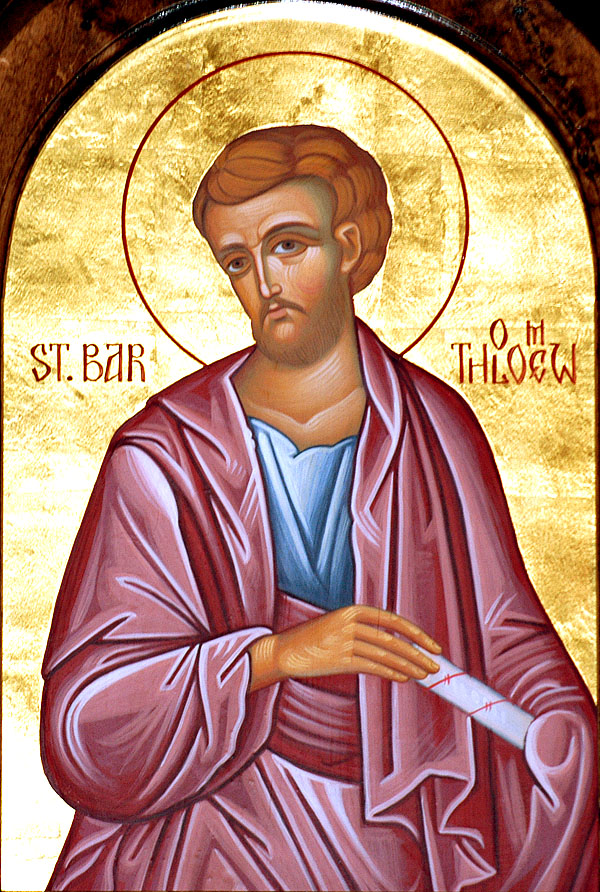
    Bartholomew: The patronymic by which the discipline Nathanael was better known. It is instructive to compare the use of this name with Nathaniel above: While Nathaniel suddenly became significantly more popular in the 16th C, Bartholomew was perennially popular throughout Europe. While it is always extremely tricky to speculate about intentions behind the choice of names, one might be tempted to say that Nathaniel could be seen as a Protestant alternative to the popular Bartholomew.

    Thomas: Another nickname, meaning ‘twin’, Thomas is one of the few names that can rival John in popularity, in certain data sets at certain times and places, and even when it wasn’t more popular than John, it remains one of the solid choices for a man’s name throughout most of Europe in the Middle Ages.

    Thaddeus: This name doesn’t fit any of the patterns we’ve seen so far: It’s the name of an apostle, but it was never popular; it was rare pre-Reformation, but does not seem to have become any more popular afterwards. This is another name where only more data collection will allow us to have a better understanding of when, where, and why it was used.

    This gets us through about half the list, so we’ll pick up the names of Greek and Roman origin in the next post!


    References


    [1] Withycombe, E.G., The Oxford Dictionary of English Christian Names, 3rd. ed. (Oxford University Press, 1977).

    Saturday, March 5, 2016

    Protestant names: Old Testament influences on men’s names (part 3)


    https://dmnes.wordpress.com/2016/01/23/protestant-names-old-testament-influences-on-mens-names-part-3/


    In this post the DMNES researchers finish up looking at Old Testament names, and whether they can see evidence of correlation between Protestant influence and the use of these names by men in the Middle Ages. You can read part 1 here and part 2 here.

    Manasses: This name, the name of a patriarch and a king of Judah, seems almost designed to ruin all of our hypotheses. It is a relatively obscure Biblical name, and yet we have no 16th C citations of it (yet). Instead, the name was moderately common in France in the 12th and 13th C, with a few examples earlier and a few examples later.

    Meshach (entry available in next edition): The second of the three brothers who visited the fiery furnace in the book of Daniel (we saw the first one two posts ago, and the third shows up later in this list), Meshach was spelled Misaac and Mysaac in the Wycliffite Bible of 1395, and the former spelling is also the French spelling; we have one instance of Misaac in Caen in 1563.

    Mordechai (entry available in next edition): The name of the father of Esther, we have one example of the name in 16th C France.

    Moses (entry available in next edition): Moses wasn’t unheard of in England before the 16th C, its use amongst non-Jews attributable to the popularity of the story of Moses in medieval mystery plays. But in the 16th C, all our examples come from Protestant contexts, with one exception — a Swedish citation of Moisze in 1582. Was this Moisze a Jew? Was he a Protestant? Neither? Who knows!

    Nathan: The name of a number of Old Testament characters, we have one example of Nathan in 16th C England.

    Noah: Bardsley notes (p. 35) that this name was used in England prior to the Reformation as a result of the medieval mystery plays, but we have not yet collected any English examples. The two examples from 16th C Caen clearly reflect the pattern under investigation.


    Sampson: This name was moderately common in France and English in the 12th C, due in part to the 6th C Welsh Saint Sampson who travelled from Wales to Brittany. After a period of reduced use, the name shows up again at the end of the 16th C.

    Samuel: The name of the eponymous character of two OT books, Samuel was quite popular among Jews, and the 12th C examples of the name in England that we have are likely borne by Jews. The name experienced a resurgence in French, Dutch, and English contexts in the 16th C.

    Shadrach: The third brother from the fiery furnace, our single example of this name was not identified as such until we researched how the name shows up in early vernacular Bible. In the Wycliffite Bible of 1395, the name is spelled Sidrac, which our identifictation of the 1583 English citation of Sidrack that we have certain.

    Solomon: The son of King David and author of the Proverbs and some of the Psalms, his name was nearly as popular as his father’s name throughout the Middle Ages; in comparison with other Old Testament names, this name saw a reduction in use in England in the 16th C.

    Uriah: The name of a number of minor OT characters, this name was spelled in a variety of ways — Urie, Vrie, and Vrye in the Wycliffite Bible, and Ury, Urye, and Urias (like Josias and Elias that we’ve seen earlier) in 16th C England.

    Zachary: This name could be treated as either an OT or a NT name, since it shows up in both, the name of a prophet in the former and the father of John the Baptist in the latter. This name was not exclusive to the 16th C, and what is most curious about it is not when and where it was used, but how it was spelled when it was! The early medieval form in England dropped the Z-, leading to Latin spellings such as Acharias and Middle English spellings such as Acris. Not many names have variants at both the beginning and the end of the alphabet!


    With this they’ve come to the end of our tour of the influence of the Old Testament on men’s names in Protestant contexts. Next up: The New Testament!

    Saturday, February 27, 2016

    Protestant names: Old Testament influences on men’s names (part 2)


    Jonathan (entry available in next edition): The name of the beloved friend of King David, Jonathan can be found in Dutch contexts in the 16th C.


    https://dmnes.wordpress.com/2016/01/21/protestant-names-old-testament-influences-on-mens-names-part-2/


    In this post the DMNES onomasts continue where they left off, with the next installment of Old Testament names and where they show clear influence of the rise of Protestantism in the second half of the 16th C.

    Gabriel: The name of one of the archangels, this name was moderately common in France, Italy, and Iberia throughout most of the later Middle Ages, but was rare in England before the 16th C.

    Gamaliel (entry available in the next edition): This could be considered an Old Testament name or a New Testament — a minor character by this name appears in each — but either way, this name typifies the pattern that we are investigating. It’s the name of a minor Biblical character, it was essentially unheard of before the end of the 16th C, and in the 16th and 17th C, we can find it used amongst both French and English Protestants.

    Gideon: The judges were a popular source for names, and Gideon is another example of this. Our examples are spread across all three of our sources, from the 1560s on.


    Hezekiah: The major and minor prophets were another popular source. Our single example of the name, Esechias, shows the typical medieval spelling of names which in modern English are often spelled with -iah (for example, as seen with medieval Elias as compared to modern Elijah) — we’ll see this quirk of spelling again below.

    Isaac: The name of the son of the great Hebrew patriarch, Isaac shows up in the medieval mystery plays, so the name was not unheard of in England prior to the 16th C, and outside of England it can be found in the 12th and 13th C, but in the 16th C, it is especially associated with the Protestant contexts that we’ve been investigating.

    Isaiah: The name of another prophet, perhaps one of the most important in the Old Testament, we find it in a variety of French spellings in the registers from Caen.


    Israel: The name given to the Biblical patriarch Jacob, after he wrestled with God. Unlike the name

    Jacob itself (which was, throughout the Middle Ages and after, so popular that there is no plausible way we can appeal to it as evidence for our pattern! A similar story can be told of John, so we will be omitting both from consideration in the present context.), Israel was never so popular, but we have a handful of examples in English and Dutch at the end of the 16th C.

    Job (entry available in next edition): Another eponymous character of one of the Old Testament books, Job’s story of perseverance in the face of adversity made it a popular choice after the Reformation for parents seeking meaningful names. However, prior to the 17th C, it still remained rare.


    Jonas (entry available in next edition): Better known in modern English in the form Jonah, the medieval form Jonas reflects the Greek spelling of the name. While the name was used rarely in Germany and Switzerland in the 12th and 13th C, in the 16th C, our examples all come from Protestant contexts.


    Josaphat: The name of one of the kings of Judah, we have a single example from Caen in 1565.

    Joseph: A curious name in that there is no clear time of context in which it was ever especially, or ever especially rare. It, unlike many of the other names that we’ve considered, was not especially taken up by the Protestants.

    Joshua: This name is the same in origin as Jesus, but the two names were almost uniformly treated as distinct. The name was never popular, but the handful of instances that we have are all from Protestant contexts.

    Josiah: Like Hezekiah above, the medieval spelling of Josiah was generally -ias rather than -iah, and we can see this spelling appearing in Dutch, French, and English.


    That’s enough of the list for now, they’ll return to it again in our next post!

    Wednesday, February 24, 2016

    Protestant names: Old Testament influences on men’s names (part 1)


    https://dmnes.wordpress.com/2016/01/20/protestant-names-old-testament-influences-on-mens-names-part-1/

    Having looked at women’s names from the Old Testament in the DMNES researchers' previous post, in this one they turn to the men!


    Except, first, the rectification of an omission — because they forgot a rather important name in their previous post! She’s a Hebrew girl turned Persian princess, she’s the cause of one of the most important Jewish festivals, she’s the eponymous character of one of the OT books…how could we forget to mention Esther? Spelled Esther, Ester, Hesther, or Hester, the name sprang into popularity in England and amongst Dutch and French Protestants in the second half of the 16th C, being virtually unknown in other linguistic, geographic, and temporal contexts. We have quite a large number of citations, but the entry for the name is not yet ready for publication because the etymology of the name is proving difficult to ascertain. There are plenty of theories — from the Median word astra meaning ‘myrtle’, from the Latin word astra meaning ‘star’, or related to the goddess name Ishtar, ultimately deriving from a root meaning ‘star’ — but we prefer good hard evidence rather than speculation when we can get it. Sometimes, though, conclusive data cannot be found, and we may simply end up having to present what information we have, and its relative merits. I suspect that it will be awhile before we have a satisfactory solution for this name.

    Digression aside, let’s look at the men’s names drawn from the Old Testament! There are so many of them, the onomasts are going to have to slit this up into multiple Posts.

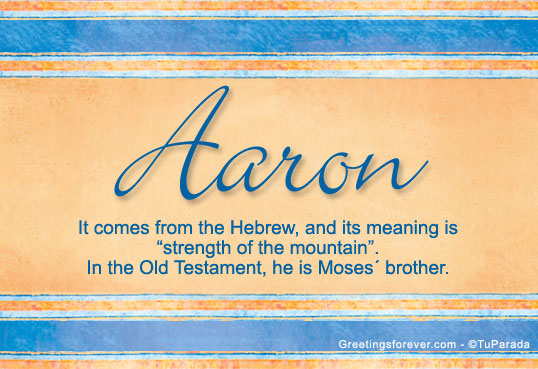
    Aaron: The name of the brother of Moses and the first high priest, this name is curious because it doesn’t provide much evidence for the “Old Testament names became more common in the second half of the 16th C” hypothesis — not because it was already in use before then, but because, unlike so many other OT names, it never became common. We have two 16th C English examples and one from the Protestant Church in Caen, but this name was nowhere near as popular as some of the other more “mainstream” OT names. It was occasionally used in England, and elsewhere, earlier, but often by Jews rather than Christians. One exception to this is Wales, where the form Aron was not uncommon in the 15th C. The cause of this is unknown.


    Abednego (entry available in next edition): The name of one of the three brothers thrown into the fiery furnace in the book of Daniel (his brothers’ names show up further down in the list!). When we first found the name Abdenago in France in 1565, given the context and the spelling our first thought was of Abednego, but the difference between bed and den seemed difficult to explain — until a bit of sleuthing revealed that in the Wycliffite translation of 1395, the Middle English form of the name was Abdenago. We are not sure when the den form switched to the bed form in English, but this is one of the questions that our investigations into early vernacular translations of the Bible will hopefully illuminate!

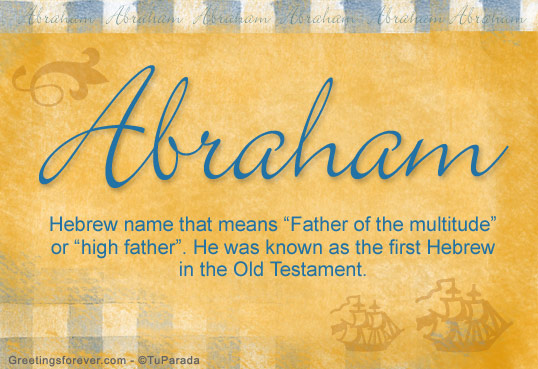
    Abraham: The name of the patriarch of Israel, this name can be found as far afield as Hungary, yet it was always rare in France before the 16th C, and almost unheard of in England or the Low Countries before then.


    Absalom: The name of the son of king David, this name is a curiosity as the only Protestant uptake of it that we have evidence for is in France; yet, the name was used sporadically before the 16th C across Europe, with most examples found in the 12th-14th C.

    Adam: Like the name of his wife (see previous post), Adam was commonly in use throughout Europe before the Reformation. There is little need to explain the universal popularity of this choice!

    Adiel: You can be forgiven for not recognizing this name, it was borne by a handful of unremarkable characters recorded in 1 Chronicles (27:25 4:36; and 9:12). The Adiel recorded in London in 1593 can be nothing other than a witness to the Protestant penchant for indiscriminate choice. Obscurity is not an issue, here!

    Balthasar: Better known as one of the names of the three wisemen, Balthasar was common outside of England, France, and the Low Countries prior to the 16th C (often in conjunction with forms of
    Casper and Melchior — either two or three brothers with these names, or father/son(s) pairs), within our area of focus, there is a clear jump in the uptake of this name in the second half of the 16th C.

    Benjamin: While our data doesn’t yet reflect this, the name Benjamin was in use in England througout the Middle Ages, albeit sporadically. It was popular enough to give rise to a surname found as early as the 12th C [1]. Outside of the second half of the 16th, the name was rare throughout Europe.

    Caleb: The name of a minor character, this name was rarely used in 16th C England.

    David: The name of one of the most important Biblical kings, David can be found quite early throughout Europe in ecclesiastical contexts; the popularity of the 7th C Saint David in Wales is the reason for the popularity of the name in Wales throughout the Middle Ages, and as the name of two kings of Scotland, its use there was also assured. The name was spread widely throughout Europe; this name’s use in the 16th C cannot be attributed exclusively to Protestant influences.

    Daniel: The case of this name of an eponymous character of one of the prophetic books is similar to that of David, though here it is clearer that its popularity in England certainly increased in the second half of the 16th C.

    Eleazar: This name could be classified as either an OT name (in this form) or a NT name (in the Latinized form Lazarus). While Lazarus and variants are not uncommon in Italy, the specific OT-influenced form Eleazar shows its face in England and France in the second half of the 16th C (the two 12th C instances in the Dictionary are from records relating to the Crusades in the Holy Land, and may be the names of Jews).

    Elias: Elias (this spelling reflecting the influence of Greek) was one of the most popular Biblical names in the Middle Ages [2]. We cannot look to the use of this name as evidence for a Protestant pattern, but we can look to something more nuanced: In the 17th C, the spelling Elijah became specifically taken up by the Puritans in England (and the New World) [2]. We have yet to see an example of this spelling in the pre-1600 scope of the Dictionary.

    Enoch: The name of an ancestor of Noah who walked with God and “then he was not”: He was taken up to heaven without ever having suffered earthly death. We have one example of it, from the Dutch Reformed Church in 1589.

    Ezekiel: The name of a Biblical prophet, we have one example of this from the Protestant Church at Caen in 1561.


    The remainder of the alphabet will be covered in future posts, but what we can see from these names alone is that the correlation between the use of OT names and Protestant influences is much lower among men’s names than among women’s names. However, if we look beyond the names of well-known, popular Biblical characters, like Adam, David, Elias etc., it is clear that there is a correlation between the use of obscure Old Testament names and English, Dutch, and French contexts from the second half of the 16th C.

    References


    [1] Reaney & Wilson, A Dictionary of English Surnames, s.n. Benjamin.
    [2] Withycombe, Oxford Dictionary of English Christian Names, s.n. Elias.

    Monday, February 22, 2016

    Protestant names: Old Testament influences on women’s names


    https://dmnes.wordpress.com/2016/01/17/protestant-names-old-testament-influences-on-womens-names/


    In the DMNES previous post they highlighted three types of names which are distinctly Protestant, by which we mean that the majority of them came into use (or came into common use) in the second half of the 16th C as a result of their uptake by Protestants. The first class of these was Biblical names, and the DMNES Researchers will devote this post and the next three to these — separating out Old Testament from new Testament names, and separating out women’s names from men’s names. In this post, they kick things off looking at women’s names from the Old Testament, surveying the ones in the Dictionary that they have found used in French, Dutch, and English Protestant contexts.

    Abigail: One of the wives of King David. Bardsley [1] notes that of all the OT feminine names, “none had such a run as Abigail” in England (p. 66). We find this name in all three of our contexts, from the 1560s on.


    Deborah (entry available in next edition): The name of one of the Israelite judges. Our evidence so far is purely on the Dutch side, from the 1570s on, but this is an artefact of our incomplete data, nothing more. Withycombe [2] notes that Deborah was popular among Puritans in the 17th C, with Bardsley describing it as “an especial pet of the fanatics” (p. 66) — though he also says that the use of this name was the product of the Reformation more generally and not the Puritans more narrowly (as our data evidences).

    Eve: The name of the second person created (and first woman), the wife of Adam. While the Biblical character went through a period of disrepute in the early Middle Ages, her name, unlike the others we were looking at, was in use prior to the 16th C, and was also used much more broadly than some of the other Old Testament names, being found in the Czech Republic, and in England and France from the 12th C. Bardsley attributes the popularity of Eve in England to the mystery plays (p. 35).

    Judith: The eponymous character of one of the books of the Apocrypha. This name was also in use before the 16th C (in England as early as the 9th C!), but it wasn’t until the 16th C that it became common — common enough that the diminutive form Juda is found in England in 1577 and Judie is found in France in 1563. Outside of this 16th C Protestant usage, the name can be found in Germany, Latvia, and the Czech Republic in the 13th and 14th C.

    Naomi: The name of Ruth’s mother-in-law in the Book of Ruth. Withycombe says the name did not come into use in England until the 17th C. Our single example comes from France in 1564.

    Orpah: Another character in the Book of Ruth, Orpah was Naomi’s other daughter-in-law. This name was not used outside of England, and it was rare in England.

    Rachel: A wife of Jacob and hence one of the matriarchs of Israel. Withycombe says the name was popular amongst Jews but not used in England until the 16th C. This name is perhaps the clearest indication of Protestant influences: Our only examples come from French, Dutch, and English contexts in the second half of the 16th C.

    Rebecca: The wife of Isaac and the mother of Jacob and Esau. We find examples of this name amongst Dutch and English Protestants.

    Ruth: The eponymous character of an Old Testament book, the daughter-in-law of Naomi and the sister-in-law of Orpah. It was more popular than either of these, but still never common.

    Sara (entry still being written): The name of the wife of Abraham and mother of Isaac. To be honest, the only reason this entry isn’t yet available is because it’s the entry for my own name, and I feel a higher level pressure on it than any other. But we already have amassed a large number of examples of the name, which was found in England and France from as early as the 12th C. A handful of other scattered examples can be found between then and the 16th, but the appropriateness of including this name in our discussion of Protestant influences is evidenced by the huge jump in examples that are found in the second half of the 16th C, again across English, French, and Dutch contexts.

    Susan (entry still being written): The name of a character in the Apocrypha, the name is found in England from the 12th C (again another result of the mystery plays), but wasn’t common there until the 16th C. It’s popularity, in England, is somewhat earlier than some of the other newly adopted Old Testament names: Our earliest 16th C example is from 1530. A similar pattern of us can be seen in France; it is found, rarely, in the 12th-13th C, and then suddenly relatively popular in the Protestant registers in the late 16th C.

    Tamar: The name of three Old Testament characters, the most prominent of which being the daughter of King David, who was raped by her half-brother Amnon. As a result, Tamar’s reputation was not highly regarded in the medieval and post-medieval periods; Bardsley notes that “surely Tamar and Dinah were just as objectionable as Venus or Lais…Bishop Corbett brought it as a distinct charge against the Puritans, that they loved to select the most unsavoury stories of Old Testament history for their converse” (p. 71). Half of the fun of reading Bardsley is seeing his 19th C social commentary, which is again in evidnece when he says “Arising out of the Puritan error of permitting names like Tamar and Dinah to stand, modern eccentricity has gone very far, and it would be satisfactory to see many names in use at present forbidden” (p. 76). But Bardsley shouldn’t be laying the blame on this name with the Puritans, for the name was used by Protestants more broadly; our single example (so far) comes from France.

    References


    [1] Bardsley, C.W., Curiosities of Puritan Nomenclature (London: Chatto & Windus, 1880).
    [2] Withycombe, E.G., Oxford Dictionary of English Christian Names, 3rd ed., (Oxford: Oxford University Press, 1977).

    Wednesday, December 2, 2015

    Talks on the Dictionary of Medieval Names

    https://dmnes.wordpress.com/2015/11/24/dmnes-goes-to-bolzano/

    Dr. Sara L. Uckelman, editor-in-chief, and Dr. Joel Uckelman, chief technical guru, will be giving talks on the Dictionary and Digital Humanities at the University of Bozen (Bolzano) next month, on Dec. 21, 2015. We’ll post more details on the Events page as they are available.


    Tuesday, November 24, 2015

    Handling of names when writing historical fiction

    https://dmnes.wordpress.com/2015/11/09/so-you-want-to-write-historical-fiction/


    The monthly topic of DMNES this month, inspired by all the people out there participating in NaNoWriMo, is the handling of names when writing historical fiction. To kick things off, this post will look at some of the issues that writers and readers of historical fiction face.
    One of the perils of doing niche research is that you can be very attune to very precise details that the average person will be completely oblivious too — and this is a peril that can manifest itself in many ways when it comes to interacting with fiction. Watch a science fiction film with a scientist, watch a period flick with a costumer, and there’s going to be some under-the-breath muttering when the details are gotten wrong.
    When you’re an onomast, it’s naturally the names that can stick out like a sore thumb. Nothing ruins your enjoyment of book quite like learning from the dust jacket that it’s set in mid 14th C England, and then finding out the first character named in the book is named Gunther. Gunther is a fine medieval name — no doubt about it — but it’s not English, and to someone who has done the research, the discrepancy is discordant.
    The tricky thing is that very few people are researchers of medieval names to such a degree, and one could argue that even a writer of historical fiction shouldn’t (or couldn’t) accommodate for all the neuroses of the niche researchers. And yet, for those writers of historical fiction who aren’t experts in names who want to lessen the chances of such jarring moments for the experts, in this month’s monthly topic posts we’ll explore both general and specific advice, and we’ve also been speaking to actual authors of historical fiction about their practices and the pitfalls they’ve faced.
    No. 1: Match period and place
    This is, of course, an obvious point — the best way to ensure that your names are appropriate for your historical context is to pick names that you know where used when/where your story was set, and so we won’t belabor it. Instead, we’ll simply point the desiring novelist to the Dictionary entries, where they can do just that.
    No. 2: Exploit the diminutives
    Using names appropriate for the period and place provides a base level of authenticity. But it is possible to use all names which are authentic for a specific period and place and yet end up with a conglomerate which is, itself, not reflective of period practice. This is because the onomastic practice of a particular place and period is not just the names being used but their frequency — no historical novel would be complete without a man named John. There are two difficulties that can arise when trying to replicate not only the names used but the frequencies in which they are used. First, there may not be any statistics available on the frequency with which names were used in a given place/period. For that, there’s always general popularity data that can be appealed to, such as our discussion of some of the most popular names for men and for women. But another problem can arise even when detailed frequency data is available: You might be stuck with naming every fourth man John. Here’s where diminutive forms come in: It might be the case that 25% of medieval men in some particular time and place where called John, but if that time and place is, say, 13th-14th C Italy, you could have Johannello, Zuanutto, Vanni, and Iovenello. Even in England John can rub shoulders with Iankyn, Jenyn, Jack, and Johannet.
    Stay tuned for more!

    Monday, November 16, 2015

    Color names by DMNES: Silver/White/Grey

    https://dmnes.wordpress.com/2015/10/29/color-names-silverwhitegrey/

    This post wraps up our series on color names for October’s monthly topic, and looks at names deriving from words for white/fair, silver, grey, and the like.
    Because whiteness was strongly associated in many cultures with purity and innocence, it’s no surprise that these words gave rise to names, particularly in cultures (like Italian) that liked to give augurative names — names that express a desire for the child or child’s future.
    Looking at names with elements meaning ‘white’, starting at the beginning of the alphabet, we have a masc./fem. pair Albo and Alba. These names have two possible origins: Either Old High German alb ‘elf’ or Latin albus (m.) or alba (f.) ‘white’. The masculine name Albin can either be a derivative of albus or a nickname for Albert. Looking at Latin roots, we also have a single example of Argenta, derived from an identical Latin word meaning ‘silver’.
     
    Next is another masc./fem. pair, Blanch and Blanche. These could also be said to be of Latin origin, but Latin blancus (m.) or blanca (f.) is ultimately a borrowing of Old High German blanc(h) ‘white, pale’. This word also occurs in compound names, such as the amazingly beautiful Blanchefleur ‘white flower’.
    The next set of names are Celtic in origin, deriving from Old Welsh gwyn (m.) orgwen (f.) ‘white, fair, blessed’. The Welsh roots of the name Gavin are disputed, but the second element may be gwyn. The feminine form gwen is quite common in Welsh names, both as a standalone name and as a part of compounds such as Gwenllian, Madwen, and Winifred. And the origins of the Arthurian heroine name Guinevere go all the way back to the Proto-Celtic root *windo. The same Proto-Celtic root gave rise to a Germanic tribal name, for the Wends. Tribal names are an interesting subset of elements that show up in dithematic Germanic names, and while words for the Wends were not as common as those for the Goths, they still show their traces in the names Wintbert and Wintbald.
     
    Finally, we have the Old English word for ‘white’, hwīt, which was used in compounds such as Whitehelm as well as a standalone name or as a nickname of any of the compounds using hwīt.
    The ‘grey’ names are of interest for two reasons; first, because we covered some of them already in the post on Color Names: Brown, as the root of the element brun has aspects of both brown and grey in its meaning; second, because looking beyond those we have only uncertain hypotheses. Despite its familiarity, the origins of the name Caesar are not entirely known. One folk etymology offered in the late Antique Historia Augusta is that it derives from Latin oculis caesiis ‘grey eyes’. And the origin of the fem. name Griselda is often connected with Proto-Germanic *grēwaz ‘grey’, but there is no clear evidence that this name was used in Germanic contexts, or for any other name which uses *grēwaz as a prototheme or deuterotheme.
    We hope you enjoyed our first monthly theme! Next month, in conjunction with National Novel Writing Month we will look at ways in which you can improve your character naming practices when writing historical fiction.

    Friday, November 13, 2015

    Color names by DMNES: Black

    https://dmnes.wordpress.com/2015/10/25/color-names-black/

    The DMNES researchers have made their way through the rainbow, but there are still two colors left. In this post, they look at names deriving from various medieval words for ‘black’ or ‘dark’.
    Black
    In terms of words directly meaning ‘black’ or ‘blackness’, we have examples from Latin, Greek, and Gaelic which gave rise to names.
    Latin nigellus is a diminutive of niger ‘black’. Nigellus, Nigel, and variants have a complicated relationship with the Gaelic name Niall (both found in English as Neil), and we have not completed the entry for this name — look for it in a future edition!
     
    Greek μελανία ‘darkness, blackness’ is recognizable as a modern name, Melanie. The name was used only rarely medievally.
    Old Irish dub ‘black’ was more commonly used as a nickname, but people familiar with Shakespeare’s famous Scottish play will be familiar with a name that uses that word: Macduff, which literally means ‘son of the black [man]’.
    Dark
    Looking beyond just ‘black’, Latin also has a number of words referring to darkness with respect to skin color or complexion, many of which gave rise to names.
    The Latin word Maurus originally referred to an inhabitant of Mauritania or North Africa more generally, but due to the complexion of these inhabitants, the word developed a secondary sense of ‘dark brown, black’ by the post-classical period. [1] Mauro and its derivative Maurice (from Latin Mauritius ‘Moorish’, Mauritanian’) were found throughout Europe.
    Another Latin word which originally referred to something other than a color and then developed a transferred meaning of ‘dark-colored, swarthy’ is aquila ‘eagle’. Aquila was used as a masculine name, and a diminutive form, Aquilina as a (relatively rare, early) feminine name.
    Lastly, for this post, is the name Fuscian, deriving from Latin fuscus ‘dark, swarthy’, the name of an early saint.

    References
    [1] “Moor, n.2.” OED Online. Oxford University Press, September 2015. Web. 21 October 2015.