Showing posts with label Taking stock of the Dictionary of Medieval Names from European Sources. Show all posts

Tuesday, March 3, 2015

New Taking Stock of DMNES

https://dmnes.wordpress.com/2015/03/01/another-month-another-taking-stock/



Another month, another taking stock

Well, another month has passed beyond our desired for publication date, and yet, it’s hard to feel too sad about the delay when the extra time has meant that we will be able to provide so much more as a result — more entries, more citations, more languages, more countries — the distance that we have come in the last month is astounding.
At the point of writing (it’s only mid-day, so I’m sure things will change), we have 20,750 individual citations (up from 16,030 last month, a 29.5% increase), distributed over 904 entries (the seriously cool mile-marker of 1,000 entries is becoming tantalizingly close), up from 764 entries last month (an increase of about 18%), resulting in an average of about 23 citations per month (this number continues to rise, it was only 21 last month).
There are 563 men’s names, ranging from Aaron (a new front-runner in the alphabetical list, and one extremely unlikely to be displaced) to Zwentibold, and 338 women’s, from Accorsa to Zoete, plus the addition of Hebrew Yael, a name which cannot be confidently assigned to either gender (the name was used by both, and the one citation we have did not indicate one way or the other).
8115 citations are from Latin records, down to 39%. And here’s the graph for all the languages:
Citations per language
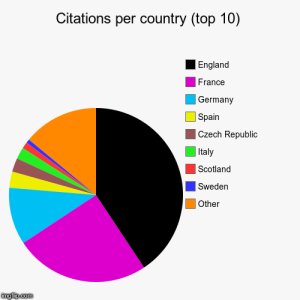
And for the top 9 countries:
citations per country
Where you can see that France has made a significant dent into England’s previous lead.

Monday, November 3, 2014

Taking stock, Nov. edition from the Dictionary of Medieval Names

http://dmnes.wordpress.com/2014/11/01/taking-stock-nov-edition/

This month has been a quiet one for the Dictionary, as the school year began, one member of staff hopped the channel and took up a permanent academic position, and another finished up her Ph.D. dissertation, but there’s nothing like the threat (incentive) of monthly updates to encourage last-minute-Friday-night working. When I realized how close we were to 7000 citations, how could I not put in the time needed to make sure we reached (and actually exceeded!) that number?
We start November with 460 entries ready for inclusion in the first edition (up from 414 last month, an 11% increase). 282 are masculine (still ranging fromAdalbod to Zdyslav — it’ll probably be a long while before the end bound changes, and the beginning bound won’t leap forward until we start working through names of Hebrew origin), and 177 are feminine (with the same bounds as before).
The more than 7000 citations (7006 to be precise) represent a 25% increase over last month (5574); the average number of citations per entry has jumped slightly to just over 15%, though it again should be stressed that most entries are far from average, either containing only one or two citations, or many, many.
Roughly 3690 citations are from Latin-language records, slightly more than 52% (what can I say? Early chartularia have so many interesting names, I haven’t been very equitable in how I’ve spent my time).
As with previous stock-takings, we’ll close with a few charts:
Citations per country
Spain has jumped ahead of the Czech Republic in the rankings, compared to previous months. (A collection of very fascinating documents from the late 15th C is partly responsible for this, with gorgeous names like Euphrosyne.)
domnz
Not much change here.

Tuesday, September 9, 2014

Taking stock of the Dictionary of Medieval Names from European Sources

http://dmnes.wordpress.com/2014/09/01/taking-stock/


Though, as noted earlier, it will be unable to release the first edition of the Dictionary at the end of this month as originally planned, nevertheless they are continuing to make good progress on the data-collection and -entry side of things. They thought it would be fun to take stock of things as they stand, and put up a few teaser statistics.
There are currently 297 entries ready for publication: Each of these entries includes the etymological derivation of the name; brief notes about any major royalty (kings/queens; emperors/empresses), popes, or saints who bore the name; and any other relevant information concerning the linguistic development of the name, references to secondary literature, or cross-references to other application dictionary entries. 176 of the entries are masculine names, ranging from Adolf to Zdyslav, and the remaining 121 are feminine, ranging from Accorsa to Zoete.
There are 3880 citations distributed over these 297 entries, making an average of just over 13 citations per entry. Of course, the reality is much different: Many of the entries have only a single citation, and a bare handful of entries have hundreds. Such minimal data is already indicative of the larger sample being confirmative of Zipf’s Law; one exciting consequence of the Dictionary is that research concerning empirical matters such as Zipf’s Law will be much easier to undertake as a huge body of data will all be gathered in a single place.
The citations are taken from records from the Czech Republic, Germany, England, France, Italy, Scotland, Spain, and Sweden. The earliest citations are from 779, a handful of masculine names from a Carolingian charter; the latest are from 1600 and are drawn from English parish records. Approximately 1850 citations are from Latin-language records; the remainder are from various vernaculars.
Maybe they’ll do updates like this the beginning of every month!