Saturday, February 7, 2015

Colloque "Enseignement / apprentissage de la littérature et les études littéraires contemporaines: onomastique, base de données et comparatisme littéraires"

http://www.fabula.org/actualites/enseignement-apprentissage-de-la-litterature-et-les-etudes-litteraires-contemporaines-onomastique_66908.php

Enseignement / apprentissage de la littérature et les études littéraires contemporaines: onomastique, base de données et comparatisme littéraires (Algérie)

Enseignement / apprentissage de la littérature et les études littéraires contemporaines: onomastique, base de données et comparatisme littéraires (Algérie)

Information publiée le 2 février 2015 par Marc Escola (source : Lila Medjahed)
Le 30 mai 2015
Algérie
RASYD, Unité de recherche « Les Systèmes de dénomination en Algérie » et  ELILAF, Laboratoire « Environnement linguistique et usages du français en Algérie »  organisent
Colloque international
Enseignement / apprentissage de la littérature et les études littéraires contemporaines: onomastique, base de données et comparatisme littéraires
Du 17 au 19 Novembre 2015, Algérie
 
Depuis quelques années, une réflexion est amorcée sur la problématique de l’enseignement / apprentissage de la littérature à l’école et l’université, notamment dans une perspective d’articulation entre les cycles de l’enseignement secondaire et de l’enseignement supérieur. En effet, la recherche en littérature a souffert d’une double mise à l’écart par les promoteurs d’une réforme scolaire et universitaire (particulièrement dans le système LMD). Les enseignants de littérature se plaignent d’un déficit de représentation du champ d’études littéraires dans les départements de langues, où elles sont considérées comme « inutiles », du moins difficiles à assimiler. Cette image dépréciative aboutit à sous - estimer l’impact des études littéraires contemporaines dans l’enseignement/apprentissage des langues. Or, la littérature est  incontournable pour acquérir les compétences disciplinaires en rapport avec certains métiers et spécialités : médias, édition, culture, communication etc.
L’objectif de ce colloque est de créer une dynamique pluridisciplinaire entre les acteurs du système éducatif, les universitaires, les sociologues de l’éducation, les concepteurs des manuels, les critiques  littéraires contemporaines, etc., à l’effet de traiter les thématiques suivantes :
Les études littéraires contemporaines
Les nouvelles configurations pédagogiques en milieu scolaire et universitaire peuvent se réaliser à travers les quelques pistes suivantes :
Ouverture sur de nouvelles approches, de type onomastique littéraire : l’étude des noms propres offre des outils d’analyse pertinents pour une exploitation pédagogique du texte littéraire. Dans ses deux volets anthroponymique (Cheriguen, 2007 ; Yermeche, 2005) et toponymique (Atoui, 2005), l’onomastique pourrait être une entrée méthodologique appropriée pour interroger le fonctionnement interne du texte ainsi que ses soubassements socio culturels et anthropologiques (Leroy, 2004).
Comparatisme et transversalité littéraires : une approche comparatiste des littératures nationales et celles des aires culturelles, linguistiques étrangères (Moura, 1998) permettra d’examiner des domaines littéraires contemporains, voire de l’extrême contemporain (Schoentjes, 2014). Il est important de s’interroger sur les productions émergentes (Laronde, 1996), diasporique ou minoritaire, sur les « mauvais genres » (roman policier, sentimental, BD, etc.), la traduction littéraire et leur place dans ces nouveaux dispositifs. 
Les ateliers de créativité : La lecture méthodique a mis en place une technicité qui a fondé sa légitimité dans le cadre de l’enseignement/apprentissage du texte littéraire.  Elle s’inscrit dans les modalités d’insertion didactique des lectures scolaire et universitaire au sein des ateliers de créativité (jeu onomastique, réécriture des textes, scénarisation, etc.).
L’ouverture incontournable aux dynamiques plurilingues : elle fait écho aux impératifs des standards universitaires internationaux, induits par la mondialisation, dans ses dimensions culturelles et interculturelles les plus productives (Puren, 2010).
Les langues des nouvelles technologies (cyberlangue) et multimédia : après les instructives conclusions du colloque[1] sur la cyberlougha au Maghreb, il est nécessaire de nous interroger sur les nouvelles études qui examinent l’impact des technologies d’information et de télécommunication sur l’émergence de nouvelles scénographies fictionnelles et narratives.
L’utilisation des bases de données : les bases de données sont de nouvelles configurations scientifiques en mesure d’asseoir  une exploitation pédagogique optimale en matière littéraire. Les sites de documentation à l’instar de Limag (Bonn, 2009) ou des centres de recherches et des archives, comme celui de Archives et Musée de la littérature en Belgique (Quaghebeur, 2009), le Centre de Littératures française et francophones contemporaines à Paris (Moura & Viart), en sont des exemples remarquables.  

Littératie et enseignement/ apprentissage du  texte littéraire
L’enseignement de la lecture prendrait en ligne de compte les implications cognitives et les effets sociaux de la lecture et de l’écriture.  La réflexion de la littératie (Goody, 2006) ne peut être pertinente que si elle fait l’objet de contextualisation pour rendre compte des pratiques de la lecture et l’écriture en milieu scolaire et universitaire. Les différentes interactions de la littératie, induites en contexte plurilingue, par le biais des transferts langagiers et linguistiques, langues maternelles/Langues étrangères, dans le dispositif enseignement/apprentissage de la lecture du texte littéraire, sont à saisir dans une vision valorisante du plurilinguisme (Benramdane, 2013).
Quel rôle joue l’enseignement/apprentissage de la littérature et/ ou de la lecture à l’école et l’université ?
Actuellement, la réflexion porte sur la distinction entre enseignement de la lecture et enseignement de la littérature (Todorov, 2004). L’histoire littéraire n’étant plus au centre de l’analyse, elle participe à la construction du sens. Les deux enseignements mettraient en œuvre les fonctions traditionnelles de l’école et de l’université : mission critique, détermination éthique et scientifique, orientation prospective, aptitudes d’anticipation et recherche de l’excellence. Donc, il s’agit de la remise en cause d’une attitude à dominante traditionnaliste ou instrumentaliste qui ne prend pas en compte les conditions de production et de réception. La conception moderne de la littérature est historiquement liée à la notion de nationalisme, consolidant l’affirmation et la légitimité de l’identité linguistique nationale. Toutefois, la littérature est un phénomène esthétique, socio-symbolique et historique.  Certains la considèrent comme un patrimoine universel d’œuvres d’écrivains célèbres et consacrés. Il est évident que les mutations mondiales ont bouleversé les univers linguistiques et les imaginaires culturels nationaux dans tous les pays. A cet égard, l’enseignement de la littérature scolaire et du texte littéraire à l’université s’inscrit dans une forme de projet pédagogique en fonction du changement de son public d’une période à l’autre.
Dans le cadre de ce colloque, c’est la dimension empirique qui est prioritairement recherchée par la mise en exergue des résultats de recherche sur des pratiques pédagogiques innovantes, insistant sur des propositions de dispositifs didactiques, renforcées par des assises théoriques appropriées et argumentées. Il est indispensable d’interroger les nouvelles recherches littéraires françaises et francophones contemporaines à partir des approches comparatistes nouvelles et de corpus différents.
Bibliographie
ATOUI (Brahim), 2005, « L’odonymie d’Alger: passé et présent », In Nomination et dénomination. Des noms de lieux, de tribus et de personnes en Algérie. Ouvrage collectif coordonné par Farid Benramdane et Brahim Atoui. Editions CRASC.
BENRAMDANE (Farid), 2013, « Littératie, rénovation des curricula des langues et transfert langue française / langues maternelles et secondes. Le cas du système éducatif algérien », actes du colloque Lille 16/17 Mai 2013.
BESSE (Henri), 1989, “Quelques réflexions sur le texte littéraire et ses pratiques dans l’enseignement du français langue seconde ou langue étrangère”, In Trèfle, 9, pp. 1-12.
BONN (Charles), « Le programme LIMAG (Littératures du Maghreb) », In Littératures Au Sud, AUF, 2009.
QUAGHEBEUR (Marc), « Des Archives pour le futur », In Littératures Au Sud, AUF, 2009.
GOODY (Jack), 2006, « La littéracie, un chantier toujours ouvert », In Pratiques. N°131/132, Décembre 2006. Traduit par Kathie Birat.
LEGROS (Denis), all, 2009, « TICE et Cognition de la Littératie plurilingue. Vers un modèle intégrateur », in Synergies Algérie n° 6.
LARONDE (Michel), 1996, L’Ecriture Décentrée, la langue de l’autre dans le roman contemporain, Paris, Harmattan 1996.
LEROY (Sarah),  2004, Le nom propre, Paris, OPHRYS.
MOURA (Jean-Marc), 1998,  L’Europe littéraire et l’ailleurs, Paris, PUF.
TODOROV (Tzevetan), 2007, La littérature en péril, Flammarion.
SOUCHON (Albert), 2000. Les textes littéraires en classe de langue. Hachette.
Calendrier du colloque 
Lancement de l’appel à communication : 1 Février 2015
Sélection des propositions des communications : Juin 2015
Information des candidatures retenues/ Envoi des invitations : Août-Septembre 2015
Date limite d’envoi des propositions de communication : 30 Mai 2015
Les propositions de communication ne devant pas dépasser un résumé de 500 mots maximum, avec une bibliographie succincte et la fiche de présentation indiquant : nom et prénom, établissement de rattachement, grade et adresse mail. Adresses de réception des propositions à Lila Medjahed : lmedjahed1@gmail.com etfarid.17@hotmail.com, ou litteraturecolloque2015@gmail.com 
Comité scientifique
 Brahim Atoui, RASYD, CRASC
 Farid Benramdane, RASYD & ELILAF
 Ouerdia Yermeche, RASYD, CRASC
 Charles Bonn, LIMAG, France
Tourya Fili-Tullon, Passage XX-XXI, Université Lyon II, France
Marc Quaghebeur, Archive et Musée de la Littérature, Belgique
Jean-Paul Meyer, Univ. Strasbourg, France,
Jean-Marc Moura, Univ. Paris Nanterre, France,
Michel Laronde, Univ. Iowa, USA,
Bernadette Mimoso-Ruiz, Univ. Toulouse, France
Pierre Schoentjes, Univ. Gand, Belgique
Katrien Lievois, Univ. Gand, Belgique
Violaine Houdart-Merot, Univ. Cergy- Pontoise, France,
Cristina Robalo Cordeiro, AUF Maghreb,
Sabine Loucif, Univ. Hofstra, New York, USA
Sonia Zlitni Fitouri, Univ. Manouba, Tunisie,
Mabrour Abdelouehed, LERIC, El Djadida, Maroc,
Slimane Lemnaoui, Univ. Fès, Maroc
Alain Sissao, CNRTS, Univ. Ouagadougou, Burkina Faso
Pierre Dumont, Univ. Martinique
Patrick Chardenet, AUF
Wafa Berri, Faculté SH, Liban
Moussa Daff, Univ. Dakar, Sénégal
Faouzia Bendjlid, LADICIL & UCCLLA, Oran,
Fatima Medjad, LADICIL, Oran,
Mohamed Daoud, UCCLLA, CRASC
Latifa Kadi, LIPED, Univ. Annaba,
Karima Ait Dahmene, Univ. Alger 2,
Mohamed Miliani, Univ. Oran,
Yamilé Ghebalou, Univ. Alger 3,
Boumedienne Benmousset, Univ. Tlmecen
Taklit Mebarek, RASYD, CRASC
Mohand Haddadou, RASYD, CRASC
Cherif Sini, RASYD, CRASC


Comité d’organisation :
Les membres du laboratoire ELILAF et de l’unité de recherche RASYD : Farid BENRAMDANE, Lila MEDJAHED, Nazéha BENBACHIR, Abdelkader SAYAD, Lynda-Nawel TEBBANI, Nezhet BENZIDANE, Malika ABDELAZIZ, Khadidja BENAMMAR, Mohand Akli SALHI, Khadidja BENKASDALI, Mimouna NOUAR, Aouatef SAHNOUN, Leila MOUSSADEK, Farid HADJARI, Saliha BENAISSA, Chahrazed HAOUCHINE, Leila BELKAIM, Azzedine MALEK, Abdelhamid KRIDECH.

[1] Colloque international organisé par ELILAF en collaboration avec REMATE (Réseau maghrébin des technolectes) sur  « La Cyberlougha : Plurilinguisme, Contact des Langues et nouvelles formes d’expression linguistiques au Maghreb », du 6 au 8 Décembre 2014 à Mostaganem (Algérie). 

Wednesday, February 4, 2015

Nora og Lucas tilbake på navnetoppen

http://www.ssb.no/befolkning/statistikker/navn/aar/2015-01-27

Toppnavnene fra 2012, Nora og Lucas, er tilbake på navnetoppen. Populariteten til tross: Bare 1,4 prosent av jentene fikk navnet Nora, og 1,4 prosent av guttene fikk navnet Lucas i 2014.
Topp ti, jentenavn og guttenavn 2014
NummerNavnAntallPer 1000
Jentenavn
1Nora/Norah43414
2Emma41814
3Sara/Sarah40413
4Sofie/Sophie38813
5Emilie35812
6Anna32711
7Linnea/Linea32611
8Thea/Tea32310
9Maja/Maia/Maya32310
10Sofia/Sophia31510
Guttenavn
1Lucas/Lukas44814
2William43814
3Markus/Marcus42313
4Emil41913
5Oskar/Oscar38912
6Mathias/Matias38212
7Magnus37712
8Filip/Fillip/Philip37212
9Jakob/Jacob37111
10Aksel/Axel36311
Figur 1. Navnetoppen 2014
Nora kom inn på topp ti i 2000 og har således vært blant de mest populære jentenavnene en stund. Nora toppet listene i 2012 og igjen i 2014, da Nora og Norah sammenlagt ga ny topp og dyttet Emma ned fra førsteplassen. Navnet Nora dukket opp i Norge på midten av 1800-tallet og fikk sitt første lille oppsving etter «Et dukkehjem». Navnet er en kortform av Eleonore, men betydningen av navnet er ikke kjent. Nora fronter den stadig voksende trenden med jentenavn som slutter på -a eller -ah. Over halvparten av jentenavnene slutter nå på -a eller -ah. , mot drøye én av ti i 1947.

Figur 2. Topp ti av alle navn 2014

Lucas tilbake på topp

Lucas og Lukas sammenlagt gjenerobret topplassen etter ett år med Filip, Lucas har vært dominerende guttenavn siden 2008 og har vært på topp i seks av de syv siste årene. Navnet betyr «mann fra Lucania». Lukas skal ha skrevet både Lukasevangeliet og Apostlenes gjerninger. På tross av Lucas, synker andelen gutter med bibelnavn langsomt til 21 prosent, mot 23 prosent i toppåret 2006. Til sammenligning hadde rundt 1,5 prosent av guttene bibelnavn på 1950-tallet.

Figur 3. Utviklingen i popularitet for Nora og Lucas

Største klatrere

I 2014 klatret gamle travere som Markus og Emil opp åtte plasser til henholdsvis 3. og 4. plass. Aksel fortsetter oppover og er ny på topp ti. På jentesiden er det Nora, Anna, Tiril og Emilie som vokser mest. Over den siste femårsperioden er det Matheo, Liam, Olav og Aksel blant guttene og Olivia, Ella, Mie og Lilly blant jentene som klatrer mest.

Bare 1,4 prosent av jentene og guttene fikk toppnavn

Selv om Nora og Lucas er på topp, er det bare 1,4 prosent av henholdsvis jentene og guttene som fikk navnet i 2014. Til sammenligning fikk nær 6 prosent av jentene navnet Anne på 1950-tallet. Vi er med andre ord blitt flinkere til å variere navnevalgene.
Statistisk sentralbyrå har laget navnestatistikk siden 1991. På 1990-tallet lå toppnavnene i median på 2,4 og 2 prosent for gutter og jenter. Den neste tiårsperioden var andelene sunket til 1,85 og 1,9. De siste fem årene år er tilsvarende tall 1,7 og 1,4 prosent. En vesentlig del av den større variasjonen i navn de siste årene skyldes innvandringen til Norge, med innslag av mange nye navn. I 2014 er det i alt 80 000 jentenavn i Norge, og 68 000 guttenavn. Om oppmerksomheten rundt de mest brukte navnene får mange til å velge andre navn, er et spørsmål vi lar stå ubesvart.

Kjært barn får mange navn

Nesten annen hvert barn får mellomnavn, altså et andre etternavn, mens knappe en av ti får etternavn med bindestrek. Begge tallene er litt lavere enn forrige år. Med mange etternavn, nøyer de fleste seg med ett fornavn: 22 prosent av guttene og 25,8 prosent av jentene får flere fornavn. De mest brukte annet fornavn er Alexander/Aleksander, André og Johan for guttene, og Sofie, Marie og Louise for jentene. Hadde vi laget navnetopp med ikke bare første fornavn, ville med andre ord andre navn ligge på topp.

Trender fra Sverige?

Siden vi erfaringsmessig arver navnemoter fra nabolandet i øst, er det spennende å følge deres utvikling. I Sverige topper Lucas, William og Oscar i 2014. På jentesiden er Elsa ny på topp før Alice, som har toppet i tre år, mens Maja kommer på tredje plass. Bortsett fra Alice og Vincent, som ikke har slått an i Norge foreløpig – navnene er på henholdsvis 156. og 143. plass her til lands – er den svenske navnetoppen nokså lik den norske.

Noen lokale variasjoner

Lucas er toppnavn i fire av landets fylker. Med ulike skrivemåter topper Mohammad som tidligere i Oslo. Erik, som er på en 39. plass på landsbasis, ligger på andreplass i Hedmark. Noah, som ligger på 13. plass på landsbasis, er i 2014 på topp i Vest-Agder. På jentesiden er Nora toppnavn i tre fylker. Vi merker vi oss Julie på topp i Akershus og Lilly på topp i Vest-Agder. Anna, ett av jentenavnene som klatrer mest, er på topp i Sogn og Fjordane.

Tuesday, February 3, 2015

В Таразе переименовали улицы Героя СССР Петрова и генерала Черняховского

http://www.russianskz.info/society/6288-k-70-letiyu-velikoy-pobedy-v-taraze-pereimenovali-ulicy-geroya-sssr-petrova-i-generala-chernyahovskogo.html


К 70-летию великой Победы?.. В Таразе переименовали улицы Героя СССР Петрова и генерала Черняховского
14 января 2015 | По материалам газеты "Время"
К 70-летию великой Победы?.. В Таразе переименовали улицы Героя СССР Петрова и генерала ЧерняховскогоВ городе Тараз улицу имени Александра Петрова, жамбылца и Героя Советского Союза переименовали в улицу Аспетова, сообщает газета «Время».

В редакцию издания с открытым письмом обратились жители улицы, которые узнали о переименовании самыми последними. В своём письме они пишут, что их еще с лета уговаривали дать своё согласие на переименование улицы, но никто из жителей этого согласия не дал.

Жители улицы пишут, что «…в разрушении памяти о подвиге наших отцов и дедов прослеживается закономерность», указывая на то, что в последнее время в городе были также переименованы улицы имен генералов Ватутина и Черняховского.

Жители улицы также написали открытое письмо президенту РК и направили жалобу на имя прокурора области.

Прокуратура Жамбылской области отреагировала на обращение, внеся протест на постановление акимата и решение маслихата Жамбылской области о переименовании на основании того, что эти правовые акты в нарушение требований законодательства были приняты без учёта мнения населения улицы Петрова.

Также прокуратура области обратилась к акиму области Кариму Кокрекбаеву и секретарю областного маслихата Баглану Карашолакову с просьбой отменить постановление акимата и решение местных депутатов о переименовании улиц Петрова и Черняховского на Аспетова и Баянова.

Между тем, сами местные депутаты, голосовавшие за переименование, вкупе с чиновниками из областного и городского маслихатов и акиматов мотивируют переименование улицы тем, что они не знали, что улица была названа именно в честь Александра Петрова, а не какого-либо другого человека с такой же фамилией.

Sunday, February 1, 2015

Names and Naming: An Ethiopian Experience

http://onomastics.co.uk/an-ethiopian-experience/

Laura Taylor, 2013 ICS volunteer
Laura Taylor


In the summer of 2013, I took part in International Citizen Service, a UK-funded volunteering initiative which brings young people from the UK and developing countries together to fight poverty.
My 12 weeks were spent in the city of Dire Dawa, eastern Ethiopia; a dusty desert town born out of the French Addis Ababa-Djibouti railway project in the early 20th century. Living with a host family and working in a national NGO with an Ethiopian counterpart gave me an unbelievable insight into what life is like for a young person growing up in Africa today.
While I learned so much about international development in practice, I also learned just as much about what it means to be Ethiopian; and the process of naming demonstrates this perfectly. A name, perhaps even more so than in Western culture, is imbued with meaning, as well as acting as a time capsule – a name will tell you a lot about the circumstances of the person’s birth.
Before we go any further, a quick disclaimer; all the names I’ll mention are female. My strongest friendships and bonds from my time in Dire Dawa were with the women and girls in the community; my host mum and sisters, my lady colleagues, and the female volunteers. Friendships between members of the same gender are incredibly powerful in Ethiopia, and provide a safe forum to discuss everything from dreams to fears, and as it happens, what names mean. By the time the girls in my host family and I got onto the meaning of our names, we’d already covered everything from the best places to buy fabric to Bollywood movie stars. I was in the sisterhood.
Ethiopian names often have a simple meaning, easily translated into another language, which makes discussing them with broken Amharic and English far more straightforward than explaining British names. (Try explaining the meaning of Laura, a crown of laurel leaves, to someone who has never seen a film with gladiators in it). A name reflects a parent’s hope for their child, particularly the children born in my generation. The Dergue regime crippled the country during the 1970s, when The Red Terror and famine swept Ethiopia. One of the Ethiopian volunteers we worked with, Selam, was so named because her parents lived through the horrors of that period, and never wanted their child to have to suffer the same. Her name, which means peace, reflects the wider mood of the time, when the first democratic government was installed in Ethiopia, promising a brighter, less violent future. My work counterpart’s name, Mehret, means mercy; again, holding a mirror to the years preceding her birth; other names such as Tigist (patience), Addis (new/fresh) and Tesfaye (hope) were also popular among girls my age.
My 4 year old host sister, Temar, was given her name as something to live up to. She had been born in a very comfortable family, who spared no expense to ensure that she had the best education money could buy to become a high achiever. Her name comes from temari, meaningstudent/learned one and it was expected that she would study hard, go to university and have a successful career in the field of her choice. Considering that girls traditionally occupy a lower place in Ethiopian society, seeing a family who were challenging the stereotype not only through the way they supported their daughter, but the very name they gave her, was completely inspirational.
A name in Ethiopia is not simply a parcel of hopes though, it’s an identifier. The name given to a child will often make evident the ethnic background or religious persuasion of the family. Ethiopia is home to over 80 distinct ethnicities, each with their own language, dress, dance and names. Some names, like Kokobe (bright star, Amharic) and Senait (gift, Tigray) are drawn from the oral traditions of a particular group; others, like Gelila (fromGalilee, Coptic Christian) and Amina (honest, Islamic), signal which religion is practiced by the family. I thought it was wonderful that cultures and languages were being kept alive through the meaning of names; in the same way that I can tell people what my Gaelic middle name means, people I met could tell me things like ‘my name means ‘precious’ in Oromiffa because my mum is Oromo’.
As I settled into my Ethiopian routine, I began noticing that my host family were calling me Laura less and less, and instead using Lauritee, a pet version of my name. Nicknames are really popular amongst close friends, and tend to elongate the name rather than shorten it – being called Laura less and Lauritee more was a sign of affection and acceptance. My host mum also thought that giving my name an Ethiopian makeover would help me to feel at home and settle in faster; Laura isn’t a name in Ethiopia, and the closest word there is, naura, translates as ‘whitewash’. Appropriate, but not exactly flattering. When I got talking to people in public transport, and I told them what my name was, they would also try to re-name me with a similar-sounding, but betam konjo (more beautiful) name. The most popular candidates came from the Oromo language, widely spoke in Dire Dawa, and on more than one occasion I’ve been ‘officially’ re-named Layla (another); Lalla (tulip); Lelo (grace); Lula (a general pet name). It’s great to be a different person every day – try it!
Children often go by numerous nicknames depending on who is speaking to them at the time. The youngest girl in the family is often referred to asmama, or mamayay (a little bit like us calling the youngest child ‘baby’); in a similar vein, Temar would switch between her full name, mama,Temariyay and dimbet (mouse child) in the course of a single conversation with different participants, all the while fully aware that comments were being directed at her. I once heard my host mum’s friend speaking to her new baby, and rather than using anchi (you), she had elongated the word so it became anchiyay, reinforcing the bond between her and her child.
Outside my host family, friends and colleagues, names continued to follow me all over the city. Foreigners aren’t a particularly common sight in Dire Dawa, and so the arrival of 12 British volunteers caused a bit of a sensation in the community. Wherever we were, people would shout various things in our direction to attract attention and say hello – sometimes there were greetings, but most of the time, they were substituted names. The most common thing shouted in our direction was ferenjii, an Amharic take on the phonetic pronunciation of foreign; most of the names given to us in the street commented on our appearance, from the flattering konjo (beautiful) through to the far more accurate kyo (red face). Many people also framed our arrival in the context of the ferenjiis who had come before us, and there was definitely an age element to how people named us. Much older people would often greet me in either Italian or French, or call me Mademoiselle or Signora when talking to me; as has been mentioned previously, the French had a presence in Dire Dawa through the building of the railway, and the Italians briefly invaded Ethiopia during the 1940s. I had Ruski shouted in my direction on a few occasions, probably due to how pale I am (so my Ethiopian friend told me), but it’s also worth remembering that the Dergue were a Soviet-backed party. My Ethiopian peers’ favourite name to shout at the UK volunteers was China (those who actually are Chinese get treated to Jackie Chan as a sign of differentiation). The Chinese government has been heavily investing in Ethiopia in the 21st century, and many of the foreigners in Dire Dawa in the recent past are likely to have been Chinese, there to work on the massive infrastructure projects.
Before I travelled to Dire Dawa, when someone said Ethiopia, the first image that came to mind was children with sunken eyes and distended stomachs, weak from hunger. While Ethiopia has come a long way from the famines which plagued it in the 1970s and 80s, even the name of the country carries its own meaning. Ethiopian people are hyper-aware of this association, and are quick to tell visitors that the Oxford English Dictionary’s definition of famine uses Ethiopia as an example. And yet in recent African history, Ethiopia has been a by-word for self-determination, native rule, and resistance to colonisation. I do not doubt that in years to come, the positive strides that the country and its people are making will tie promise and positivity to the meaning of Ethiopia, and it will once again be a name to be proud of, not just a footnote in the OED.
My experiences in Ethiopia showed me how central names are to the relationships we form in our societies, not only between parents and children, but amongst friends, acquaintances (and in my case) total strangers. They help define who we are, and where we come from, and understanding the forces behind the names we are given – and give to others – is a way of understanding the world we live in. While in Dire Dawa, I have been a stranger, a foreigner, a friend and a part of the family all in one day; many things to many different people, and each new relationship marked with a different name.

Taking stock, February edition by DMNES


https://dmnes.wordpress.com/2015/02/01/taking-stock-february-edition/

I was going to stop doing these monthly recaps with January, because after that you could see first hand what was new and improved. Alas, we haven’t quite made the Jan. 31 goal, so you get one more month’s worth of stats and graphs. We’re up to 16030 individual citations (up from 10288, an increase of nearly 56%!) distributed over 764 entries (up from 639 last month, a 19.5% increase), resulting in an average of 21 citations per name (up from 16 last month, no doubt due to the completion of the extremely popular names John and Joan, both of which have hundreds of citations.)
There are 463 men’s names and 278 women’s, and, excitingly, for the first time in months, our ‘earliest/latest in the alphabet’ names have changed! The alphabetically foremost masculine name is now Achard, of Germanic origin and with French citations, and the alphabetically hindmost name is now Zwentibold, of Slavic origin but influence, in its Latin form, by Germanic elements.
7174 of the citations are from Latin records, that is, around 44.7%, a significant decrease from last month, due no doubt to the large number of 16th C English parish registers that we’ve been working through. Here’s the breakdown for all the languages:
citations per language
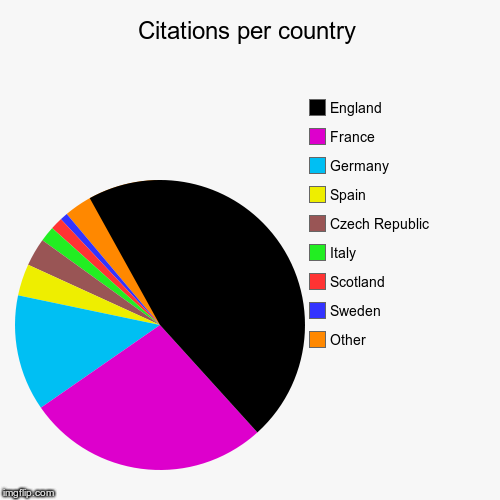
When it comes to citations per country, we’ve now reached the point where we’re constrained by the number of slices we can put into our pie chart (on the free online automatic pie-chart generator we’re using), which means neither Brabant nor Malta show up on the below, despite now having sizeable showings:
citations per country
Lastly, this month the Dictionary welcomed a new assistant to the editorial team:Dr. Mariann Slíz is a member of the Institute of Hungarian Linguistics and Finno-Ugric Studies at Eötvös Loránd University, specializing in Onomastics, Cultural History, Historical Linguistics, Medieval History, Literature, Magical Realism, History of Hungary, Medieval Hungary, Hungarian linguistics, and Anthropology of Personal Names. We are very grateful to have an expert on Hungarian names joining us, in part because it means we can move Hungarian from the second phase to the first phase! So keep a look out for Hungarian citations and citations from Hungary in upcoming editions of the Dictionary.