Friday, December 24, 2021

Voprosy onomastiki / Problems of onomastics (2021, Vol. 18, Issue 3)

 link 


The new issue is available online: 

Articles

Sobolev, A. I.
Improving Reliability of Onomastic Etymology (with Reference to the Southeastern Lake Onega Region)

Kabinina, N. V., Kornienko, E. D.
The Nothern Russian Toponym Urdoma: Old and New Etymologies

Tóth, V.
Linguistic Prestige and Toponym Use at the Crossroads of Languages and Cultures

Napolskikh, V. V.
“My Arrow, Fly Up Double, Come Down Single”: To the Problem of Scandinavian–Alanic Parallels in the Mythological Onomasticon

Petrosyan, A. Ye.
Reflexes of a Hurrian Word in Armenian: A Theonym, a Dendronym, an Anthroponym

Dugarov, B. S.
Theophoric Names in the “Heavenly” Prologue of the Buryat Epic Cycle Geseriada

Nazarov, A. I.
Corpus of Surnames of the Ilek Cossacks (Based on the 18th–19th Centuries Census Material and Parish Registers)

Zubov, N. I.
On the Codicological Features of the Odessa Manuscript of the 16th–17th Centuries Slepchensky Commemoration Book

Preobrazhenskaya, A. A.
AvgustAvgustinAvgustaly: To the History of Russian Monastic Names Unmentioned in Menologies

Zhamsaranova, R. G.
Personal Names of the Bulteger Tungus Clan of the Urulgin Steppe Duma (Based on Early 19th Century Census Lists)

Kostylev, Yu. S.
Names of Crystal-Bearing Deposits of the Circumpolar and Southern Urals: A Comparative Study

Kryukova, I. V., Suprun, V. I.
Ways of Development of Slavic Onomastic Lexicography: An Analytical Overview

Anniversaries

Matveyev, A. K.
The Main Objectives of Studying Ural Toponymy

Dmitrieva, T. N.
Selected Works on Ural Toponymy (1968–2021)

Ivanova, E. E.
On the 60th Anniversary of the Ural University Toponymic Expedition: A Return to the Urals

Academic curriculum

Conferences, congresses, symposia

Vlahova-Angelova, M., Petkova, G.
International Onomastic Conference “Anthroponyms and Anthroponymic Studies at the Beginning of the 21st Century”

In memoriam

Myznikov, S. A.
Alexey Alexeyevich Burykin (1954–2021)

Basangova, T. G.
A Bibliography of Works on Onomastics by A. A. Burykin

Thursday, December 23, 2021

New NamSor onomastics app!

NamSor is a European company applying digital onomastics to gender and migration studies since 2012. They launched their new website recently, which is easier to use by non-IT people (onomasts, geographers, sociologists, social scientists, statisticians, ...)

If you like our content and would like to support e-onomastics, check-out NamSor services via our affiliate link below.
They've been a long partner of us, cited in many of our blog posts. 
They've supported dozens of large scale studies with the World's top universities (Harvard, INSEAD, Chicago University, ...)

They offer a wide range of name classification services,
- to recognize personal names (anthroponyms) from place names (toponyms) or brand names;
- to infer the most likely gender of a personal name, with a probability estimate;
- to guess the likely country of origin of a name;
- to recognize aspects of 'race'/ethnicity for diversity analytics
and more.
Here is a direct link to the app, 
https://namsor.app/?via=eugen 


«ОНОМАСТИКА – ЗЕРКАЛО НАЦИИ»

Sunday, December 19, 2021

Histoire des noms de famille français. De leur formation à leur disparition

 lien 


Xavier Deniau

Collection : Nomino ergo sum

Cet ouvrage posthume, laissé pratiquement achevé par l'auteur, raconte deux mille ans de constitution du patrimoine onomastique français. Élément constitutif primordial de l'identité individuelle, le nom de personne fait aussi partie de l'histoire et de la géographie de la nation. Notre système onomastique est issu de la lente imbrication de trois systèmes historiques distincts : gaulois, gallo-romain et germain. Le nom de baptême unique en vigueur durant le haut Moyen Âge sera remplacé à partir du XIe siècle par le système de nom double. En 1539, l'ordonnance de Villers-Cotterêts affermit ce système de double nom, ancêtre de nos « prénom et nom de famille ». Les noms vont continuer de s'enrichir jusqu'à la loi du 11 germinal an XI qui fi gera les règles, entraînant mécaniquement, par le jeu statistique, la disparition progressive des noms les plus rares. Depuis lors, le patrimoine onomastique semble condamné à s'étioler. Outre une analyse précise et imagée de l'histoire et de la richesse de notre patrimoine onomastique, cet ouvrage est un appel à sa sauvegarde.


  • Date de publication : 14 décembre 2021
  • Broché - format : 15,5 x 24 cm • 258 pages
  • ISBN : 978-2-343-23528-8
  • EAN13 : 9782343235288
  • EAN PDF : 9782140198168

Xavier Deniau, haut fonctionnaire et homme politique gaulliste (1923-2011) est notamment connu pour avoir créé la Francophonie. Passionné de la langue française, il était aussi passionné d'onomastique. Devenu membre de l'Institut et de l'Association française d'onomastique, il cultiva cette passion tout au long de sa vie

Thursday, December 16, 2021

The SNSBI Spring Conference 2022 and 2023

 An unfortunate - but sadly necessary - announcement about the Spring 2022 conference, from the Hon. Secretary of the SNSBI


Well, 2022 - online, while 2023 -in-person!!!


Wednesday, December 15, 2021

Panel Discussion on Columba and His Legacy in the Place-Names of Ireland and Scotland


UPNS Seán Mac Airt Memorial Lecture 2021


Date and time


Regensburger Studien zur Namenforschung 10

Link 

Der Aspekt der Praxisrelevanz wird in der Namenkunde häufig unterschätzt und vernachlässigt. Vor diesem Hintergrund werden in diesem Sammelband Namenarten wie z. B. Orts- und Familiennamen, Warennamen oder auch Pseudonyme unter praxisrelevantem Blickwinkel betrachtet. 

Darüber hinaus werden Überlegungen dazu angestellt, wie die in der onomastischen Forschung gewonnenen Resultate der interessierten Öffentlichkeit präsentiert und zugänglich gemacht werden können. Besonders hervorzuheben sind Beiträge von Vertreterinnen und Vertretern aus Berufsfeldern mit besonderer Relevanz der Namenpraxis, etwa im Bereich der Marken- und Patentprüfung oder des schulischen Unterrichts. Durch diese ganzheitliche Betrachtungsweise der Praxisrelevanz von Eigennamen werden neue Forschungsfelder für die Onomastik erschlossen, wozu diese Publikation Anstöße gibt. 

Der vorliegende Sammelband ist Albrecht Greule zu seinem 75. Geburtstag gewidmet. Die meisten Beiträge gehen zurück auf Vorträge und auf ein Podiumsgespräch im Rahmen eines Symposiums anlässlich dieses Ehrentags des Jubilars, das am 21.04.2017 in Regensburg stattfand und mit Leipziger Beteiligung stattfand. Die Laudatio hielt Dieter Kremer (hier abgedruckt), mit dem Albrecht Greule lange Zeit im Vorstand der Deutschen Gesellschaft für Namenforschung zusammenarbeitete.

Русский Север: лексика и ономастика

РУССКИЙ СЕВЕР: ЛЕКСИКА И ОНОМАСТИКА 

Редколл.: Е. Л. Березович, Н. В. Кабинина, В. С. Кучко, К. В. Осипова. М.: Индрик, 2021. — 840 с., ил., карты. (Серия: «Традиционная духовная культура славян. Современные исследования».)
ISBN 978-5-91674-651-8

 
Это коллективная монография. Любимое изд-во "Индрик" оказало нам честь, включив ее в серию "ТРАДИЦИОННАЯ ДУХОВНАЯ КУЛЬТУРА СЛАВЯН: ЭТНОЛИНГВИСТИЧЕСКИЕ ИССЛЕДОВАНИЯ" (серия "с ключом"). 
 

Книга основана главным образом на полевом материале (диалектной лексике и ономастике, преимущественно топонимии), собранном в ходе экспедиционной работы на Русском Севере – в Архангельской, Вологодской областях, на севере Костромской. В ней представлены исследования коллектива ученых Уральской школы этимологии, ономастики и этнолингвистики последних лет – преимущественно 2017–2019 гг. Основатель школы – А. К. Матвеев, руководители в настоящее время – Е. Л. Березович и М. Э. Рут. Некоторые параграфы написаны в соавторстве с коллегами из Москвы и Петрозаводска, с которыми екатеринбургский коллектив связан узами многолетнего сотрудничества. Рассматривая судьбы слов и имен, авторы вносят вклад в реконструкцию лингвоэтнической и историко-культурной ситуации на Русском Севере, народных представлений о мире. В монографии представлен спектр методик, применяющихся учеными школы для анализа фактов апеллятивной и проприальной лексики: от методик анализа субстратной финно-угорской топонимии, сформировавшихся в последней трети ХХ в., до относительно новых разработок в области семантико-мотивационной реконструкции лексики с опорой на мотивационные параллели.
Коллективная монография адресована широкому кругу специалистов по лексикологии и ономастике, русской диалектологии, финно-угроведению, фольклористике, этнолингвистике, а также всем интересующимся проблемами языка.

Tuesday, December 14, 2021

Recepción de Ana Boullón como académica de número da Real Academia Galega


A Real Academia Galega celebrou o sábado 11 de decembro de 2021 a sesión extraordinaria pública de ingreso de Ana Boullón Agrelo como membro de número da institución. O acto tivo lugar no Teatro Cine Elma da Pobra do Caramiñal, a localidade natañ da académica. Ana Boullón leu o discurso titulado 'Todos os nomes: identidade, pobo, país', ao que lle deu resposta o académico Ramón Lorenzo Vázquez. A profesora da Universidade de Santiago de Compostela, investigadora de referencia no eido da onomástica, profundou na vertente lingüística e mais na dimensión social de nomes, apelidos e topónimos.

Юбилей Топонимической экспедиции

Saturday, December 11, 2021

В Казахстане создадут 3D-ономастическую карту

 ссылка

Руководитель отдела ономастики Комитета культуры Елерке Толеухан сообщила, что в Казахстане планируют создать 3D-карту ономастических наименований. 

Министерство культуры и спорта инициировало масштабный проект для приведения в порядок исторически устаревших наименований и присвоения им коренных названий. Проект реализуется с 2020 года. В прошлом году были исследованны топонимические наименования Северо-Казахстанской и Карагандинской областей. 

Тендер на проект «Систематизация ономастических наименований путем использования историко-диахронного метода» выиграло ТОО «Высшая школа профессиональной подготовки «Кайнар». На сегодня из числа известных ученых, географов создана рабочая группа, проводятся исследования.

Также со стороны министерства поставлена задача приведения в порядок и стандартизации ономастического пространства. В этом году были выбраны Акмолинская и Жамбылская области. 

По ее словам, в результате реализации проекта Акмолинская и Жамбылская области создадут табличный словарь, а также изучат динамику изменения топонимических названий. «Также планируется исследовать все топонимические наименования страны, их исторические названия, таким образом, создать 3D-карту. После того, как изучим все 17 регионов, предоставим результаты. В дальнейшем планируется восстановить исторические названия населенных пунктов всех областей Казахстана», - сказала Елерке Толеухан.

По ее словам, ожидается, что по диахронному методу будут упорядочены этимология и значение всех исторических наименований.

160,000 new Galician microtoponyms collected

 link

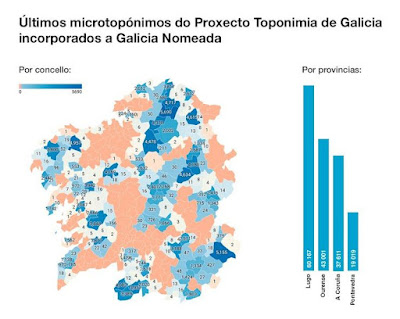
The application platform 'Galicia Nomeada' is going to update its databank with 160,000 new microtoponyms collected between 2000 and 2011 within the Galician Toponymy Project (PTG). This platform, created in collaboration with the Royal Galician Academy and the Xunta de Galicia, was launched in 2019 and aims to recover and disseminate toponyms from all over the country.

After this last update, more than 500,000 toponyms are collected and referenced, including names of mountains, beaches, cliffs and woods. Most of them have been already digitized. 

Since its launch, the application has received more than 32,000 contributions with microtoponyms from all parts of Galicia. Overall, 2,256 people and institutions participated in the project.

Friday, December 10, 2021

56th Annual Meeting of the Canadian Society for the Study of Names

 Call for Papers: 

Canadian Society for the Study of Names (CSSN) 

56 th Annual Meeting, held virtually in conjunction with the Congress of the Humanities and Social Sciences of Canada 

https://www.federationhss.ca/en/congress/congress-2022 

May 14th and 15th, 2022 


The theme of the 2022 Congress is: “Transitions,” but papers on any onomastic topic are welcome. 

Presentations are allotted 20 minutes, with an additional 10 minutes for questions and discussion. 

Please submit an abstract of 150-250 words, including the title of your paper and indicate whether you would like your paper to be considered for this year’s special panel. 

Along with your abstract, please provide the full name and affiliation of each author, along with a current email address for each. 

You need not be a current member of the society to submit an abstract, but at the time of acceptance of your paper, you must become a member in order to be included in the programme. In addition, all presenters are required to pay registration dues for Congress and for CSSN. Further details will be provided when you are notified of acceptance of your paper. 

Please email your abstract to: jonathan.lofft@mail.utoronto.ca ; all abstracts should arrive by February 1st, 2022

Jonathan S. Lofft (University of Toronto)


Appel à communications: 

Société canadienne d'onomastique (SCO) 

56e Réunion annuelle virtuellement conjointement avec le Congrès des sciences humaines du Canada 

https://www.federationhss.ca/fr/congres/congres-2022 

14 et 15 mai 2022 

Le thème retenu en 2022 est : « Transitions », toutefois, les communications sur tout autre sujet portant sur l’onomastique sont les bienvenues. 

Les communications sont d’une durée de 20 minutes et sont suivies d’une période de 10 accordées aux questions et à la discussion. 

Veuillez soumettre un résumé ne dépassant pas 200 mots, titre inclus. Indiquez les noms et affiliations des auteurs de la communication sans omettre d’inclure l’adresse courriel de chacun. 

Bien qu’il ne soit pas indispensable d’être membre de la Société pour soumettre une communication, il est toutefois indispensable d’en devenir membre pour être inscrit au programme. Tous les participants sont tenus de débourser les coûts de leur inscription au Congrès, ainsi qu’à la SCO. Des informations additionnelles vous seront acheminées lors de l’envoi des avis d’acceptation ou de refus de communications. 

Veuillez faire parvenir votre résumé par courriel à : jonathan.lofft@mail.utoronto.ca. Tous les résumés devront être soumis au plus tard le 1er février 2022

Jonathan S. Lofft (University of Toronto)

Wednesday, December 8, 2021

Dicionarização de topônimos


Esta é a sexta e última live de uma série de atividades realizadas pelo Observatório Onomástico ao longo do ano de 2021. Para discutir o tema, convidamos os palestrantes: Ana Claudia Castiglioni Doutora pelo programa de Pós-graduação em Estudos Linguísticos da UNESP - Universidade Estadual Paulista Júlio de Mesquita Filho - Campus de São José do Rio Preto - SP e é professora adjunta nível IV da Universidade Federal do Tocantins, atuando no curso de Letras do campus de Araguaína, no Programa de Pós-Graduação em Letras: Ensino de Língua e Literatura (Mestrado e Doutorado) e no Mestrado Profissional em Letras. É membro efetivo do Grupo de Trabalho em Lexicologia, Lexicografia e Terminologia da ANPOLL e atua nas seguintes áreas: Lexicologia e ensino, Lexicografia, Lexicografia Pedagógica, Terminologia e Toponímia. Marilze Tavares Doutora em Estudos da Linguagem pela Universidade Estadual de Londrina (2015). Professora efetiva da Universidade Federal da Grande Dourados. Tem experiência na área de Linguística e Língua Portuguesa, com ênfase em Sociolinguística, atuando principalmente nos seguintes temas: léxico (especialmente toponímia), variação linguística, língua indígena. Como mediadora, temos: Suely Aparecida Cazarotto Doutora em Estudos Linguísticos pela UFMS/Universidade Federal de Mato Grosso do Sul/CPTL. Tese: INTERFACES ENTRE A TOPONÍMIA BRASILEIRA E A PARAGUAIA EM ÁREA DE FRONTEIRA: PERSPECTIVA ETNODIALETOLÓGICA (2019). Professora de Língua Portuguesa da Rede Estadual de Ensino/MS. Pesquisadora do Projeto ATEMS - Atlas Toponímico do Estado de Mato Grosso do Sul. (Informações retiradas dos respectivos currículos na Plataforma Lattes) Mais sobre o O-onoma no site http://www.letras.ufmg.br/o-onoma

Immersion onomastique chez quelques peuples du Nord-Cameroun

 lien


Auteur(s) Rosalie Maïrama (Auteur)
Editeur(s) Harmattan Cameroun
Date de parution : 08/11/2021

Immersion onomastique chez quelques peuples du Nord-Cameroun Les noms sont des sources de savoirs et des conservateurs de connaissances exploitables en sociolinguistique, en histoire, en sociologie et en géographie. Riches de significations, les noms renseignent et informent sur les origines des peuples, leur culture et leur environnement. Ils donnent également à comprendre les conquêtes et les déplacements des personnes qui en sont à l'origine ainsi que la charge spirituelle dont ils regorgent. Il s'y établit un lien étroit entre la signification et le contexte puisque les circonstances (faits sociaux et historiques) sont à l'origine de la création ou du choix des noms. Et pour mieux le saisir, une intrusion onomastique dans la culture de ces peuples permet de comprendre la signification des noms et le contexte qui les entoure. L'on observera par exemple que la formation des noms se fait par le processus de préfixation et de suffixation selon le cas... En somme, le nom en Afrique peut être exploité comme un outil méthodologique pour des recherches pluridisciplinaires.


Rosalie Maïrama est titulaire d'un doctorat/Ph.D. en linguistique française. Maître de conférences, elle est enseignante-chercheuse à l'Université de Maroua (Cameroun) et s'investit dans la recherche en sciences du langage. Ses travaux portent principalement sur la sociolinguistique et l'analyse du discours.

Friday, December 3, 2021

Acta onomastica 2/2021

 link

The new issue of Acta onomastica (2/2021) presents ten studies, among them:

  • an article by Hana Mžourková and Helena Dobrovoljc on the problem of names' inflection in the Czech Republic and Slovenia; 
  • a paper by Martina Ptáčníková on the place names of the so-called Czech Corner. 
  • It also contains three reviews, 
  • a number of onomastic reports on conferences and on forensic expertise, 
  • and last but not least, an interview by Žaneta Dvořáková with veteran of the Czech Onomastics Maria Nováková (1936) about her onomastic work.

Wednesday, December 1, 2021

Former President of the Galician Association of Onomastics elected as full member at the Royal Galician Academy


link

Photo
We congratulate the new full member of the Royal Galician Academy Prof. Ana Boullón. 

She is a well-known researcher in the fields of Galician anthroponymy, toponymy, and lexicography. 

The Royal Galician Academy will hold on the 11th December the extraordinary public session for Ana Boullón Agrelo to become a full member of the institution. The event will take place at 12:30 pm at the Teatro Cine Elma in Pobra do Caramiñal (Rúa Rafael Calleja, 51), the philologist's hometown. 

The new full member will give a lecture entitled "Todos os nomes: identidade, pobo, país". Prof. Ana Boullón Agrelo will occupy the vacant chair after the passing of Xosé Luís Franco Grande in March 2020.

Since 2012 Ana Boullón Agrelo has been Professor of Galician Philology at the University of Santiago de Compostela (Instituto da Lingua Galega) and member of the Onomastics Seminar at the Royal Galician Academy. 


She has also headed the Galician Association of Onomastics, where she is still a member of the Board of Directors.


Photo

Prof. Ana Boullón has published inter alia several dictionaries of forenames and surnames. She is also taking part together with Xulio Sousa in the project "Galician Surname Maps" (Cartografía dos apelidos de Galicia). The GSM provides facts about the frequency and distribution of more than 5 million surnames in Galicia based on the 2001 census.

Currently, also on behalf of the Royal Galician Academy, she is coordinating the preparation of the Dictionary of Galician Surnames and the publication of the Guide on Galician Surnames, which will be available on the website of the Royal Galician Academy.