Showing posts with label Carole Hough. Show all posts
Showing posts with label Carole Hough. Show all posts
Friday, October 21, 2022

Friday, January 15, 2016
PhD studentship on Berwickshire place-names
http://www.gla.ac.uk/colleges/arts/graduateschool/fundingopportunities/leverhulmeenglishlanguagehough/
 The Leverhulme-funded project ‘Recovering the earliest English language in Scotland: evidence from place-names’ seeks a suitably qualified graduate to pursue doctoral research on Scottish place-names. The doctoral work will be on some aspect of the place-names of Berwickshire, and will be carried out under the supervision of Prof Carole Hough and Dr Simon Taylor. The successful candidate will have a strong background in historical linguistics, with a good first degree relevant to the history of English or Scots, and some undergraduate or postgraduate training in place-name study.
 This 3-year project will use place-name evidence to investigate the Old Northumbrian dialect of Old English and its development into Scots. It focuses on the historical county of Berwickshire, the heartland of Anglo-Saxon settlement in Scotland, and aims to collect and analyse all place-names in six parishes along the Anglo-Scottish border, and all major settlement names throughout the historical county of Berwickshire.



 Leverhulme Doctoral Studentship commencing April 2016
‘Recovering the earliest English language in Scotland: evidence from place-names’
 The Leverhulme-funded project ‘Recovering the earliest English language in Scotland: evidence from place-names’ seeks a suitably qualified graduate to pursue doctoral research on Scottish place-names. The doctoral work will be on some aspect of the place-names of Berwickshire, and will be carried out under the supervision of Prof Carole Hough and Dr Simon Taylor. The successful candidate will have a strong background in historical linguistics, with a good first degree relevant to the history of English or Scots, and some undergraduate or postgraduate training in place-name study.
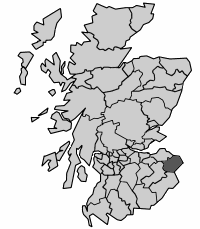 This 3-year project will use place-name evidence to investigate the Old Northumbrian dialect of Old English and its development into Scots. It focuses on the historical county of Berwickshire, the heartland of Anglo-Saxon settlement in Scotland, and aims to collect and analyse all place-names in six parishes along the Anglo-Scottish border, and all major settlement names throughout the historical county of Berwickshire.

The project is headed by Professor Carole Hough and Dr Simon Taylor, and draws on the University of Glasgow’s considerable and growing strengths in research within Name Studies and on Scotland’s history and languages. The objectives of the research are:
- to investigate the Old Northumbrian dialect of Old English. As most Old English texts are preserved through the medium of the West Saxon literary dialect, place-names comprise key data for other varieties. The project will use place-name evidence to produce a ground-breaking study of Old Northumbrian, including its lexis, morphology and phonology.
- to investigate the development of Older Scots in the Scottish borders. Like Middle English, Older Scots is a descendant of Old English, but it is uncertain how far the differences reflect the respective varieties of Old English from which they derive, and how far they result from interaction with other languages, particularly Norse. With no evidence of major Norse settlement in the borders, there is greater continuity of language from Old English to Scots here than elsewhere, so this is the best opportunity to establish which features of Scots derive from Old Northumbrian rather than from Old Norse.
- to advance understanding of the relationship between place-names on either side of the present Scottish/English border. Cross-border comparison will both assist analysis of the project data, and lead to significant re-interpretations of place-names related to those in the study area.
- to advance the recently-inaugurated Survey of Scottish Place-Names, making available data for the study of the history of language, settlement, environment, social organisation, and the use and perception of landscape.
Candidates interested in applying for funded PhD study on this project are encouraged to make informal contact with Professor Hough (Carole.Hough@glasgow.ac.uk) in the first instance.
Candidates wishing to submit an application should prepare and submit the following documentation:
- A research proposal of no more than 1,000 words
- A current CV
- A transcript of qualifications to date (and anticipated results if you are still studying for your Masters)
- An example of scholarly work up to 5000 words in length (e.g. a full essay or dissertation chapter)
- 2 academic references
The closing date for receipt of complete applications is 12 noon on Monday, 1 February 2016. Applications should be emailed to critstudies-pgscholarships@glasgow.ac.uk.
Tuesday, December 8, 2015
The Oxford Handbook of Names and Naming
Edited by Carole Hough
Oxford Handbooks in Linguistics
- Offers an international perspective on naming systems
- Includes both traditional and emerging areas of name studies
- A valuable resource for specialists while also being accessible to the general reader
This handbook offers an up-to-date account of the state of the art in different areas of onomastics, in a format that is both useful for specialists and accessible to the general reader. International experts examine name theory, place and personal names, names in literature, socio-onomastics, names and other disciplines, and other types of names.
In this handbook, scholars from around the world offer an up-to-date account of the state of the art in different areas of onomastics, in a format that is both useful to specialists in related fields and accessible to the general reader. All known languages make use of names, most commonly to identify individual people and places. Since Ancient Greece, names have been regarded as central to the study of language, and this has continued to be a major theme of both philosophical and linguistic enquiry throughout the history of Western thought. The investigation of name origins is more recent, as is the study of names in literature. Relatively new is the study of names in society, which draws on techniques from sociolinguistics and has gradually been gathering momentum over the last few decades. The structure of this volume reflects the emergence of the main branches of name studies, in roughly chronological order. The first Part focuses on name theory and outlines key issues about the role of names in language, focusing on grammar, meaning, and discourse.
Parts II and III deal with the study of place-names and personal names respectively, while Part IV outlines contrasting approaches to the study of names in literature, with case studies from different languages and time periods. Part V explores the field of socio-onomastics, with chapters relating to the names of people, places, and commercial products. Part VI then examines the interdisciplinary nature of name studies, before the concluding Part presents a selection of animate and inanimate referents ranging from aircraft to animals, and explains the naming strategies adopted for them.
Prof. Dr. Carole Hough, University of Glasgow, Faculty of Arts, School of English & Scottish Language & Literature, 12 University Gardens, Glasgow G12 8QQ – T. +44.141.3304566 – E-mail: Carole.Hough @glasgow.ac.uk – Web: www.gla.ac.uk/ departmentes/englishlanguage/staff/carole ahough.
’ Oxford University Press, Great Clarendon Street, Oxford OX2 6DP – T. +44. 1865.556767 – Fax +44.1865.556646 – E-mail: WebEnquiry@oup.com – Web: www.ox.ac.uk/about/organisation/oxforduniversity-press.
In this handbook, scholars from around the world offer an up-to-date account of the state of the art in different areas of onomastics, in a format that is both useful to specialists in related fields and accessible to the general reader. All known languages make use of names, most commonly to identify individual people and places. Since Ancient Greece, names have been regarded as central to the study of language, and this has continued to be a major theme of both philosophical and linguistic enquiry throughout the history of Western thought. The investigation of name origins is more recent, as is the study of names in literature. Relatively new is the study of names in society, which draws on techniques from sociolinguistics and has gradually been gathering momentum over the last few decades. The structure of this volume reflects the emergence of the main branches of name studies, in roughly chronological order. The first Part focuses on name theory and outlines key issues about the role of names in language, focusing on grammar, meaning, and discourse.
Parts II and III deal with the study of place-names and personal names respectively, while Part IV outlines contrasting approaches to the study of names in literature, with case studies from different languages and time periods. Part V explores the field of socio-onomastics, with chapters relating to the names of people, places, and commercial products. Part VI then examines the interdisciplinary nature of name studies, before the concluding Part presents a selection of animate and inanimate referents ranging from aircraft to animals, and explains the naming strategies adopted for them.
CONTENT
1st PART
WILLYVAN LANGENDONCK / MARK VAN DE VELDE, Names
and grammar;
STAFFAN NYSTRÖM, Names and meaning;
ELWYS DE STEFANI, Names and discourse.
2nd PART
SIMONTAYLOR,Methodologies in placename
research;
CAROLE HOUGH, Settlement names;
SVANTE STRANDBERG, River names;
PETER DRUMMOND, Hill and mountain names;
PEDER GAMMELTOFT, Island names;
JULIA KUHN, Rural names;
BERTIE NEETHLING, Street names. A changing
urban landscape;
STEFAN BRINK, Transferred names and analogy in
name-formation.
3rd PART
EDWIN D. LAWSON, Personal naming systems;
KATHARINA LEIBRING, Given names in European
naming systems;
PATRICK HANKS / HARRY PARKIN, Family
names;
EVA BRYLLA, Bynames and nicknames;
ADRIAN KOOPMAN, Ethnonyms;
ELLEN S. BRAMWELL, Personal names and
anthropology;
GEORGE REDMONDS, Personal names and
genealogy.
4th PART
GRANT W. SMITH, Theoretical foundations of
literary onomastics;
BERTIE NEETHLING, Names in songs. A comparative
analysis of Billy Joel’s We Didn’t Start The Fire and Christopher Torr’s Hot
Gates;
BIRGIT FALCK-KJÄLLQUIST, Genre-based
approaches to names in literature;
KARINA VAN DALEN-OSKAM, Corpus-based approaches
to names in literature;
PAUL CAVILL, Language-based approaches to names
in literature.
5th PART
TERHI AINIALA, Names in society;
EMILIA ALDRIN, Names and identity;
GUY PUZEY, Linguistic landscapes;
LAURA KOSTANSKI,
Toponymic attachment;
IRMA TAAVITSAINEN /
ANDREAS H. JUCKER, Forms of address;
KATARZYNA ALEKSIEJUK,
Pseudonyms;
PAULA SJÖBLOM,
Commercial names. Nella sesta parte si discute dei rapporti tra
onomastica e altre discipline, linguistiche e no:
RICHARD JONES, Names and archaeology;
SERGE BRÉDART, Names and cognitive
psychology;
MARGARET SCOTT, Names and dialectology;
PEDER GAMMELTOFT, Names and geography;
GILLIAN FELLOWS-JENSEN, Names and history;
RICHARD COATES, Names and historical linguistics;
BERIT SANDNES, Names and language
contact;
ANDREAS TEUTSCH, Names and law;
ALISON GRANT, Names and lexicography
KAY MUHR, Placenames and religion. A study of
Early Christian Ireland.
6th PART
GUY PUZEY, Aircraft names;
KATHARINA LEIBRING, Animal names;
ADRIAN KOOPMAN, Names of dwellings;
RICHARD COATES, Railway locomotive names and
train names;
MALCOLM JONES, Ship names.
Prof. Dr. Carole Hough, University of Glasgow, Faculty of Arts, School of English & Scottish Language & Literature, 12 University Gardens, Glasgow G12 8QQ – T. +44.141.3304566 – E-mail: Carole.Hough @glasgow.ac.uk – Web: www.gla.ac.uk/ departmentes/englishlanguage/staff/carole ahough.
’ Oxford University Press, Great Clarendon Street, Oxford OX2 6DP – T. +44. 1865.556767 – Fax +44.1865.556646 – E-mail: WebEnquiry@oup.com – Web: www.ox.ac.uk/about/organisation/oxforduniversity-press.
Tuesday, November 20, 2012
Professor of Onomastics Carole Hough
My first "hero of Onomastics" to be presented is:
Professor Carole Hough

(photo and information from here: http://www.gla.ac.uk/schools/critical/staff/carolehough/#tabs=0)
Professor of Onomastics (English Language)
telephone: 01413304566
email: Carole.Hough@glasgow.ac.uk
University of Glasgow

Professor Hough is President of the International Council of Onomastic Sciences, First Vice-President of the International Society of Anglo-Saxonists, Convener of the Scottish Place-Name Society, an Associate Director of the Historical Thesaurus of English, a Council Member of the English Place-Name Society, a Fellow of the Society of Antiquaries, and a Fellow of the Royal Historical Society.
Research interests:
Anglo-Saxon law
History of the English Language
Manuscript Studies
Old and Middle English Language and Literature
Onomastics
Semantics
Biography
Carole Hough is Professor of Onomastics. Her research interests include English and Scottish personal names and place-names, literary onomastics, onomastic theory, Old English language and literature, and semantics. Recent books and edited volumes include New Directions in Colour Studies (2011, with Carole P. Biggam, Christian J. Kay and David S. Simmons), Beginning Old English (2007, with John Corbett), The Power of Words: Essays in Lexicography, Lexicology and Semantics (2006, with Graham Caie and Irené Wotherspoon), Cultural Contacts in the North Atlantic Region: The Evidence of Names (2005, with Peder Gammeltoft and Doreen Waugh), and New Perspectives on English Historical Linguistics: Selected Papers from 12 ICEHL, Glasgow, 21–26 August 2002 Vol. 2: Lexis and Transmission (2004, with Christian Kay and Irené Wotherspoon). She also has about 250 other publications, mainly on Old and Middle English, historical and contemporary semantics, Anglo-Saxon law, onomastics and manuscript studies. She edited the journal Nomina from 1998-2007. She was Principal Investigator for the JISC-funded Scots Words and Place-names project (March-November 2011, in partnership with Scottish Language Dictionaries and the Scottish Place-Name Society), and is Co-Investigator for the AHRC-funded Mapping Metaphor with the Historical Thesaurus project (2012-2014) and the AHRC-funded Scottish Toponymy in Transition project (2011-2014).
Publications of year 2012:
Hough, C. (2012) Scottish toponymy in transition: progressing county surveys of the place-names of Scotland. Scottish Place-Name News , 33 . pp. 5-7.
Hough, C. (2012) Linguistic levels: onomastics. In: Bergs, A. and Brinton, L.J. (eds.) English Historical Linguistics: An International Handbook. Series: Handbooks of Linguistics and Communication Science, 1 (34.1). De Gruyter Mouton , Berlin, Germany, pp. 212-223. ISBN 9783110202205
Hough, C. (2012) Review of: Lisi Oliver, The Body Legal in Barbarian Law. Toronto, Buffalo and London: University of Toronto Press, 2011. Law and History Review, 30 (2). pp. 641-642. ISSN 0738-2480 (doi:10.1017/S0738248012000041)
Hough, C. (2012) Celts in Scandinavian Scotland and Anglo-Saxon England: place-names and language contact reconsidered. In: Stenroos, M., Makinen, M. and Saerheim, I. (eds.) Language Contact and Development around the North Sea. John Benjamins, Amsterdam and Philadelphia, pp. 3-22. ISBN 9789027248398
Hough, C.A. (2012) Facebook and Falkirk, Twitter and Twynholm: investigating Scottish place-names with social media. Scottish Place-Name News , 32 . pp. 10-11.
Hough, C.A. (2012) Women and law in the Anglo-Saxon period. Early English Laws .
Hough, Carole (2012) Repayment and revenge: metaphorical or metonymic links between two semantic fields. In: Sauer, Hans and Waxenberger, Gaby (eds.) English Historical Linguistics 2008. Selected papers from the fifteenth International Conference on English Historical Linguistics (ICEHL 15), Munich, 24–30 August 2008. Volume II: Words, texts and genres. Series: Current Issues in Linguistic Theory (324). John Benjamins, Amsterdam, pp. 85-97.


Subscribe to:
Posts (Atom)